Rules
Part of Goals, access and consent guide this salon consultation process
Nine haircut consultation problems and how to respond in the salon
A salon guide to nine haircut consultation problems: vague briefs, communication, sensory overload, companions, service animals, photos, privacy and consent.
What to take away
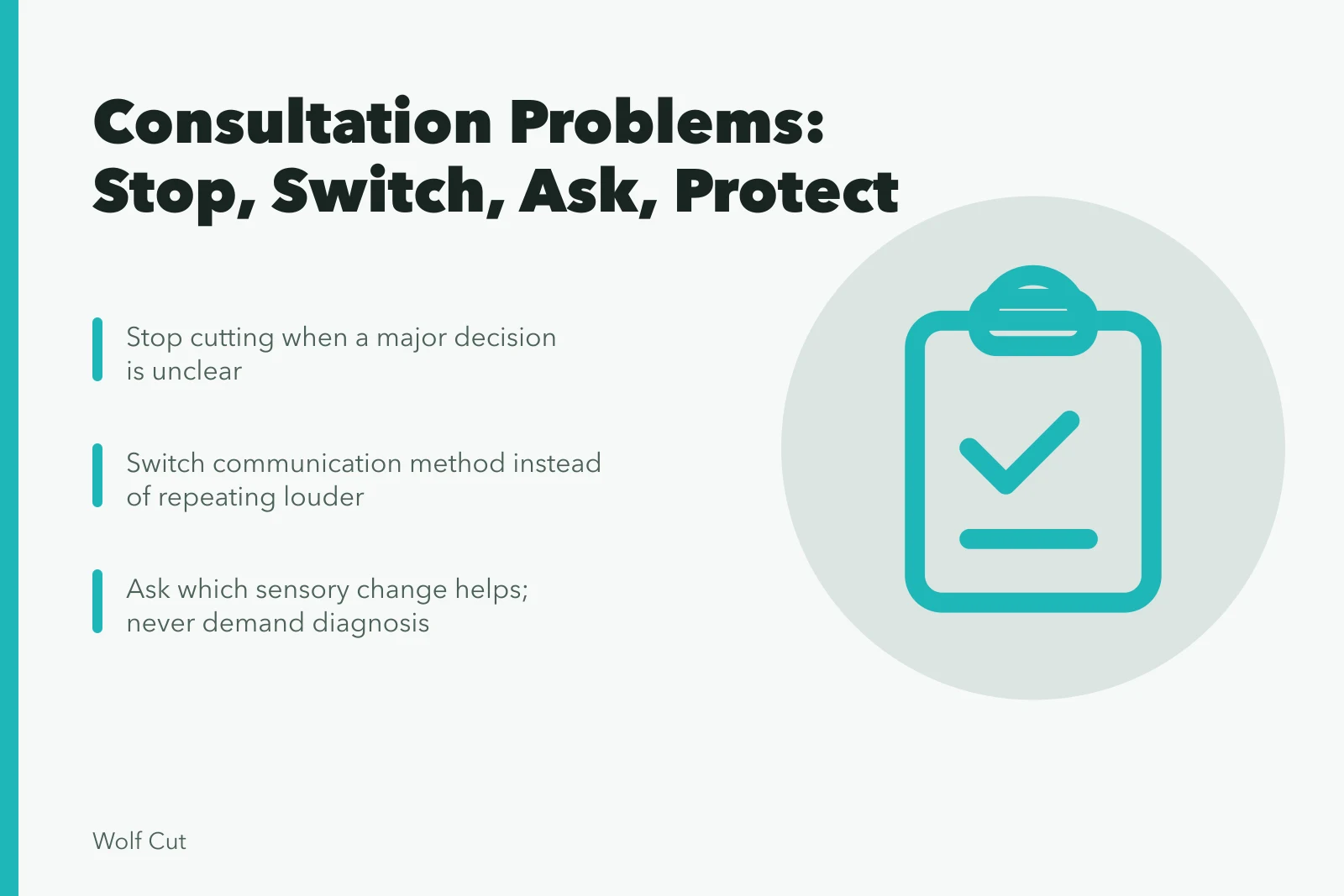
- Stop when a major decision is unclear instead of cutting through uncertainty.
- Change the communication method when repeating the same words does not work.
- Ask which sensory change helps and avoid demanding a diagnosis.
- Speak to the client even when a companion is present.
- Protect private notes, images, and conversations from unnecessary access.
Consultation failures often look like personality conflicts after the fact. In practice, the cause may be an ambiguous word, rushed timing, inaccessible communication, sensory overload, an undisclosed styling burden, or consent requested after the irreversible step. The sequence these failures depart from is the salon haircut consultation guide.
Problem 1: The brief stays vague
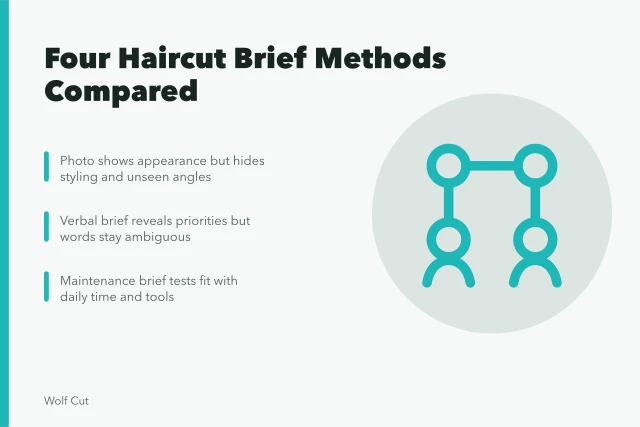
Words such as shorter, softer, cleaner, edgy, or manageable do not identify a cutting line. The four ways clients brief a haircut show which kind of evidence closes that gap. Ask the client to show the area, select a body landmark, compare two lengths, and name what must remain.
Briefing a Haircut
- Show the area
- Select a body landmark
- Compare two lengths
- Name what must remain
- Cover perimeter, layers, front, finish, upkeep
Create one sentence covering perimeter, layers, front, finish, and upkeep. A consent and record checklist is where that sentence gets confirmed. If the client cannot yet choose, preserve length and offer a staged change.
Problem 2: Repeating louder does not help
A person may use sign language, typed text, lip reading, captioning, an interpreter, pictures, speech, or several methods. Louder speech is not a universal solution. Reduce background noise, face the client where appropriate, write the decision, or arrange the effective aid required for the situation. The prepared options are set out in inclusive consultation methods.
Communication Methods
Method
- Sign language
- Client's preferred language
- Typed text
- Quiet or written record
- Lip reading
- Face client, reduce noise
- Captioning
- Live speech to text
- Interpreter
- Complex or legal decisions
- Pictures
- Show length or shape
When to use
- Sign language
- Typed text
- Lip reading
- Captioning
- Interpreter
- Pictures
Do not pretend understanding. Stop before cutting and restate the plan through a different channel.
Problem 3: Sensory overload begins during service
The client may become uncomfortable with a tight cape, water near the face, dryer noise, vibration, fragrance, bright light, touch, conversation, or unexpected movement. Use the agreed stop signal. Remove or reduce the trigger when safe, provide time, and ask which option works.
Sensory Overload Response
Client shows distress?
Use stop signal, reduce trigger, ask what works
Continue service with agreed plan
Do not diagnose the response, restrain the client, or frame distress as bad behavior. If the service cannot continue safely, preserve dignity, stop, and plan another approach.
Problem 4: A companion takes over
Speak to the client. Ask how the companion should participate. A companion may help with memory, communication, transport, comfort, or decision support, but their preference does not automatically replace the client's decision.
For complex communication, applicable disability rules may limit when a business can rely on a friend or family member as interpreter. Arrange qualified help when required. Keep the client included throughout.
Problem 5: A service animal is treated as a pet
Train staff before a client arrives with a service animal. Do not pet, feed, distract, or move the animal. Keep routes clear and discuss station placement with the handler.
The Justice Department's questions and answers on service animals define a service animal under the ADA as a dog individually trained to do work or perform tasks for a person with a disability.
Where that is not obvious, staff may ask only two questions. No vest, identification tag, or special harness is required, and an entity with a no-pets policy generally must modify it.
State law and other countries may differ. A salon should get qualified advice for its location rather than inventing a blanket exclusion.
If a legitimate safety issue arises, address the actual conduct and applicable rule, not a stereotype about breed or disability.
Problem 6: The stylist discovers a photo is for marketing
A technical record image and a public promotion are different uses. Stop before taking or posting the image. Explain the purpose, platform, identifiability, intended duration, and permission process. Give the client a genuine choice.
Do not assume that tagging the salon, agreeing to a haircut, accepting a discount, or allowing a mirror photo grants every future use. Follow privacy, advertising, contract, and image-rights rules that apply.
Problem 7: Staff write excessive private notes
The record may need haircut dimensions, products, hair response, requested adjustment, and service outcome. It usually does not need gossip, guessed diagnoses, relationship history, or a detailed account of a private conversation.
Privacy harm can occur even without a hack. NIST's discussion of privacy risks in small-business data analytics notes that people can experience embarrassment, discrimination, economic loss, or other adverse effects from how organizations use data. Its examples are general, but the principle supports minimizing salon notes and reviewing what vendors do with client information.
Correct subjective or inaccurate notes through the salon's process. Limit access to workers who need the information for their role.
Problem 8: Consent is requested after cutting starts
Stop immediately. Show what has already changed, state what remains reversible, and rebuild the plan. Do not pressure the client to agree because the appointment is underway.
If the client withdraws consent, stop the service. Follow the salon's incomplete-service, payment, incident, and complaint policies and obtain legal advice when necessary.
Problem 9: A stylist says the request is impossible without explaining why
Identify the exact constraint: current length, density, fragile condition, curl response, hairline, time, scope, or maintenance. Offer an adaptation or staged route. The technical versions of those constraints are collected in haircut planning problems. Avoid using suitability language to enforce a personal view of gender, age, face shape, or professionalism.
When safety prevents service, state the observed fact and relevant boundary without diagnosing or shaming.
A short recovery script
Say: "I do not think we have the same picture of the length yet. I am stopping before I cut further. Let us mark the shortest dry point and write the front and back plan separately."
The script admits uncertainty, protects length, and creates a concrete next step.
Common questions
Should a stylist speak through a companion?
No. Address the client and ask how the companion should support communication or decisions.
Can a salon demand service-animal certification in the United States?
Federal ADA guidance says service animals are not required to have certification. Obtain advice on the rules that apply to the business.
Is every client note useful for future service?
No. Keep factual, necessary information tied to a lawful purpose and remove unsupported personal commentary.
What if consent becomes unclear mid-service?
Stop tools, change the communication method, restate the remaining plan, and continue only after specific agreement.