Reviews
Part of Goals, access and consent guide this salon consultation process
A haircut brief compared four ways: photo, verbal, maintenance, demonstration
Haircut brief methods compared by precision, limitations, access, maintenance detail, consent, photo privacy, confirmation, and best combined use.
What to take away
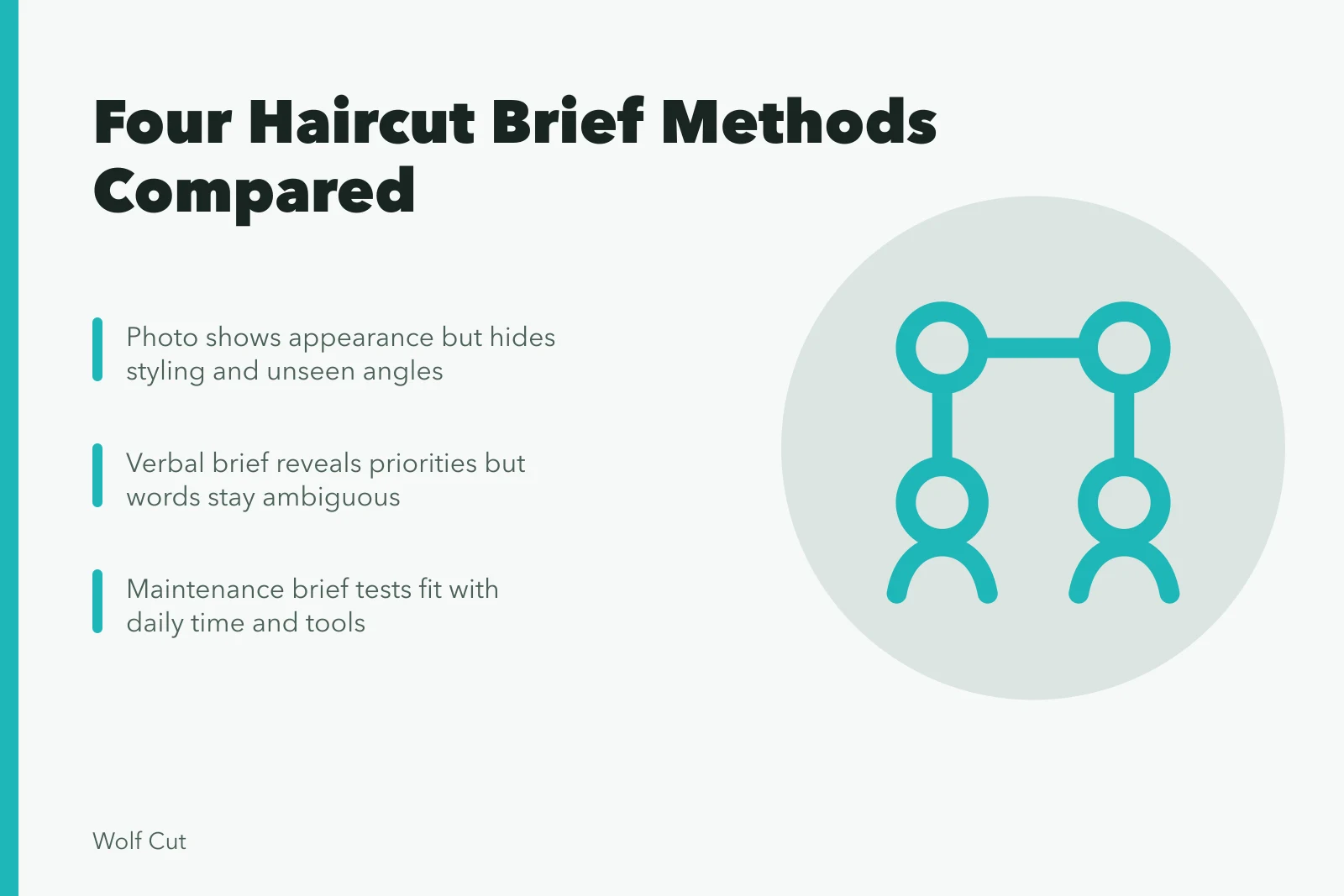
- A photo shows appearance but may conceal styling, density, editing, and unseen angles.
- A verbal brief reveals priorities but common haircut words remain ambiguous.
- A maintenance brief tests whether the proposed result fits daily life.
- A live demonstration makes length and movement visible before cutting.
- The strongest consultation combines methods and ends with one written plan.
Clients describe haircuts in different ways. One brings a saved image, another names a style, another explains what takes too long each morning, and another shows how the hair is tied back. Each method contributes different evidence. The service they feed is the salon haircut consultation guide.
Comparison table
Best contribution
- Photo
- Visual direction and proportion
- Verbal
- Priorities, identity, and dislikes
- Maintenance
- Time, tools, and practical constraints
- Demonstration
- Landing points, movement, and habits
Main limitation
- Photo
- One angle and styled moment
- Verbal
- Terms mean different things
- Maintenance
- May not describe desired appearance
- Demonstration
- Temporary hand position can distort fall
Useful confirmation
- Photo
- Mark the exact liked features
- Verbal
- Restate in visible design terms
- Maintenance
- Agree on acceptable daily steps
- Demonstration
- Release hair and show dry landmark
Photo brief
A reference can quickly show fringe density, silhouette, layer movement, or a finish. Ask the client to point to two liked features and one feature they do not want. Compare multiple images if they conflict.
Check before trusting a reference photo
- Crop and angle
- Lighting
- Extensions
- Color contrast
- Product and brush work
- Whether the back is visible
Check crop, angle, lighting, extensions, color contrast, product, brush work, and whether the back is visible. Do not promise to reproduce a photographed result on different hair without adaptation. A reference photo case works through one such adaptation.
Keep client references separate from photographs taken by the salon. A picture viewed on the client's phone does not grant permission to copy, store, or publish it.
Verbal brief
Words reveal what matters emotionally and practically. "Keep it soft" may mean no blunt edge, no exposed ears, low contrast, touchable movement, or simply not too short. Ask what the word changes.
Turn vague words into a plan
- Hear the client's word
- Ask what the word changes
- Restate the request back
- Convert to visible design terms
- Avoid treating trend name as plan
Active listening includes clarifying and repeating the request back. Australian government guidance on how to communicate with customers recommends clarifying questions and rephrasing what the customer says to confirm understanding. The page is general business guidance, so salon technique still requires professional analysis.
Convert the answer into parting, length, weight, perimeter, layers, movement, finish, and maintenance. Avoid treating a trend name as a complete plan.
Maintenance brief
Ask what the client does after washing, what tools are available, and what usually fails. Establish a time budget for ordinary days and a different budget for special styling if relevant.
Maintenance questions reveal constraints that a polished photo may hide:
Maintenance questions to ask
- Front tuck behind glasses or hearing devices?
- Hair tie back for work or sport?
- Diffuser noise or dryer heat acceptable?
- How often can client return?
- Products unpleasant or causing response?
- Fringe reset realistic each morning?
A design can still require effort, but that effort should be chosen knowingly.
Live demonstration brief
Invite the client to show the normal parting, tuck, tie-back, wash-day grouping, or the section they keep pushing away. Use hands, a comb, clips, or a mirror to demonstrate proposed boundaries without cutting.
Show the first short point against a dry landmark. Release the hair after holding it because tension can change the apparent length. For curl, demonstrate a conservative group rather than stretching one strand to a misleading endpoint.
Combine the four methods
Use the photo for visual direction, verbal brief for priorities, maintenance brief for feasibility, and demonstration for exact boundaries. Then record one plan.
Example:
Retain collar contact at back; begin long layers below the cheek; keep both temple pieces behind eyewear; no full fringe; natural wave finish; ten-minute diffuser routine; review dry before further face-frame shortening.
That statement is more useful than "soft wolf cut." The pre-cut consultation and design plan is where it belongs on paper.
Separate design images from marketing images
A salon may photograph a client for a private service record, technical review, training, portfolio, website, or social media. These are different purposes and may require different legal bases and permissions.
The UK Information Commissioner's Office explains in its small-business marketing and data-protection guidance that using customer photographs in a marketing campaign is an optional further use that requires its own lawful-basis analysis; its example chooses consent. A salon should obtain jurisdiction-specific advice and should not bundle public marketing permission into haircut agreement.
State whether the face, tattoos, jewelry, or background could identify the person. Explain platform, duration, editing, withdrawal process where applicable, storage, and who can access the image. A refusal should not reduce service quality.
Choose the primary method by access need
Not every client benefits from spoken detail or a mirror. Offer written, tactile, audio, large-print, captioned, interpreted, or simplified visual communication as appropriate and legally required. Ask the client what works. The wider set of options is laid out in inclusive consultation methods.
The output must remain the same: a specific plan that both parties can review before irreversible cutting.
Common questions
Is one reference photo enough for a restyle?
Usually not. Ask about unseen angles, finish, maintenance, and the exact features the client wants.
What if the client does not know haircut vocabulary?
They do not need it. Use landmarks, demonstrations, pictures, and plain questions.
Can a stylist save a photo from the client's phone?
Only with a lawful purpose and appropriate permission and handling. Viewing it does not create storage or publication rights.
Which brief is most reliable?
The combined brief is strongest because the methods expose different gaps.