Rules
Part of Built around a one-way tool path: the salon sanitation guide
Salon infection-control problems: lice, broken skin and reporting
Salon infection-control problems guide for cuts, tool contamination, suspected head lice, scalp sores, broken skin, exposure reporting, and client privacy.
What to take away
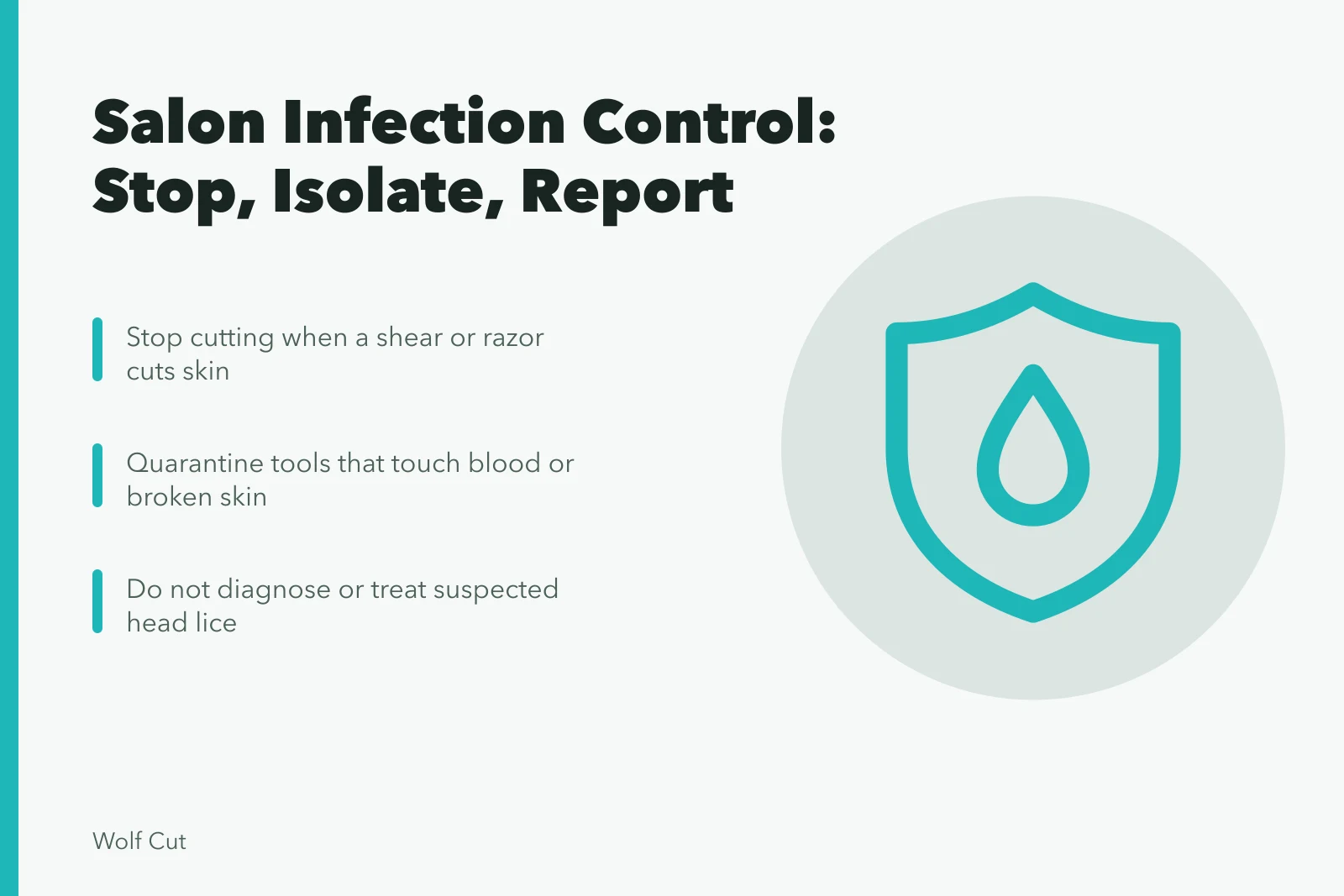
- Stop the service when a tool contacts blood, broken skin, or an uncertain surface.
- Protect the person first, then isolate items and follow the written response plan.
- A stylist should not diagnose or treat head lice or a scalp disorder.
- Contaminated tools do not return to service after a quick wipe.
- Neutral language and private communication protect clients without weakening safety.
Most infection-control problems become harder when a stylist tries to preserve the appointment. A safer rule is to stop, contain, assess within scope, and follow the salon's written process. Lost minutes are less serious than an undocumented exposure or a contaminated tool returned to the station. The written process it refers to is the salon haircut sanitation guide.
Problem 1: A shear or razor causes a cut
Place the contaminated tool where nobody can touch its edge. Attend to the client within staff first-aid training and legal scope. Keep these supplies at the station: nitrile gloves, a barrier or dressing for the wound, a hospital-grade disinfectant, and a sharps container for blades.
Cut Response Steps
- Stop cutting, secure sharp tool
- Attend to client within training
- Use exposure-plan protective equipment
- Quarantine reusable items, separate disposables
- Record time, people, tool, route, response
A neck strip, tissue, or fresh cape does not turn broken skin into a normal cutting area. Log the event in the salon exposure log. Keep the log confidential.
For covered workplaces, OSHA's bloodborne-pathogen exposure incident fact sheet defines an exposure incident as specific eye, mouth, other mucous-membrane, non-intact-skin, or parenteral contact with blood or other potentially infectious materials from work duties.
It also describes immediate confidential medical evaluation and follow-up. A salon should use qualified safety advice and its written plan to determine applicability, not diagnose risk from memory.
Salon exposure log
Use one log for every incident. Record these fields:
| Field | Example |
|---|---|
| Date and time | YYYY-MM-DD, HH:MM |
| People involved | client initials, staff initials |
| Tool or product | clipper, shear, disinfectant batch |
| Contact route | blood, broken skin, uncertain surface |
| Action taken | stopped service, first aid, set aside tools |
| Person notified | salon manager, state board, health department |
| Follow-up date | when the client or staff member is checked |
Notify your manager or owner the same day. For a bloodborne exposure, follow your written plan and notify the person named there. For a reportable condition, contact your state board of cosmetology or the local health department. Retention is set by your state board and health department; check those rules and keep the log for the period they require.
Problem 2: A used tool touches a client
Remove the item from service and identify whether it merely bypassed storage or carried visible soil, blood, or contact from another client. Check whether skin was intact without turning the stylist into a medical examiner.
Used Tool Mix-Up Checklist
- Stop service when mix-up noticed
- Remove item from service
- Identify bypass or visible soil
- Explain known facts privately
- Quarantine tool for full processing
- Record event and tool identity
Then:
- Explain the known facts privately and plainly.
- Follow the salon's incident and notification procedure.
- Inspect the station for other status errors.
- Correct the workflow that allowed the mix-up.
Do not claim there is zero risk and do not speculate about disease. A manager should handle further communication under policy and the reporting channel for your state: the state board of cosmetology or the local health department.
Problem 3: A comb or clipper falls
A dropped tool becomes used. Pick it up in a way that avoids an injury, place it in the dirty zone, perform hand hygiene when required, and replace it with a completed tool. Floor contact cannot be corrected by brushing off hair or spraying while the tool remains in the stylist's hand.
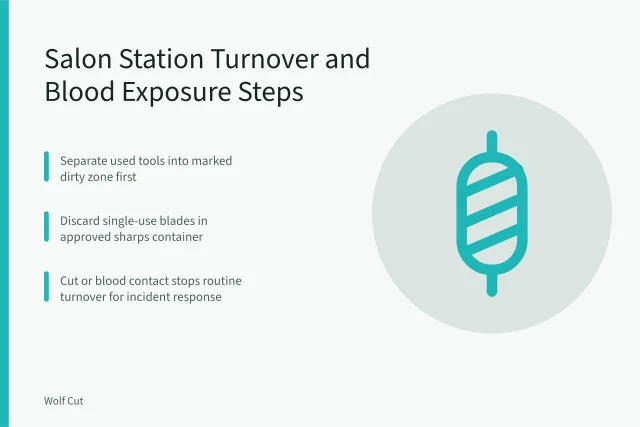
If drops happen often, examine cord routing, crowded trolleys, unstable mats, tool holsters, and rushed handoffs. Repeated drops are usually a workstation-design signal. The station turnover and exposure checklist is where that signal gets recorded.
Problem 4: Head lice are suspected
Pause the service and speak privately. A salon worker should not diagnose an infestation, prescribe a pesticide, or provide treatment unless separately qualified and legally authorized. Explain that the service cannot safely continue under salon policy and refer the person to an appropriate healthcare or public-health resource.
Suspected Head Lice Decision
Is head lice infestation suspected?
Pause service, speak privately, refer to healthcare
Continue service under salon policy
The CDC's head lice treatment guidance covers treatment choices, comb and brush handling, and steps that are generally unnecessary, including toxic fumigant sprays. It is a resource for the client and clinician, not permission for a salon to diagnose or treat. The salon still follows local rules for the cape, tools, linens, chair, and surrounding area.
Avoid stigmatizing language. Head lice are not proof of poor hygiene. Do not announce the concern to the waiting room, photograph the scalp without explicit consent, or share the client's identity with uninvolved staff.
Problem 5: The scalp has sores, drainage, or broken skin
Do not run comb teeth, guards, blades, or shear points across an open area. Explain the visible condition without naming a disease. If the service cannot avoid contact safely, decline or postpone it and suggest appropriate medical evaluation. The clipper cutting guide sets the same limit before a blade reaches unsuitable skin.
Moving the parting may not solve the problem. Consider whether hair washing, sectioning tension, brushing, heat, product, or a cape closure could also irritate the area.
Problem 6: A disinfectant step was incomplete
If the timer stopped, the surface dried early, the solution was mixed incorrectly, or the wrong product was used, the item is not ready.
For a quaternary ammonium disinfectant, the label often states a 10 minute contact time on a pre-cleaned surface; the label governs. Quaternary ammonium is generally compatible with stainless steel and hard plastic, but it can corrode carbon steel and damage anodized aluminum.
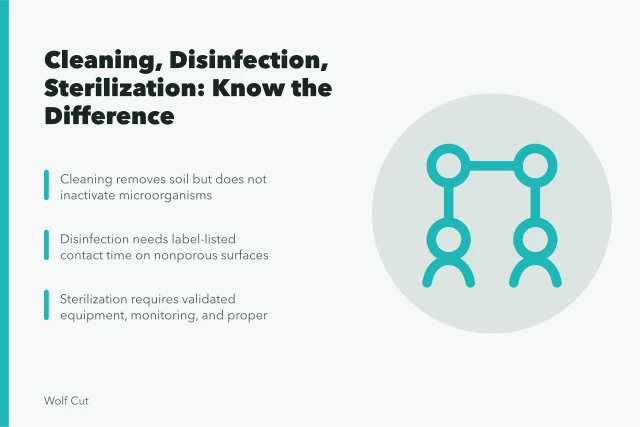
When earlier cleaning status is uncertain, begin the full sequence again. Which step it restarts from depends on the difference between the three words.
Set aside any tool from the same batch until its status is confirmed. Check preparation logs, timestamps, and staff accounts. Notify clients only under the salon's incident policy and qualified advice. Avoid both concealment and unsupported alarm.
Problem 7: The product damages the tool
Remove a corroded, pitted, cracked, sticky, discolored, or rough tool from service. Damage can create places that are difficult to clean, harm a client, or change cutting performance. Review material compatibility, dilution, exposure time, rinsing, drying, and lubrication instructions. Those are the same fields covered in cleaning, disinfecting, and storing tools.
Do not solve repeated damage by weakening the solution or shortening contact time. Select compatible equipment and an approved method.
What to say to a client
Short factual script: "I need to pause because this tool contacted a surface outside our clean process. I am following our incident procedure."
Scalp concern: "I can see broken or irritated skin where the tools would pass. I cannot diagnose it. We should postpone this part of the service."
Common questions
Can a stylist finish around a small cut?
Do not continue until the written exposure procedure is completed and the service can proceed without unsafe contact. In many cases, stopping is the sound choice.
Should the salon treat head lice?
No, not as part of a haircut service. Pause, protect privacy, follow local salon rules, and refer the client appropriately.
Is a dropped comb safe after a quick spray?
No. Treat it as used and complete the full required process.
Should staff tell other clients about an incident?
Protect confidentiality. Share information only with people who need it for response, reporting, or care.