Maintenance
Part of Goals, access and consent guide this salon consultation process
Consent, access and records: what a haircut consultation checklist covers
Haircut consultation checklist for communication, access, comfort, design agreement, cost, consent, checkpoints, photography, client records, and retention.
What to take away
- Confirm how the client wants to communicate before you discuss detailed choices.
- Answer access questions at booking, not at the door on the day.
- Agree dry length, structure, maintenance, cost and time before the first cut.
- Take consent separately for the cut, add-on products, photography and marketing.
- Keep only the records you can justify, protect and delete on schedule.
Booking, arrival and access
Access answers belong in the booking conversation. A client who uses a wheelchair, a cane or a support worker needs facts before travelling, not after arriving.
- Offer at least two ways to bookphone, text, email or an online form.
- Describe the entrance, steps, door width, seating and restroom clearly.
- State where parking, transit stops and drop-off points sit.
- Explain how to request an interpreter, a quiet slot or a longer appointment.
- Ask what would make the visit workable, then write the answer into the booking.
- Keep routes clear and seating stable on the day.
In the United States, Title III of the Americans with Disabilities Act asks public-facing service businesses to remove access barriers where that is readily achievable. State and city rules often add more.
In the United Kingdom the duty differs: Schedule 2 of the Equality Act 2010 sets reasonable adjustments for service providers. Treat it as an optional note, not the baseline for a US or Canadian salon.
The adjustments a stylist can offer, and the phrasing for offering them, sit in the salon haircut consultation guide.
Communication preferences
Communication is the section most checklists leave blank. It decides whether every later question lands.
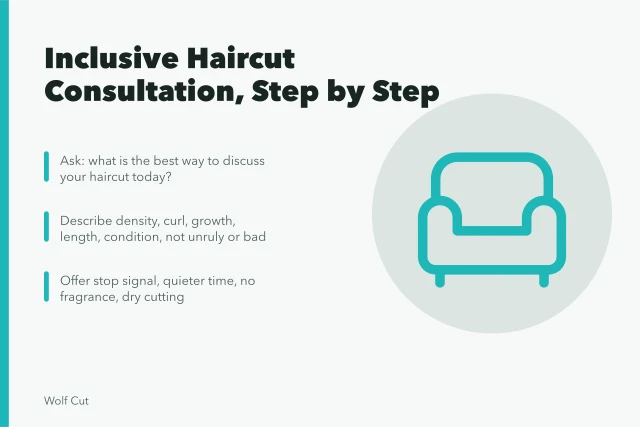
- Ask whether the client prefers spoken, written or demonstrated explanations.
- Record the preferred language and whether a professional interpreter is needed.
- Agree which channel carries confirmations: text, call or email.
- Offer a quiet chair, a side room or a low-traffic time where you have one.
- Agree the words for stop, pause and "shorter than that".
- Confirm the adjustment worked before the client leaves.
[figure 1]
Language and access needs shape the whole appointment, and the step-by-step method sits in making a haircut consultation inclusive. Write the preference down so the client does not repeat it at every visit. Ask again next time, because preferences change.
Design agreement, cost and time
The design agreement confirms cost and time, not estimates. A price range and a clock range belong on the same page as the length plan.
| What to agree | Ask the client | Record as |
|---|---|---|
| Dry length | How much comes off at the longest point? | Measured length |
| Structure | Where should weight sit? | Section plan |
| Fringe | Any fringe or face-framing change? | Shape and length |
| Maintenance | How many weeks between cuts? | Interval |
| Price | Is the quoted range accepted? | Quoted range |
| Time | Does the slot cover wash, cut and dry? | Minutes booked |
- Show the reference and name what will transfer and what will not.
- Measure the dry length on the client's own hair.
- State the price range and the time the appointment needs.
- Read the plan back and ask for a yes.
Quotes track local wages and rent. The BLS data on barbers, hairstylists and cosmetologists gives a floor for pricing a service in your market. In Canada, tips count as taxable income, and the Canada Revenue Agency explains how gratuities are treated.
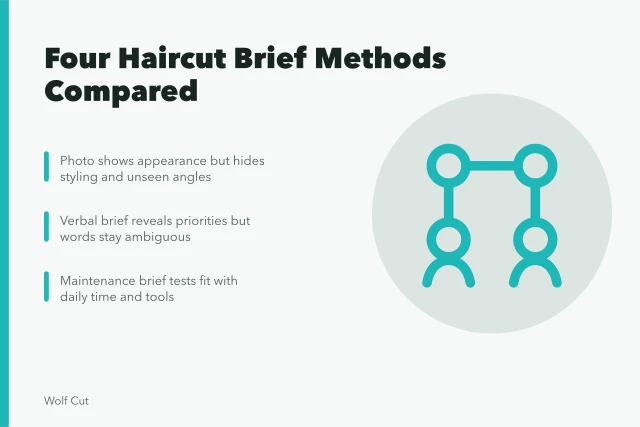
How the client briefs the cut, by photo, words, maintenance or demonstration, changes what you can confirm beforehand. The four methods are compared in four ways to brief a haircut.
Consent before cutting
One consent line is not enough. Split it so a client can accept one decision and refuse another.
Consent before cutting
- Stop and summarize exact plan
- Explain risks, tradeoffs, alternatives
- Show first irreversible length
- Ask open confirmation question
- Do not use silence or cape as consent
- Record agreement and declined technique
- Consent to cutlength, structure, fringe and any chemical service.
- Consent to touchscalp, neck, ears and repositioning.
- Consent to productswhich add-ons apply, and what they cost.
- Consent to photograph: technical record, training, portfolio or public marketing.
- Consent to publishplatform, crop, face visibility, duration and reuse.
- Consent to share the record, and with whom.
- Consent to pause at any point.
Consent runs through the appointment. A client can accept a trim and refuse a photograph in the same visit.
[figure 3]
Checkpoints during the cut
Each checkpoint is a stop, not a running commentary.
- Confirm after the first perimeter guide.
- Stop before shortening a fringe or face frame.
- Show one finished side before matching the other.
- Review the dry fall before final refinement.
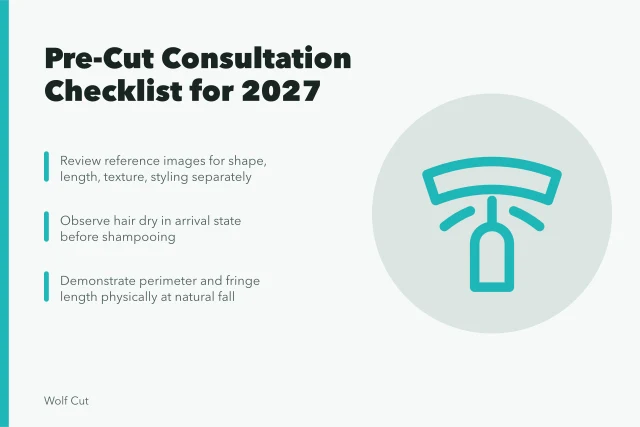
Record any change the client agreed to. The template for the written plan itself is in the pre-cut consultation and design plan checklist.
Records, retention and disposal
No single US statute fixes how long a salon keeps client records. State boards, tax rules, insurance terms and the limitation period for claims set the periods.
- Collect only what a stated purpose needscontact details, service history, patch-test results, consent choices.
- Keep factual observations separate from opinion.
- Restrict access by role and log who opened a record.
- Set a retention date per record type and delete on schedule.
- Report a breach under your state law and your insurer's terms.
A typical retention range runs three to seven years, but that is a starting question. Check your state rules, your insurer's requirement and any contract you signed.
Several states, Massachusetts among them, require a written information security program for businesses holding residents' personal data.
Common questions
Is a signed form enough for haircut consent?
No. A form supports the process but cannot replace explanation, specific agreement and checkpoints through the service.
Must a client disclose a diagnosis to request an adjustment?
Do not assume so. Ask what functional change the client needs and take qualified advice on any eligibility question.
Can one checkbox cover service photos and social media?
Keep the purposes separate. Technical records, training, portfolio work and public marketing can rest on different permissions.
How long should consultation records be kept?
Use a justified schedule based on purpose, state law, insurance and dispute needs. Do not keep everything indefinitely.