Rules
Wolf cut salon prices in US cities: what drives the cost and what doesn't
What US and Canadian salons charge for a wolf cut, which factors raise or lower the bill, and the licensing and tipping rules sitting behind the price.
What to take away
- A wolf cut is priced as a long layered cut with thinned ends, so the bill tracks chair time and hair volume, not the style name.
- Length, density, stylist seniority and city rent push the price up, while short fine hair and a fast finish pull it down.
- State boards set the training hours behind every licensed stylist, so wage floors differ between US cities.
- Canadian quotes are written in Canadian dollars, and tips count as taxable income.
- Ask for a consultation and a total before the wash, because a length surcharge is easier to discuss first.
What a US salon charges for a wolf cut
Few price boards in US cities list a wolf cut by name. Salons print "long layered cut", "shag" or "scissor cut with blowout" and quote from that base.
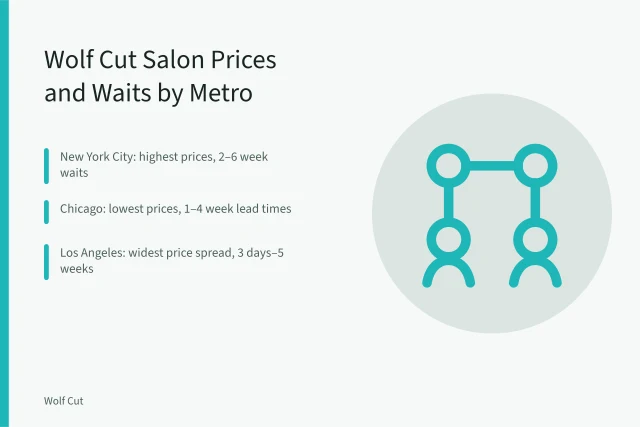
Typical planning ranges from US salon menus are $45 to $110 in lower-rent cities such as Buffalo or Kansas City, $70 to $180 in mid-range cities such as Chicago or Austin, and $120 to $300 in high-rent cities such as Manhattan, Los Angeles or San Francisco. These are typical ranges, not official quotes.
The shape behind the name is a layered cut, with softer layers near the crown and longer strands kept at the back. Wikipedia's wolf cut entry describes the shag and mullet blend behind the look.
A quote is built in three parts: a base cut rate, a length or density surcharge, and a finish charge for a blowout or styling.
Stylist earnings sit underneath those rates. The BLS wage data for barbers, hairstylists and cosmetologists explains why salons guard chair time so closely.
The technique behind the bill is a separate craft, and salon craft guides show how the layers get built and thinned. The tools named in those guides are cutting shears, a razor, thinning shears and a blow dryer with a round brush.
The factors that move the price
Every surcharge on a salon menu maps to work that someone has to do.
| Factor | Effect on the bill | Reason |
|---|---|---|
| Hair past the shoulders | Higher | More sections to cut and dry |
| Thick or very curly density | Higher | Thinning and blending take longer |
| Senior stylist or salon owner | Higher | Established books support higher rates |
| Downtown rent | Higher | Each chair carries more overhead |
| Wash and blowout added | Higher | Extra service time and product |
| Short, fine hair | Lower | Fewer sections and a faster finish |
Example: a consultation that sets the quote
The consultation is where the number is agreed, so treat it as part of the service.
A consultation that sets the quote
- Bring two photographs, one from the front and one from the back, so layer heights can be read clearly.
- Say how you dry your hair at home. An air dried wolf cut sits differently from a blow dried one.
- Ask how much length will leave the back and how the face framing will be blended.
- Ask for the total before the wash, including any surcharge and the finish.
What does not change the price
Some things clients expect to matter never reach the invoice.
- The trend status of the cut.
- A photograph saved from social media.
- The stylist's personal product preferences.
- The label used on the booking form.
Physical work is what sets the total: sectioning, shear or razor work, thinning, and drying time.
State licences, hours and the cost of a chair
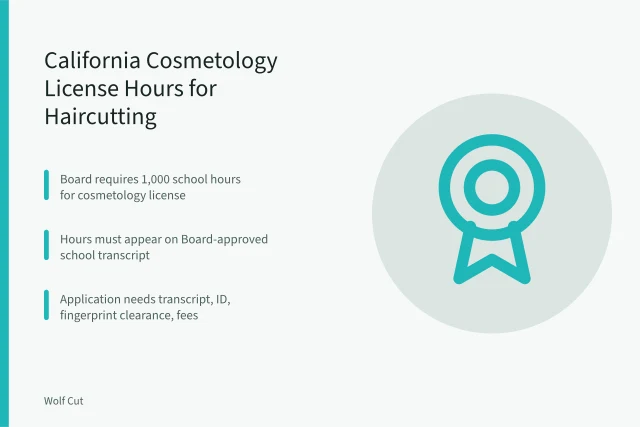
Every stylist in a US salon works under a state board licence, and minimum training hours are set state by state. Those hours shape local wages. Typical state minimums run from about 1,000 to 1,600 hours.
Two cities an hour apart can carry different wage floors because the training minimums differ. A booth renter also pays rent, insurance and supplies, which appears in the rate.
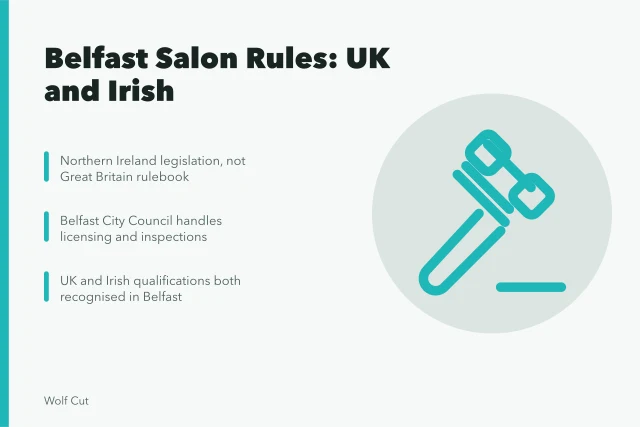
For a different rulebook, the Belfast hairdressing rules cover council licensing, environmental health and cross-border training between the UK and Ireland.
How a chair actually earns
A salon splits its money between rent, product, front desk wages and the stylist. A booth renter keeps the service price but carries the fixed costs alone.
A commission stylist trades a percentage for a steady chair and a steady client list. A typical split is 40% to 60% to the stylist. That split is why two salons can quote differently for identical hair.
Canadian dollars and northern tipping
Canadian salons quote in Canadian dollars, so exchange rates matter when a Toronto price sits beside a Buffalo one. A move in the Canadian dollar can shift that gap without any change in the cut.
Tips count as income for the stylist under Canada Revenue Agency rules, which shapes how a chair really earns.
Licensing also moves differently north of the border. The guide to Canadian hairstylist licensing hours sets out what transfers to a US state board and what does not.