Rules
Part of Growth pattern and density shape this fringe and face-framing guide
Why a fringe jumps, gaps or sits heavy, and how to fix it
Fringe cutting problems explained: dry recoil, cowlicks, gaps, heavy corners, asymmetry, eyewear conflicts, over-shortening, heat, and staged correction.
What to take away
- Reset the fringe and identify the cause before cutting again.
- Dry recoil, root lift, tension, and head position can all make a fringe jump.
- A cowlick is a growth direction, not excess length to be removed.
- Gaps may come from section design, density, growth, or over-thinning.
- Over-shortening is usually managed through styling and growth, not more removal.
The front section changes quickly under water, heat, product, sleep, and touch. Diagnose the fringe in the state that bothers the client, then compare it with a clean, settled state. A correction based on one forced position can make another wearing state worse. The design decisions behind the section are in the fringe and face-framing guide.
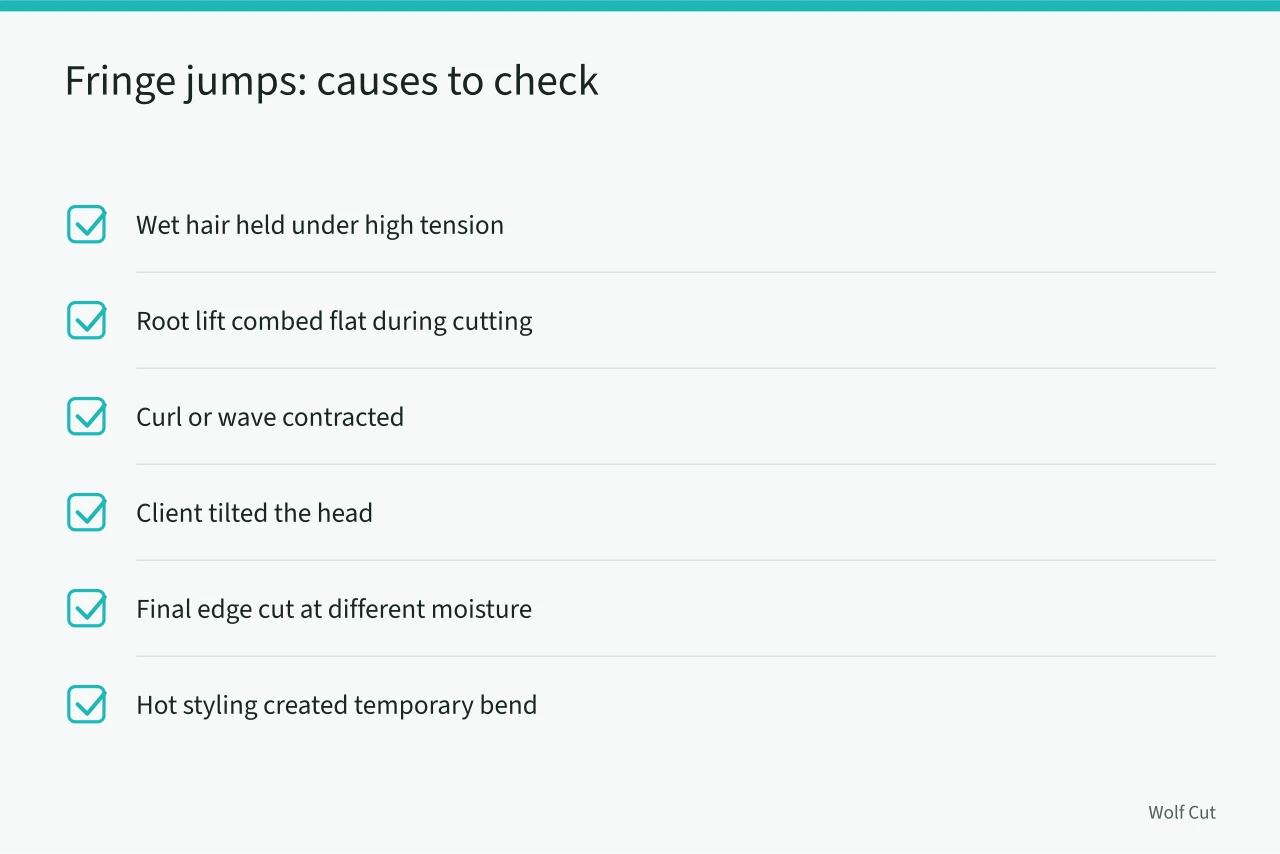
Problem: the fringe jumps after drying
Possible causes
- wet hair was held under high tension;
- root lift was combed flat during cutting;
- curl or wave contracted;
- the client tilted the head;
- the final edge was cut at a different moisture level;
- hot styling created a temporary bend.
Rewet and dry a small section with the client's ordinary method. If the length is already short, do not keep trimming neighboring hair to match. Adjust the finish and let the shortest point establish the temporary boundary.
Problem: a cowlick splits or lifts the fringe
Medical morphology terminology describes a frontal upsweep as upward or sideward anterior hair growth, replacing the casual term cowlick in that context. For a haircut, the key fact is the direction: the hair emerges and travels in a pattern that cutting cannot erase.
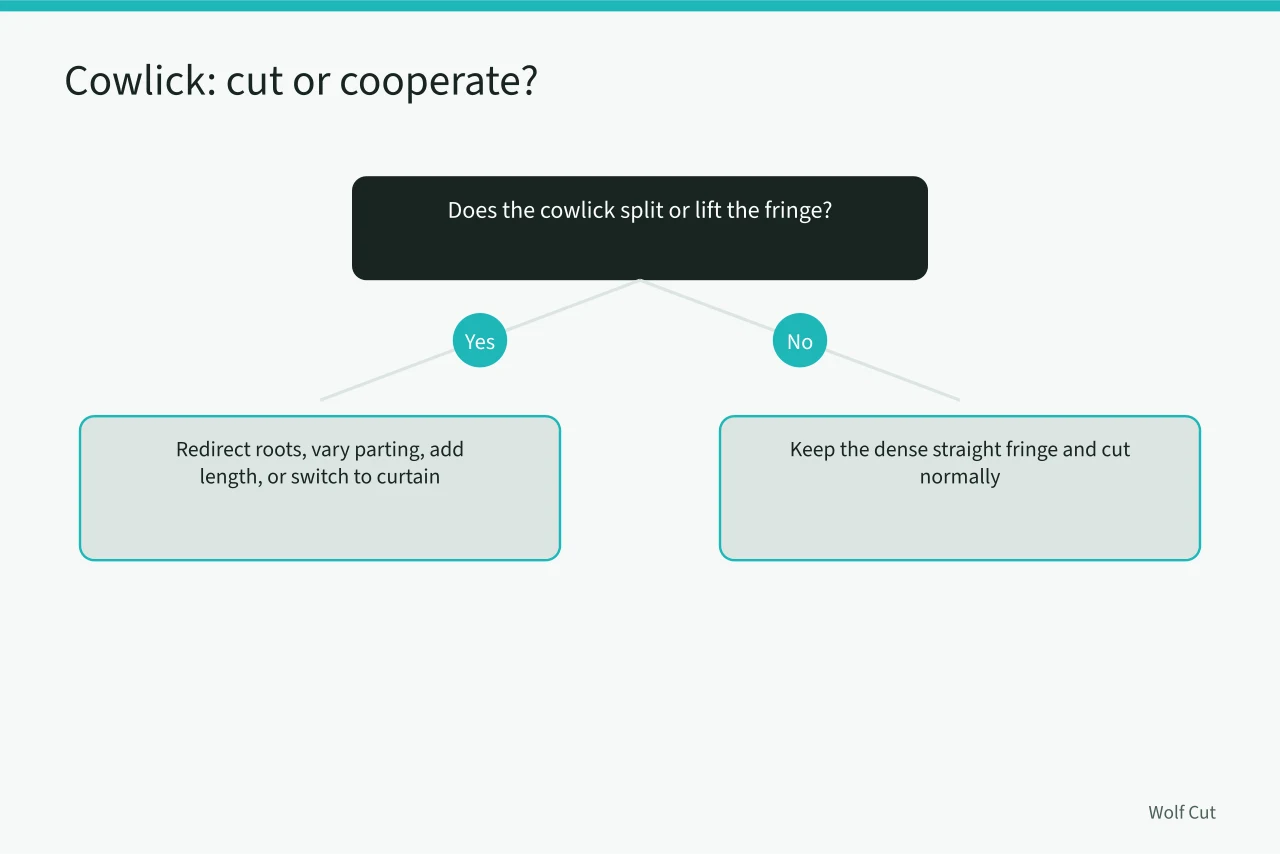
Try root redirection during drying and vary the parting. More length may supply weight. A shallower section may stop fighting the strongest area. A side-swept or curtain design can cooperate with the opening better than a dense straight fringe. The method for cutting a curtain fringe starts from the center split for that reason.
Shortening the lifted point often makes it stand more freely. Before cutting, show the client the natural split and agree on how much daily styling is acceptable.
Problem: a center gap appears
A gap may be a natural split, insufficient center density, a section divided too widely, over-thinning, breakage, or a curtain opening that has widened. Determine which hair is supposed to occupy the area. A fringe suitability checklist records the section boundaries that answer it.
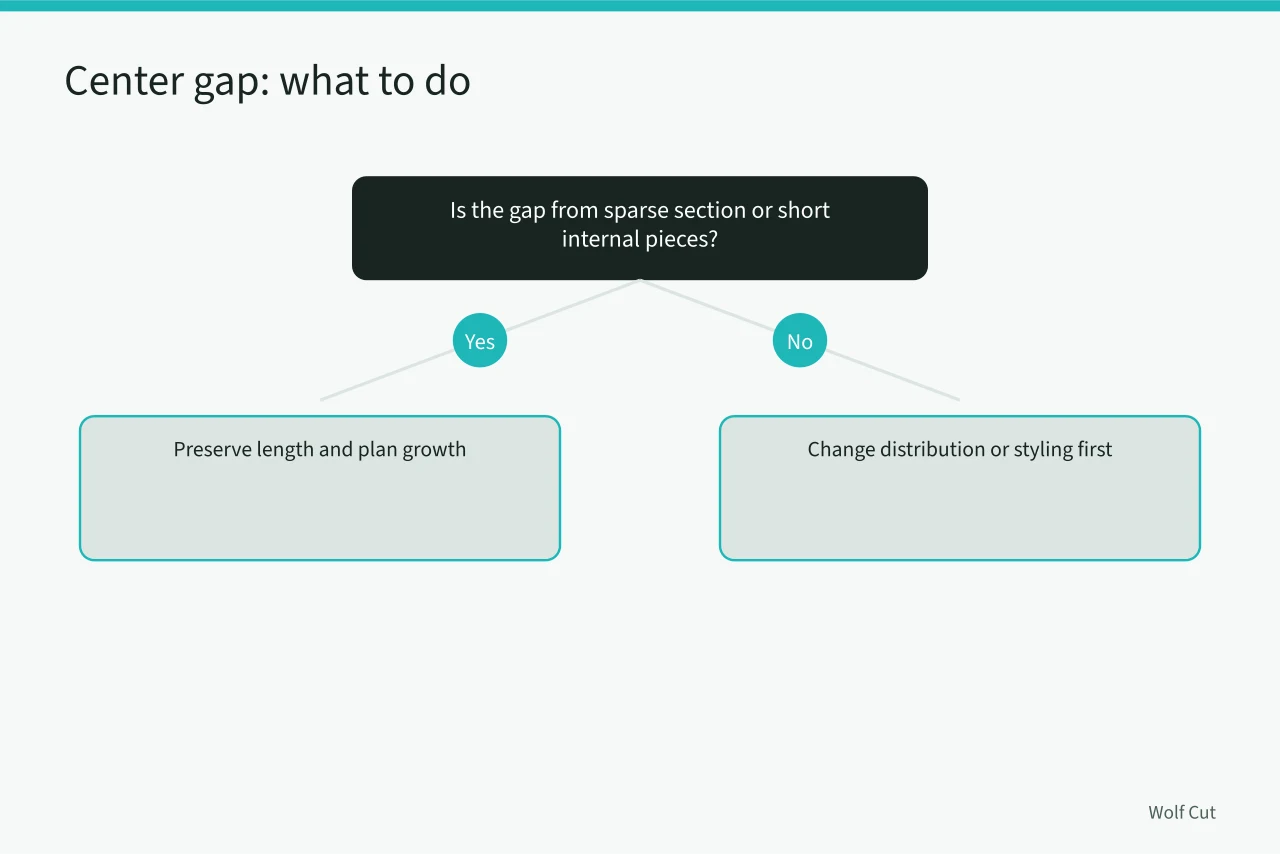
If nearby hair reaches the gap, change distribution or styling first. If the section itself is sparse, taking more hair from behind may create side weakness without solving the growth direction. If short internal pieces caused the gap, preserve length and plan growth.
Do not cut the rest of the fringe to the height of a small missing area unless the client knowingly chooses a much shorter line.
Problem: the sides look heavy
Heavy corners can come from a blunt edge, deep section, insufficient graduation, or abrupt transition into face framing. Check the profile. A corner that looks dense from the front may be needed to cover the temple from the side.
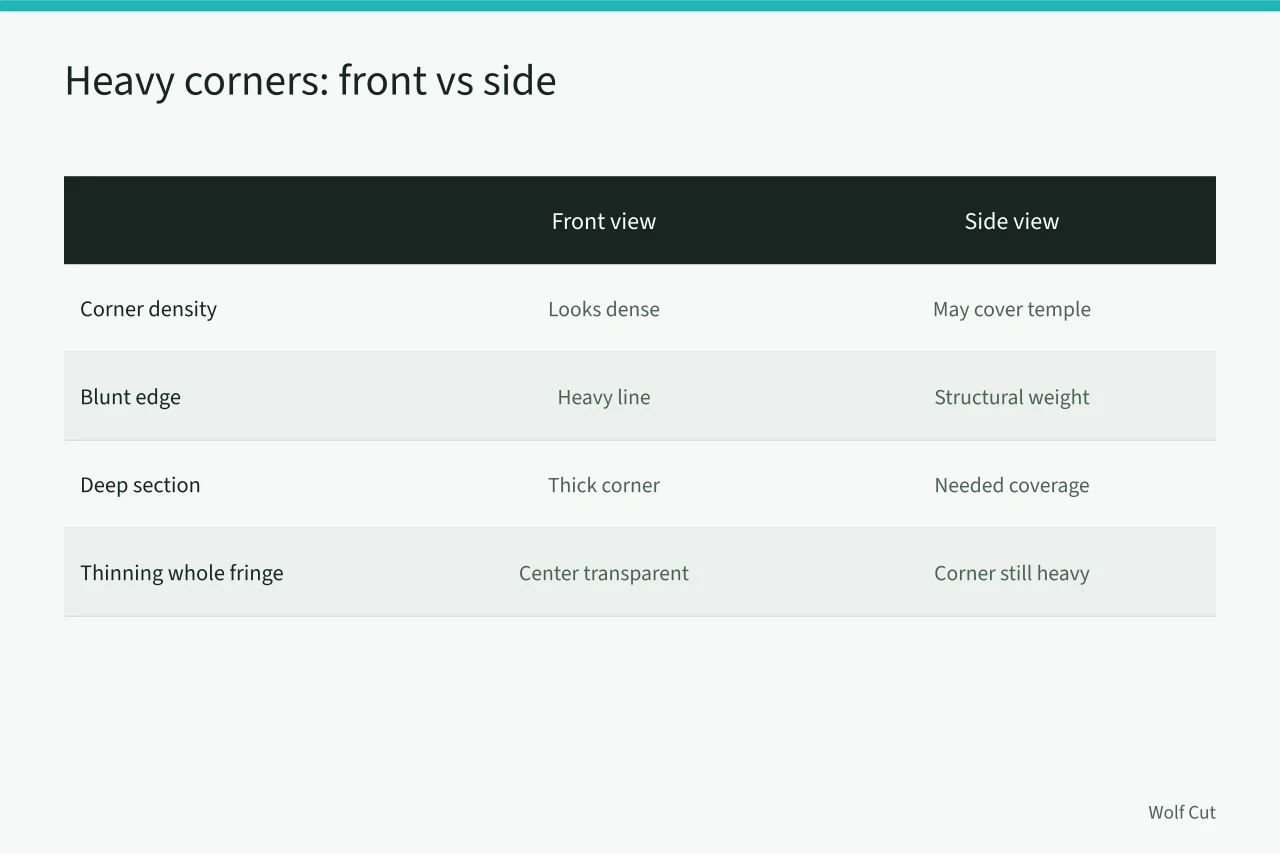
Options include softening the edge, redistributing a small side section, or extending the progression into the face frame. Avoid thinning the entire fringe because the center may become transparent while the corner remains structurally heavy.
Problem: the fringe looks uneven
First level the client's head and remove eyewear if appropriate. Let the hair fall without a comb holding it. Compare dry landing points, density, root direction, and brow asymmetry separately.
Mechanical equality does not always look visually balanced, and visible balance does not require ignoring minimum length. Correct only the confirmed hair length difference. Do not use the brows as an absolute ruler when the client's goal is a moving, asymmetrical fringe.
Problem: styling causes roughness or breakage
Daily flat-ironing, curling, or forceful brushing can make a short front section fragile. The American Academy of Dermatology's healthy hair tips advise limiting heat, using low or medium settings, and handling wet hair gently with a suitable comb. That supports reducing styling stress while a fringe grows or recovers.
Hair breakage, thinning, pain, scaling, or scalp inflammation that persists needs clinical assessment. A stylist should not diagnose the cause.
Problem: the fringe is over-short
There is no cutting technique that restores removed length. Establish the shortest point, stop refining, and show the client the settled result honestly.
Short-term options may include changing the parting, reducing root lift, sweeping the fringe, using an accessory without tension, or blending the edge only if enough length remains and the client consents. Product can control movement, but should not be presented as permanent repair.
Create a growth plan with checkpoints. As the center grows, the shape may become a longer blunt fringe, curtain opening, side sweep, then face frame. Those stages map onto the four common fringe families. Record the current section so future stylists do not deepen it while trying to add weight.
Correction order
- Reconstruct the problem state.
- Reset moisture, product, and parting.
- Observe growth and density.
- Protect the shortest point.
- Test styling before cutting.
- Make the smallest confirmed change.
- Recheck in motion and with eyewear.
- Record the response and growth plan.
Common questions
Can a cowlick be trained permanently?
Styling can redirect its appearance, but cutting and combing do not change the follicle's growth direction.
Should a gap be filled with a deeper section?
Not automatically. Extra hair may weaken the sides and still separate at the same growth pattern.
Can over-short bangs be fixed immediately?
Length cannot be restored. Styling and a staged growth plan are the main options.
When should a stylist stop correcting?
Stop when the cause is uncertain, the shortest agreed point is at risk, or the requested change exceeds consent.