Guides
Growth pattern and density shape this fringe and face-framing guide
Fringe and face-framing guide covering section depth, hairline growth, density, recoil, landing points, side connection, eyewear, styling, upkeep, and records.
What to take away
- A fringe is defined by its section, distribution, edge, length, and movement.
- Hairline growth, density, curl, and normal parting matter more than a trend label.
- Section depth controls how much hair leaves the rest of the haircut.
- Face framing must be planned in profile as well as from the front.
- Agree on dry landing points and upkeep before making the first short cut.
A fringe changes the most visible part of a haircut with relatively little hair. That small area can also be unforgiving. A few extra millimeters of section depth may make the fringe too dense, remove side coverage, or leave a gap when the client changes parting. The silhouette it sits inside is planned in haircut design fundamentals.
Define the front section
Identify the natural front hairline and the point where hair stops falling forward comfortably. Do not assume a perfect triangle. A curved, shallow, diagonal, or asymmetrical section may better follow the hair's density and growth.
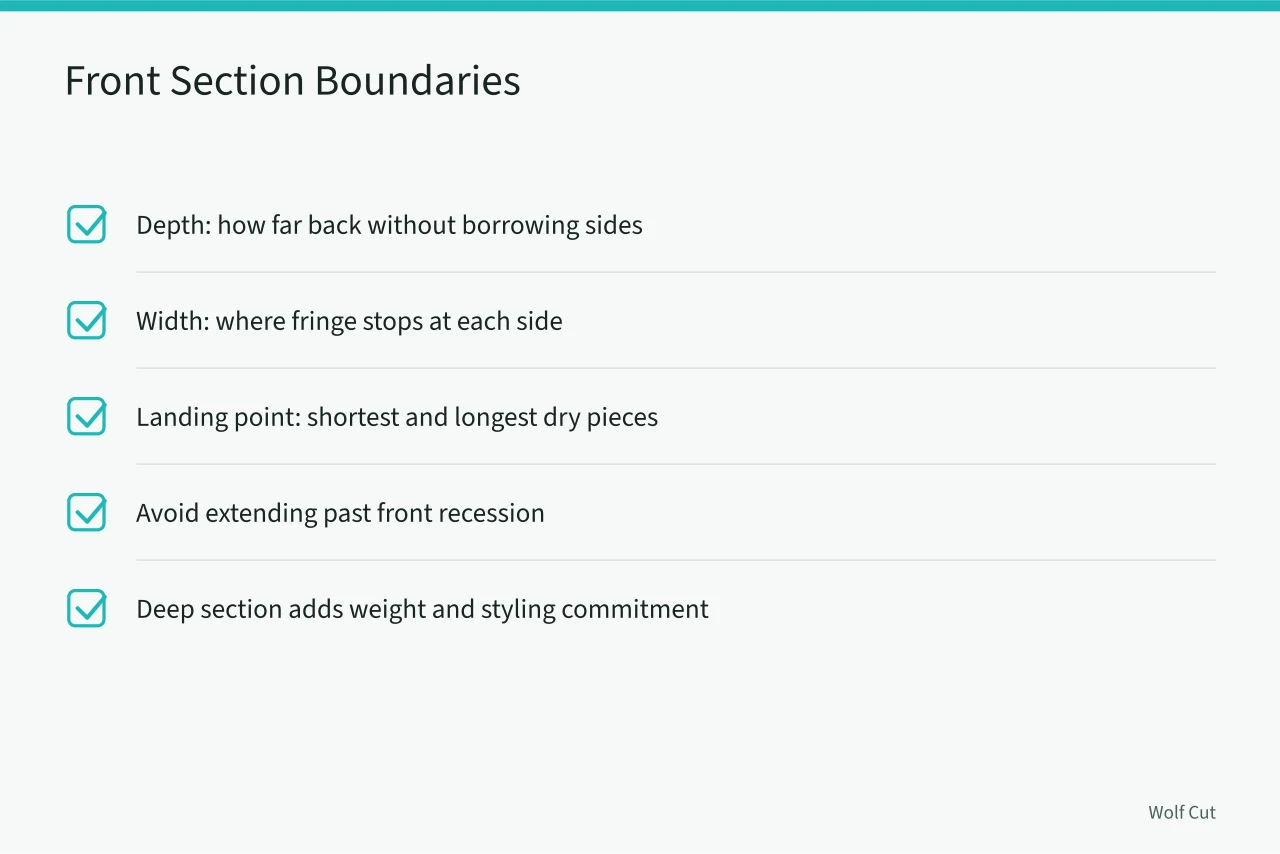
Record three boundaries:
| Boundary | Question |
|---|---|
| Depth | How far back can the section begin without borrowing from the sides? |
| Width | Where should the fringe stop at each side? |
| Landing point | Where should the shortest and longest pieces sit when dry? |
The width affects the transition into face framing. Extending too far past the front recession can create weak side corners. A deep section creates more weight but also commits more hair to daily forward styling.
Read the growth pattern
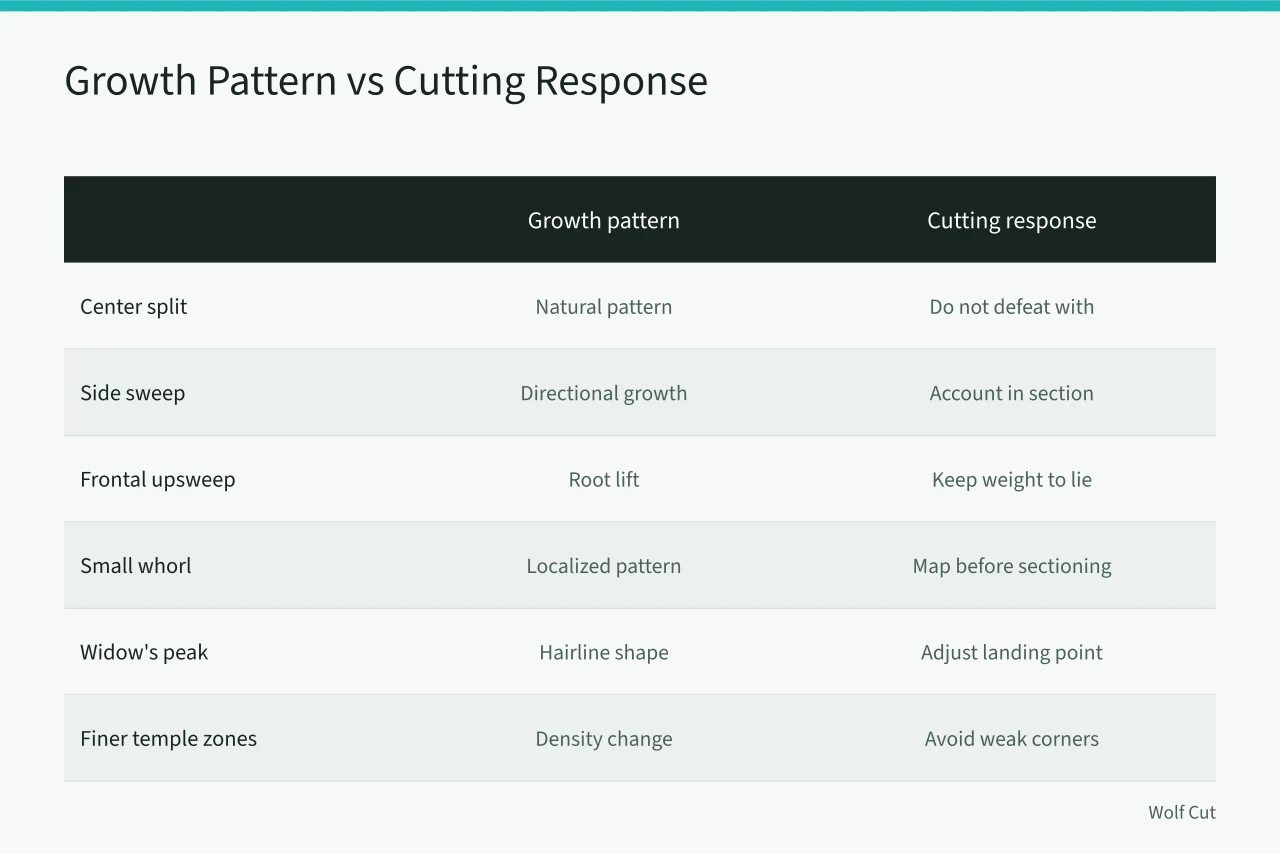
Observe the front dry and product-light; check a center split, side sweep, frontal upsweep, small whorl, and widow's peak. Note strong directional growth and finer temple zones; mist a test section and let it settle again.
A classic study of the topology of hair streams and whorls treats hair slope, whorls, crosses, and fields as one connected pattern in the upper dermis during development. Front split is part of the pattern, not a styling failure.
The UK National Occupational Standard for cutting and clippering hair requires consultation, hair/scalp analysis, an agreed service plan, an initial guideline, and suitable technique. It also requires visible perimeter work that accounts for natural hairline and growth patterns, cross-checking, client confirmation, and records.
These controls apply to fringe work even if the haircut otherwise stays unchanged.
Do not try to defeat a cowlick only with a shorter cut. A head shape and movement map records the direction before the section is taken. Shortening can remove the weight that helps hair lie down. Styling may redirect some growth, but a strong natural split can remain visible.
Choose density and edge separately
A fringe can be dense with a soft edge or light with a blunt edge. Decide how much hair belongs in the section, then decide how the edge should read.
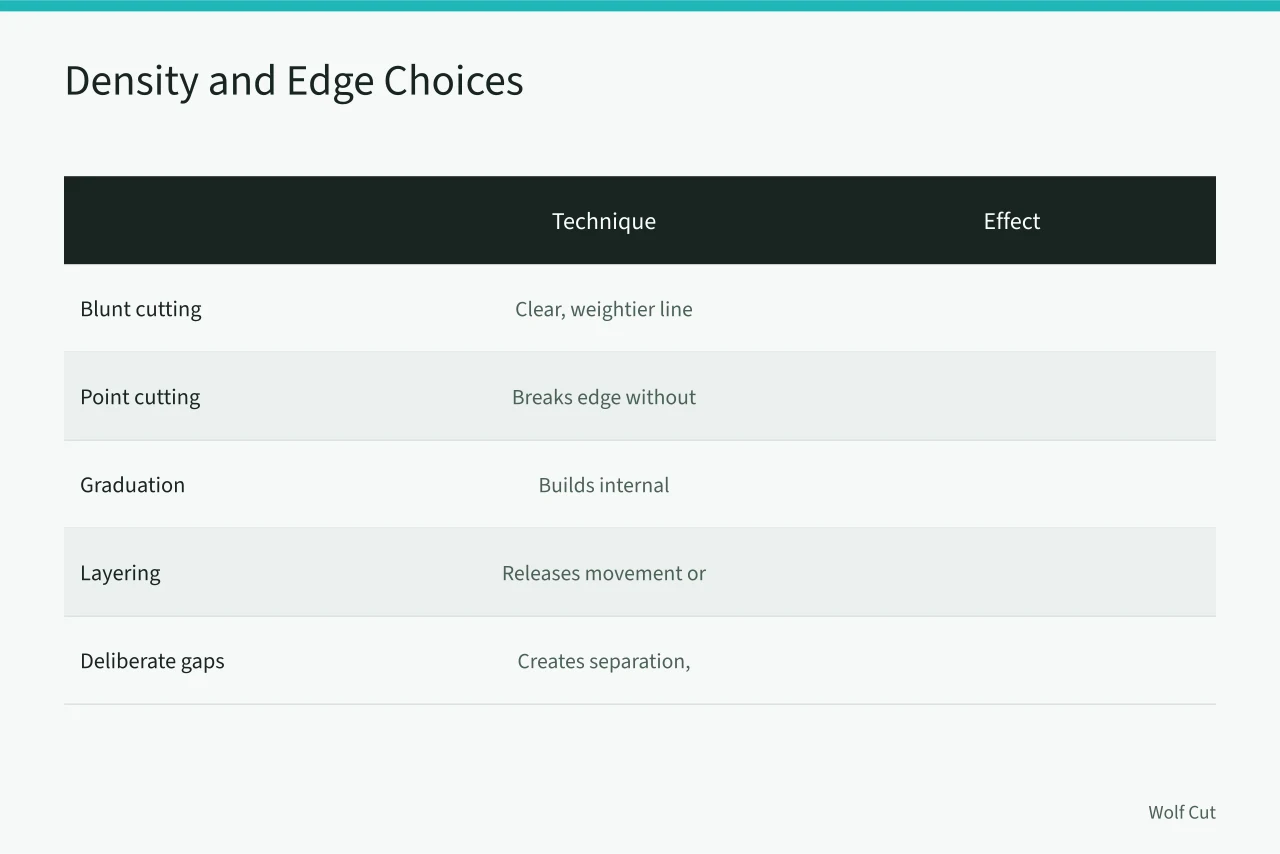
- Blunt cutting creates a clearer, weightier line.
- Point cutting can break the edge without changing the entire section depth.
- Graduation can build internal support.
- Layering can release movement or reduce weight.
- Deliberate gaps can create separation but need enough surrounding density.
Avoid repeated thinning at the root or mid-length simply to make a heavy fringe look airy. The differences between blunt, point, slide, and channel work are worth knowing before that decision. Reducing section depth or changing distribution may solve the structural cause more cleanly.
Plan face framing in three views
Front view shows cheek, jaw, and chin landmarks. Profile shows how the front joins the side and whether an abrupt shelf appears. Overhead view shows section width and depth.

Set the first face-framing length with the client's normal parting, eyewear, and tie-back needs. Decide whether the line moves continuously into the side, forms separate steps, or remains disconnected under longer hair.
Ask the client to tuck the hair, put on glasses, and move the head. A piece that looks well placed at rest may catch on a frame or fall into the eye during normal movement.
Control wet-to-dry change
Hair can rise as it dries, especially at a curved hairline, in tight curl, or where the root lifts. Set a conservative wet length and check the dry fall before refining. Avoid pulling a fringe firmly against the forehead and cutting to the intended dry point.
For curly or coily fronts, compare several groups. A center section and temple section may contract differently. The finished outline can be balanced without every extended strand being identical.
Style for ordinary life
Demonstrate how to reset the roots after sleep or moisture. Use the lowest effective product, heat, and tension. Explain whether the design expects a center split, side direction, round-brush bend, diffuser, or natural fall.
Show a lower-effort result when the reference used extensive styling. If the fringe depends on daily heat to sit as pictured, that belongs in the consultation before cutting. A pre-cut consultation and design plan gives that conversation a written home.
Plan upkeep and growth-out
A short fringe changes quickly. Discuss whether the salon offers fringe-only appointments and what can be adjusted without altering the full haircut. For growth-out, the path may move from full fringe to curtain shape, side sweep, cheek-length frame, and eventual side connection.
Record section boundaries, dry landing points, distribution, edge technique, growth pattern, styling response, and client preferences.
Common questions
Does a deeper section always make a better full fringe?
No. It adds hair but can weaken side coverage and create more daily styling work.
Can a cowlick be cut away?
No. Length and styling can manage its appearance, but the follicle growth direction remains.
Should a fringe be cut wet or dry?
Either can work. The final dry landing point must be checked, especially when recoil or root lift is present.
Must face framing connect to the sides?
No. It may connect, step, or disconnect deliberately, but the choice should be visible and recorded.
In this guide
- Cutting a curtain fringe from section depth to dry refinementCurtain fringe cutting workflow covering section depth, center length, side progression, distribution, recoil, dry refinement, styling, and accurate service records.
- Blunt, curtain, side-swept and micro fringe compared by upkeepBlunt, curtain, side-swept, and micro fringe compared by line, section, movement, styling effort, eyewear, upkeep, growth patterns, and growth-out.
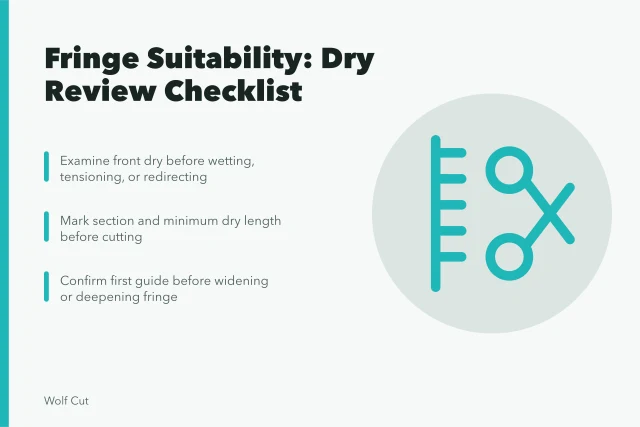
- Client goals through dry review: the fringe suitability checklistFringe checklist for client goals, hairline growth, density, curl, section depth, eyewear, consent, cutting controls, dry review, upkeep, and records.