Maintenance
Part of Growth pattern and density shape this fringe and face-framing guide
Client goals through dry review: the fringe suitability checklist
Fringe checklist for client goals, hairline growth, density, curl, section depth, eyewear, consent, cutting controls, dry review, upkeep, and records.
What to take away
- Suitability is a shared decision about hair behavior, goals, routine, and tradeoffs.
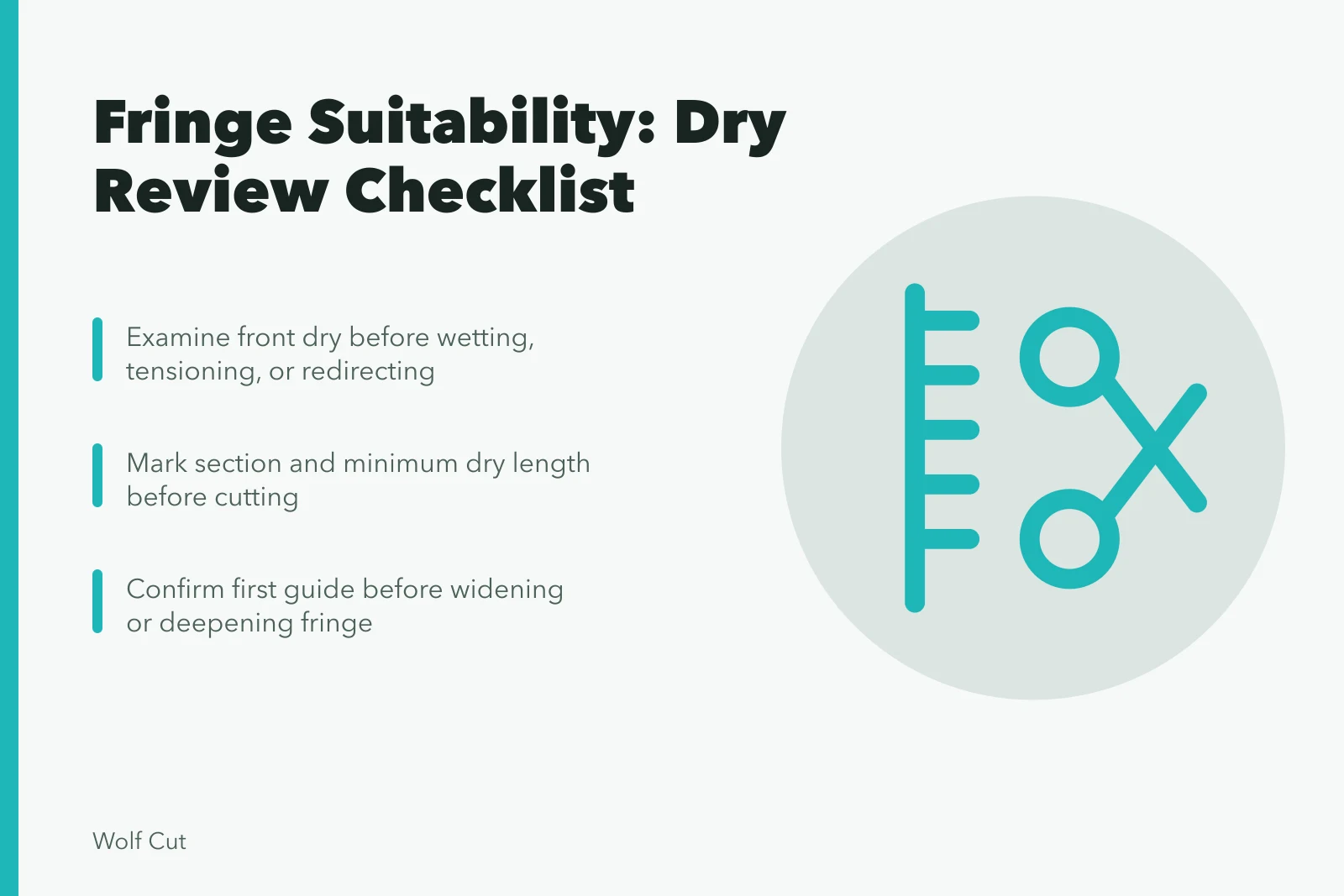
- Examine the front dry before wetting, tensioning, or redirecting it.
- Mark the section and minimum dry length before cutting.
- Confirm the first guide before widening or deepening the fringe.
- Review the result without tools holding it in position.
Use this checklist for professional fringe services. It assumes the client has already chosen among the four common fringe families. Adapt it to local requirements, salon policy, product instructions, and the stylist's training. A fringe request does not remove the need for consultation or informed consent. The design side of the service is covered in the fringe and face-framing guide.
Goals and daily function
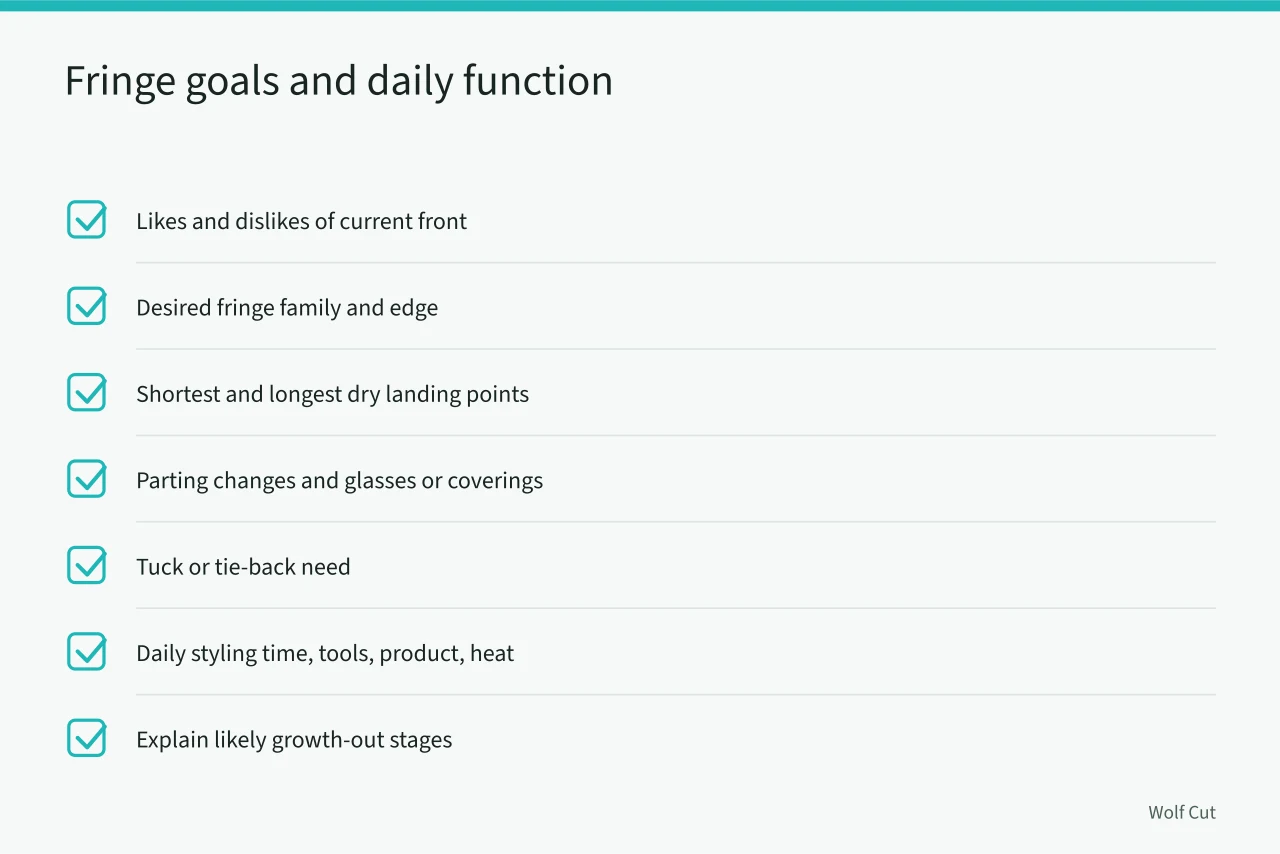
- Ask what the client likes and dislikes about the current front.
- Identify the desired fringe family and edge.
- Mark shortest and longest dry landing points.
- Ask how often the parting changes.
- Check glasses, contact habits, head coverings, and work needs.
- Test whether the client needs the front to tuck or tie back.
- Discuss daily styling time, tools, product, and heat.
- Explain the likely growth-out stages.
The National Occupational Standard for consulting, assessing, and planning services calls for discussion of concerns, expectations, desired outcomes, risks, alternatives, fees, diverse needs, consent, visual aids, records, and pre- and post-service advice. That makes suitability a documented agreement rather than a stylist's private judgment. The workflow for cutting a curtain fringe shows how that agreement becomes checkpoints.
Hairline and front-section analysis
- Observe the hair dry and in its normal parting.
- Locate frontal upsweep, whorl, split, widow's peak, and side direction.
- Map density across the center and temples.
- Note strand diameter and condition.
- Compare curl or wave recoil by zone.
- Identify previous fringe, breakage, or chemical alteration.
- Check whether product or sleep compression is changing the fall.
- Reset the hair when the starting state is not representative.
Section design
- Mark the maximum safe depth without borrowing side coverage.
- Mark the width and side boundaries.
- Choose symmetric or intentionally asymmetric placement.
- Keep fine temple hair out of a dense center section when needed.
- Decide how the fringe joins the face frame.
- Confirm whether a hidden disconnection is planned.
- Clip all non-fringe hair securely away.
- Show the proposed section to the client.
Consent checkpoints
- Confirm the shortest center point.
- Confirm side landing points.
- Explain wet-to-dry rise and styling dependence.
- State any uncertainty caused by growth or curl.
- Agree on a conservative first guide.
- Confirm before widening, deepening, or shortening further.
- Record a change if the plan shifts during the service.
Cutting controls
- Prepare clean, maintained, disinfected tools.
- Position the client upright and level.
- Choose wet, damp, or dry work by purpose.
- Keep moisture and tension consistent.
- Cut a narrow test guide first.
- Release and check recoil before expanding.
- Build side progression with controlled distribution.
- Cross-check without forcing the hair flat.
- Complete the main line before optional texture.
The occupational standard for safe and hygienic working practices requires risk assessment, infection-control measures, a prepared environment, suitable positioning, fit-for-purpose equipment, manufacturer guidance, informed consent, and records. These controls matter in a short service as much as in a full haircut. For a full restyle the equivalent is the pre-cut consultation and design plan.
Dry review
- Dry in the agreed direction with suitable heat and tension.
- Let the fringe cool and settle.
- Check the ordinary parting and one alternate parting if relevant.
- Remove the brush or comb before judging length.
- Test glasses and normal head movement.
- Look for a gap, jump, heavy corner, or uneven edge.
- Identify whether the cause is length, growth, density, or styling.
- Make small corrections within consent.
Closeout
- Show front, profile, and side connection.
- Demonstrate one realistic reset.
- Explain behavior without styling.
- Discuss fringe-only maintenance and growth-out.
- Record section, guides, distribution, edge, and dry response.
- Obtain consent before taking or keeping photographs.
Common questions
Does suitability depend on face shape?
Not alone. Hair behavior, preferences, routine, sensory comfort, eyewear, and upkeep matter too.
Why show the section before cutting?
It makes the amount of hair being reassigned to the fringe visible to the client.
When should the first guide be rechecked?
Before widening or deepening the section and again after drying.
Is a fringe trim too small for a full record?
No. The section, length, growth pattern, consent, and result can affect future services.