Reviews
Part of Growth pattern and density shape this fringe and face-framing guide
Blunt, curtain, side-swept and micro fringe compared by upkeep
Blunt, curtain, side-swept, and micro fringe compared by line, section, movement, styling effort, eyewear, upkeep, growth patterns, and growth-out.
What to take away
- Fringe names describe a visual tendency, not a complete technical diagram.
- Blunt fringes emphasize a line, while curtain fringes emphasize an opening and side progression.
- Side-swept designs work with directional movement but still need a defined short and long side.
- Micro fringes expose growth patterns and length changes quickly.
- Compare the dry result, styling effort, and growth-out route before choosing.
In American English, "bangs" and "fringe" are often used for the same front section. This comparison uses "fringe" and separates four common design families by visible structure.
Comparison table
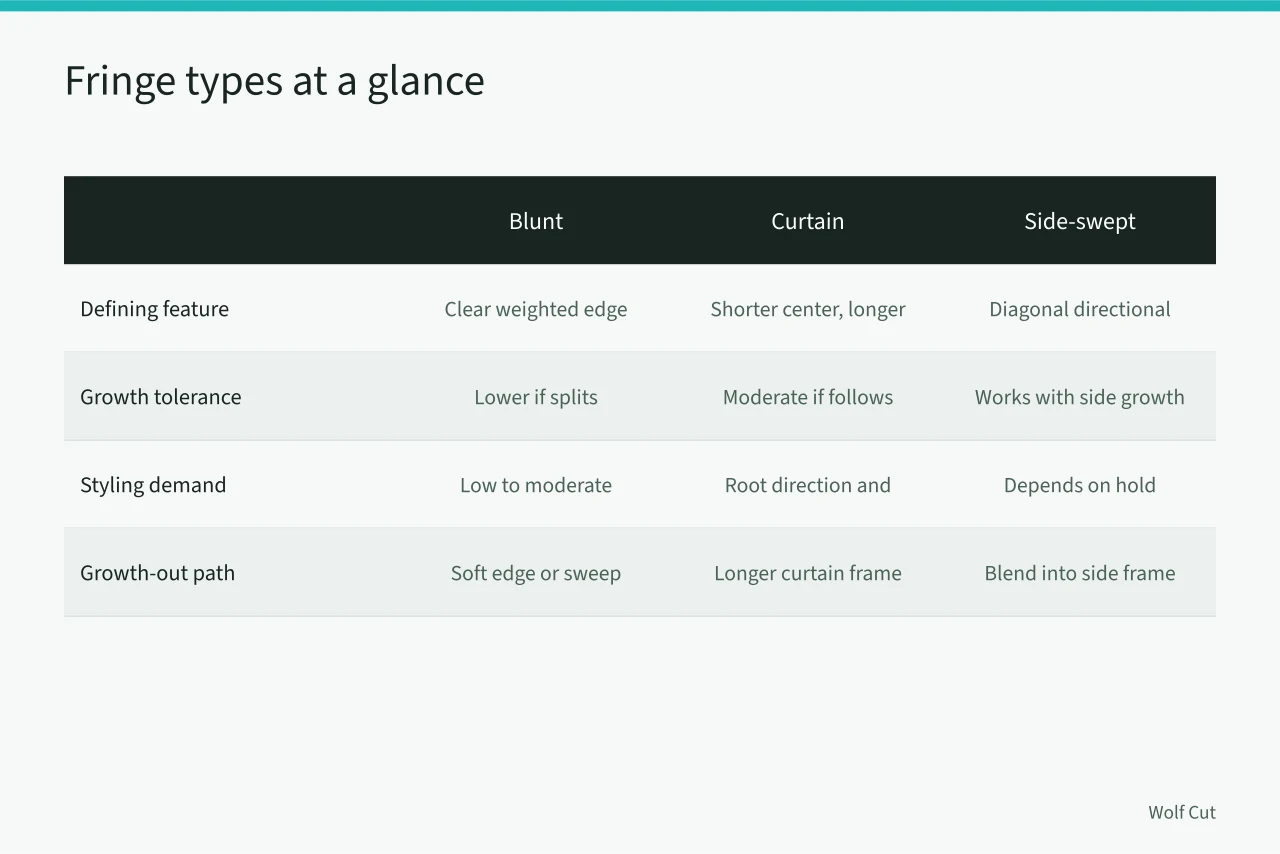
| Type | Defining feature | Growth-pattern tolerance | Styling demand | Growth-out path |
|---|---|---|---|---|
| Blunt | Clear weighted edge | Lower when growth strongly splits | Low to moderate if hair falls forward | Soft edge, side sweep, or curtain |
| Curtain | Shorter center, longer sides | Moderate if opening follows growth | Often needs root direction and side bend | Longer curtain into face frame |
| Side-swept | Diagonal directional fall | Can work well with side growth | Depends on hold and length | Blend into side frame |
| Micro | Very short exposed edge | Low when recoil or upsweep is strong | Simple only when natural fall cooperates | Longer blunt phase before sweep |
The general definition of bangs or fringe is front hair that falls over the forehead, with possible straight, curved, or ragged shaping and varied lengths. That broad definition explains why the label alone cannot specify section depth, edge density, or side connection. Those three decisions are worked through in the fringe and face-framing guide.
Blunt fringe
A blunt fringe uses a visible, usually weighted edge. It can be horizontal, curved, or slightly irregular while still reading as one line. The result depends on a controlled section and sufficient density reaching the edge.
Best consultation questions:
- How much forehead coverage is wanted?
- Should the edge sit above, at, or below the brows when dry?
- Is a solid line acceptable as it grows?
- Does the hair naturally fall forward without daily redirection?
A deep section can make the line stronger, but it may remove side coverage. A fine edge can still look blunt if the section is controlled and not over-texturized.
Curtain fringe
A curtain fringe opens around the center or an agreed off-center point. It is shorter near the opening and extends toward the sides. The design can sit at brow, cheek, or jaw level. The step order for cutting a curtain fringe sets the center and sides separately.
It often suits clients who want a less enclosed forehead and a clear growth-out route. It may require daily root resetting if the natural hair falls straight down or separates somewhere else. The side pieces can interfere with glasses or escape a tie, so function should be tested.
Side-swept fringe
A side-swept fringe has directional movement across the forehead. It can be light and layered or dense with a clear diagonal edge. The short side, long side, and pivot point must be agreed.
This option can cooperate with a natural side direction, but it is not automatically effortless. A frontal upsweep or opposing cowlick may create a gap. A head shape and movement map shows that before the section is cut. Cutting the short side too far back can expose the temple when the hair shifts.
Micro fringe
A micro fringe ends well above the brows and makes the hairline highly visible. Small differences in recoil, growth, tension, and head position show quickly. The look changes rapidly as hair grows.
Use conservative dry checkpoints, especially with curl. Explain the intermediate growth-out stages before cutting. The client may need a period of short blunt fringe before enough length exists for a side sweep or curtain opening.
Structural controls across all four
The Australian training unit for one-length or solid haircut structures links natural fall, minimal lift, sectioning, partings, growth patterns, hairline, texture, density, movement, head position, and client agreement. A fringe may be a small part of the service, but the same controls determine whether a solid or weighted edge lands accurately.
For every type, record:
- section width and depth;
- dry shortest and longest points;
- distribution and tension;
- edge technique;
- curl or root-lift response;
- connection to face framing;
- ordinary styling method.
Choose by tradeoff, not face-shape rule
There is no single fringe that a face shape must wear. Using suitability language to enforce a view of face shape is listed among haircut planning problems. Use the client's preferences, hair behavior, desired maintenance, sensory comfort, eyewear, styling time, and haircut balance.
A reference can help describe proportion, but it does not prove suitability. The most useful sentence is specific: "I want a soft curtain opening at the brow, cheek-length sides, and enough length to tuck behind my glasses."
Common questions
Which fringe needs the most frequent attention?
A micro or short blunt fringe usually shows length change soonest, though individual growth and tolerance differ.
Is a curtain fringe always low maintenance?
No. It may need root redirection and side styling, especially when natural growth opposes the opening.
Can curly hair wear a blunt fringe?
Yes. Set the target in the dry state and account for different recoil across the section.
Which fringe grows out most quietly?
Long curtain and side-swept shapes often move into face framing more smoothly, but the original section depth still matters.