Guides
Built around a one-way tool path: the salon sanitation guide
Salon haircut sanitation guide covering dirty-to-clean tool flow, cleaning, disinfection, linens, storage, workstation turnover, and staff records.
What to take away
- Cleaning and disinfection are separate steps, and the order matters.
- A salon needs a visible one-way path from used tools to clean storage.
- Product labels, equipment instructions, and local rules set the working method.
- Clippers, shears, combs, capes, towels, and touch surfaces need different controls.
- Enough duplicate tools are needed to keep contact times from being cut short.
Sanitation in a haircut service is a working system, not a jar on a counter. Hair, skin debris, product residue, and occasional blood can move through hands, tools, linens, and surfaces. A reliable system keeps used items from crossing back into the clean side of the station.
This guide gives a practical framework for salon planning. It does not replace state or local cosmetology rules, a product label, an equipment manual, or an employer exposure-control plan.
Build a one-way tool path
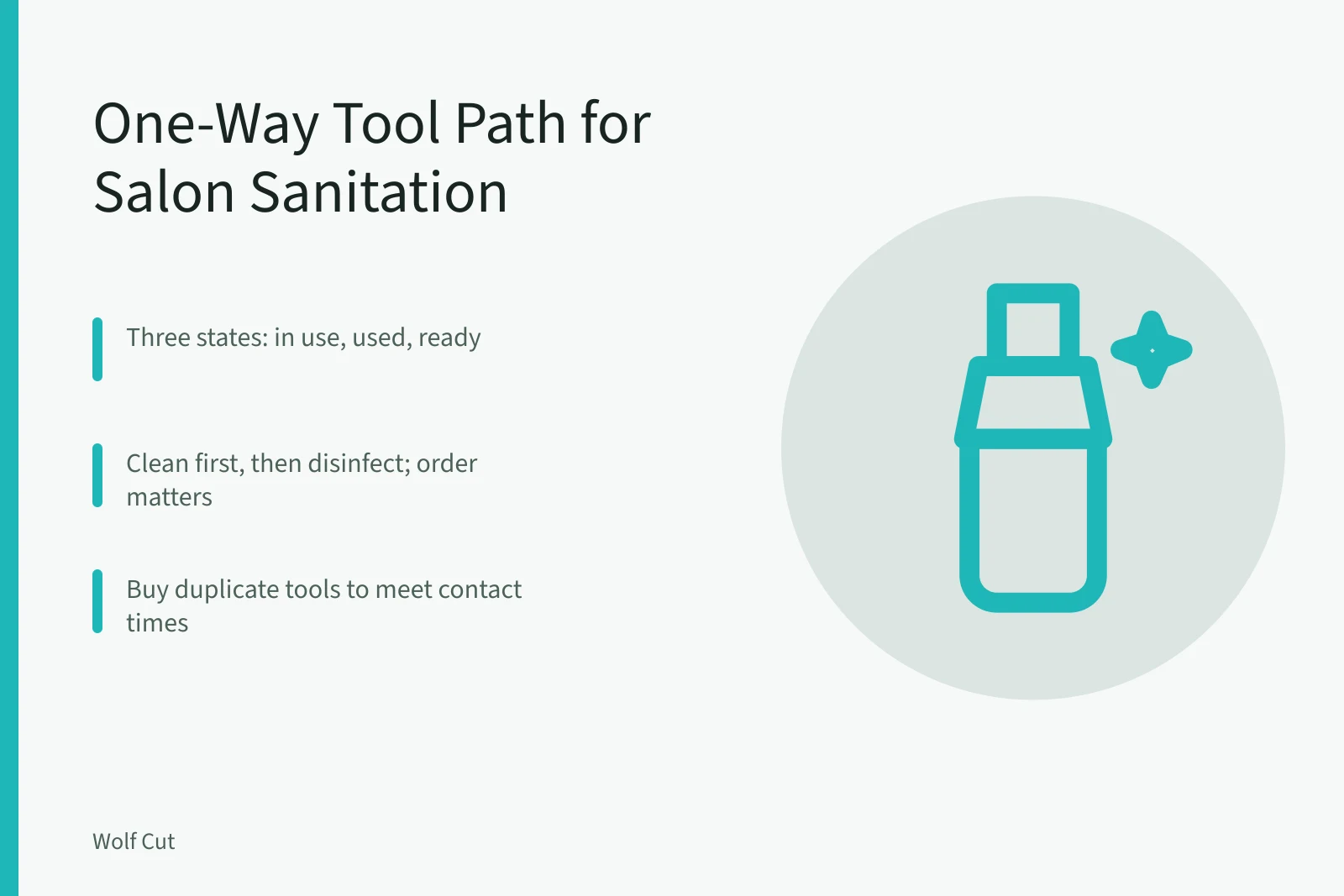
Divide the work area into three states. Used items go into a clearly marked dirty container or zone. Cleaning happens away from ready-to-use tools. Fully processed and dry items move into protected clean storage.
One-Way Tool Path
- In use: current client's tools and cape
- Used: hairy, soiled, contaminated items
- Clean: remove visible material
- Disinfect: inactivate covered organisms
- Ready: clean, processed, dry tools
- Never return used comb to clean towel
| State | What belongs there | Main control |
|---|---|---|
| In use | Current client's tools and cape | Keep the set together |
| Used | Hairy, soiled, or potentially contaminated items | Contain and separate |
| Ready | Clean, processed, dry tools | Protect from recontamination |
Do not place a used comb on a clean towel. Do not return a clipper guard to a clean drawer because it looks free of hair. Visual appearance alone does not establish that an item has completed the required process. The clipper service setup and finish checklist turns that rule into station steps.
Use the right word for each step
Cleaning removes visible material and prepares a compatible tool or surface for its next required step. Disinfection uses an appropriate product and method on an inanimate item to inactivate the organisms covered by that method. Sterilization is a more demanding process intended to eliminate all forms of microbial life.
Cleaning vs Disinfection vs Sterilization
Cleaning
- Removes
- Visible material
- Product
- Soap or detergent
- Spores
- Not addressed
- Sequence
- Usually first
- Controls
- Tool instructions
Disinfection
- Removes
- Covered organisms
- Product
- EPA disinfectant
- Spores
- Not necessarily
- Sequence
- After cleaning
- Controls
- Product label
Sterilization
- Removes
- All microbial life
- Product
- Sterilizer
- Spores
- Eliminated
- Sequence
- Most demanding
- Controls
- Local rules
The CDC's technical definitions of cleaning, disinfection, and sterilization come from infection-control guidance for healthcare. They are useful for keeping the terms distinct, but they do not decide a salon's legal requirements. Local licensing rules and the exact product and tool instructions control salon practice.
The product categories are separated the same way. The EPA's explanation of antimicrobial pesticides defines a sanitizer as reducing rather than necessarily eliminating microorganisms to a level public health codes consider safe.
A disinfectant destroys or irreversibly inactivates infectious fungi and bacteria but not necessarily their spores, while a sterilizer eliminates spores as well.
Cleaning usually comes first because hair, oils, and other residue can block a disinfectant from reaching a surface. Follow the required sequence even if a product is advertised with convenient shorthand. Check what item the label covers, how the solution is prepared, how it is applied, and how long the surface must stay wet.
Match controls to the item
Shears and razors
Remove hair without putting fingers in the blade path. Clean hinges, finger rests, serrations, and other small spaces. Use only a process compatible with the metal, finish, inserts, and lubricant. Single-use blades go into the correct sharps container and are never reprocessed. The scissor setup and cross-check list covers the craft side of the same station.
Clippers and trimmers
Unplug corded equipment or isolate power as directed. Remove detachable parts only as the manufacturer allows. Brush or otherwise remove hair from guards, teeth, housings, vents, and seams without forcing liquid into electrical components. A detachable blade may have a different process from the clipper body. Blade faults noticed mid-service belong to clipper cutting problems.
Combs, brushes, and clips
Remove trapped hair before washing or disinfection. Inspect cracked combs, damaged brush cushions, porous handles, and corroded clips. An item that cannot be fully cleaned or safely processed should leave service.
Capes, neck strips, and towels
Use a fresh barrier or clean cape as local rules require. Keep clean and used textiles apart. Do not shake used laundry. Store it in the designated container, then wash and dry it according to the textile, product, and regulatory instructions.
Station surfaces
Clear loose hair first. Process chair controls, headrests, counters, trolley handles, tool mats, sink touch points, and any other surface contacted during service. Floors need routine hair removal, but a broom should not travel from a dirty floor into clean tool storage.
Design capacity around contact time
The service schedule must fit the infection-control process. If a product requires a stated wet contact time, the tool cannot return to service until that time passes and the remaining label steps are done.
One comb and one clipper guard set per operator may be insufficient during consecutive appointments. The service those tools support is described in the clipper cutting guide.
Buy enough compatible duplicates. Provide timers, measuring devices, labeled containers, fresh solution at the required interval, and a place for tools to dry without crossing into the used zone. Assign responsibility for opening checks, between-client turnover, spills, and closing work.
Handle an interruption safely
Stop service after a cut, blood contact, dropped tool, suspected contamination, or product spill. Protect the client first within staff training and scope. Keep other people away from the area. Put on the specified protective equipment, contain disposable waste, and isolate reusable items for the required process.
Do not improvise by wiping a tool and continuing. Follow the salon's written incident and exposure procedures, including reporting and medical evaluation when applicable. Replace gloves and perform hand hygiene at the correct points.
Keep proof the system works
Records should be brief enough to use and specific enough to audit. Track solution preparation or replacement when required, opening and closing checks, equipment damage, training, exposure incidents, and corrective action. Review whether appointment timing repeatedly pushes staff to shorten a step.
Observe the workflow, not just the written policy. A clean drawer beside an overflowing used-tool tray signals a design problem. Correct capacity, location, labeling, and responsibility before blaming an individual worker.
Common questions
Is cleaning the same as disinfection?
No. Cleaning removes visible material. Disinfection is a separate controlled process for compatible inanimate items.
Can every salon tool go into the same disinfectant?
No. Material, construction, electrical parts, product labeling, equipment instructions, and local rules all matter.
Must a surface stay wet during contact time?
Follow the disinfectant label. When it specifies wet contact time, the surface must remain visibly wet for that period.
Why keep clean tools covered?
Protected storage reduces the chance that dust, hair, hands, splashes, or used items will contaminate them again.