Guides
Canadian hairstylist licensing hours vs US states: what transfers and what doesn't
Canadian hairstylist licensing hours vs US: how Red Seal hours, provincial certificates and state board rules decide what transfers across the border.
What to take away
- Canadian hairstylist licensing hours vs US states: provincial apprenticeship hours and a Red Seal endorsement sit on one side, and individual state board minimums such as California's 1,600 hours sit on the other.
- A Red Seal endorsement is a Canadian interprovincial standard, not a license, and it carries no automatic weight with a US state board.
- Provincial certificates set their own hour counts: Quebec's Coiffure diploma is commonly listed at about 1,935 hours, Ontario's hairstylist apprenticeship at about 3,000.
- US state boards set their own minimums: California and Washington 1,600 hours, and Texas and Illinois 1,500.
- Florida requires 1,200 hours and New York 1,000, so the same Canadian program can clear one board and miss another.
- Exam fees land in different currencies: provincial exams in CAD, state board exams commonly $50 to $200 USD per attempt.
- Portability runs province to province far more easily than province to state, and every US move starts with the specific board, not a national body.
What is being compared
Two systems count training hours, and they count different things. In Canada, a hairstylist usually finishes a provincial apprenticeship or a recognized diploma, then writes a provincial certificate exam.
The Red Seal adds a national endorsement on top of that provincial ticket. Provinces and territories administer it, so the endorsement travels inside Canada far better than it travels south.
In the United States, each state board sets its own cosmetology or barber license. There is no federal license. California publishes a 1,600 hour minimum for cosmetology, Florida 1,200 and New York 1,000.
A Canadian reader weighing a move is comparing one provincial system against fifty state systems, each with its own hour count, fee schedule and exam.
Hours, fees and transfer routes compared
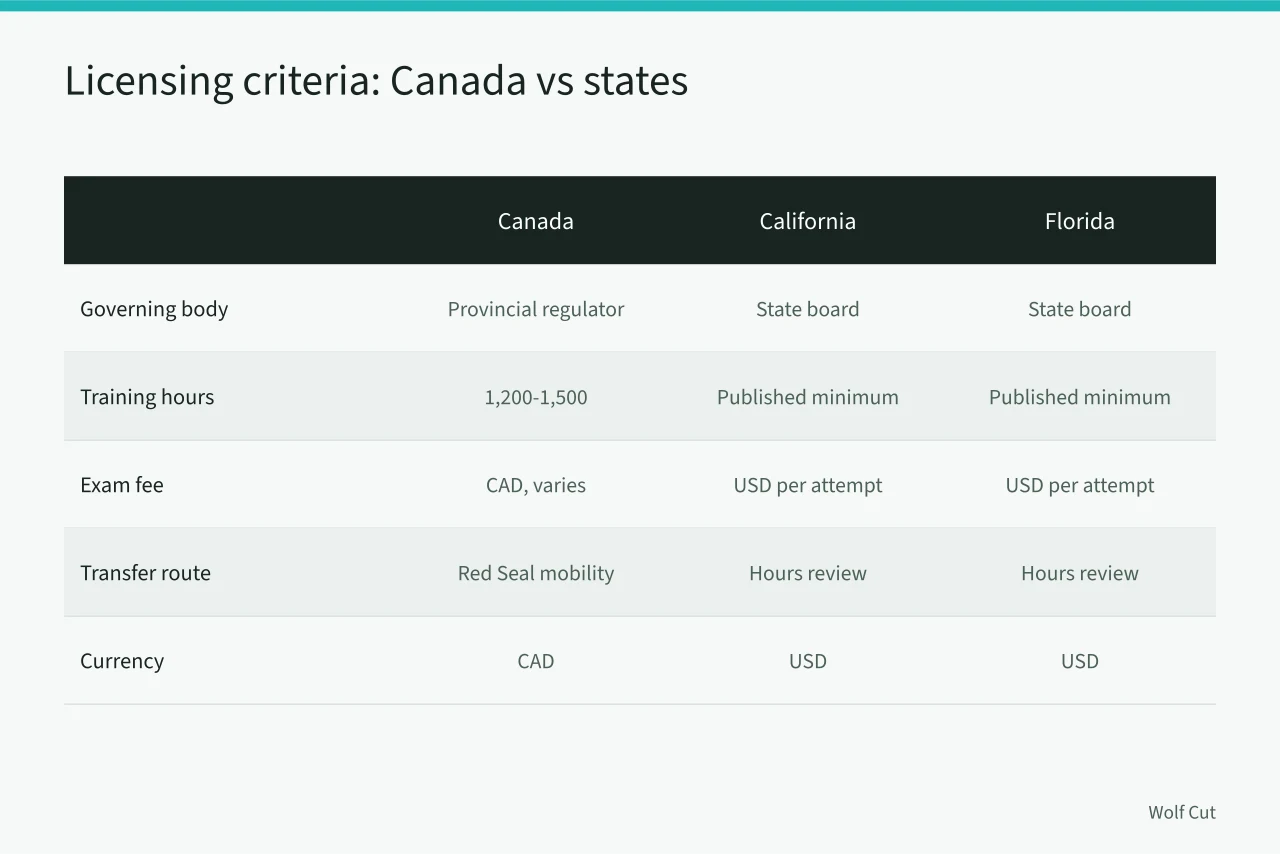
| Criterion | Canada (provincial plus Red Seal) | California | Florida |
|---|---|---|---|
| Governing body | Provincial regulators; Red Seal administered through the provinces and territories | Board of Barbering and Cosmetology | Department of Business and Professional Regulation |
| Training hours | Quebec's Coiffure diploma about 1,935 hours; Ontario apprenticeship commonly about 3,000 | 1,600 hours at an approved school | 1,200 hours at an approved school |
| Exam fee | Provincial exam fees, commonly $100 to $300 CAD | Exam and licensing fees published in USD | Exam and licensing fees published in USD |
| Transfer route | Provincial recognition and Red Seal mobility | Board application, transcript hours review | Board application, transcript hours review |
| Currency of cost | CAD | USD | USD |
Provincial counts are not uniform. Quebec's hairdressing diploma, the DEP in Coiffure, is commonly listed at about 1,935 hours. Ontario's hairstylist apprenticeship is commonly cited at about 3,000 hours.
British Columbia and Alberta set their own apprenticeship hours, commonly in the 2,000 to 3,000 band. Manitoba and Saskatchewan certificates typically land between 1,500 and 2,000 hours.
Each province also decides how much of that time is on the job and how much is classroom. A Red Seal endorsement says nothing about your total until a board reads the transcript.
US minimums drift the same way. California and Washington each require 1,600 hours, Texas and Illinois 1,500, and Florida 1,200. New York asks for 1,000 hours, the lowest in this set.
Fees sit in different currencies. Provincial certificate exams commonly cost $100 to $300 CAD. State board exams commonly cost $50 to $200 USD per attempt, with licensing and fingerprint fees on top.
Both countries revise these numbers, and a program can be rebuilt between your enrolment and your application. Confirm the current figure with the provincial regulator or the state board before you pay for anything.
Ontario against California and Florida
Ontario issues its own certificate of qualification, and its hairstylist hours sit inside an apprenticeship commonly listed at about 3,000 hours. California's Board of Barbering and Cosmetology asks for 1,600 cosmetology hours at an approved school before you sit its exam.
The two totals rarely line up, which is where transfer applications stall. California counts specific subjects inside those hours, so a longer Ontario program can still show a gap.
Florida runs a similar shape: 1,200 approved school hours, a board exam and a fee. Neither state promises to accept a Canadian program hour for hour. Boards review transcripts, and a shortfall means more school.
A Red Seal certificate proves a Canadian standard. It does not replace a state license, and no US board is obliged to treat it as one.
If you are still deciding whether the trade is worth the paperwork, the same arithmetic shows up in wolf cut upkeep cost in Chicago, where cut frequency and product spend decide the real annual figure.
Where each route wins
Staying in Canada wins on mobility. A Red Seal endorsement is built for moving between provinces, and provincial recognition is the normal path. For that side of the trade, the Government of Canada's job training and certification resources set out how apprenticeship and certification fit together.
What transfers is the provincial certificate and the Red Seal, and both work between Canadian provinces. What does not transfer is the Red Seal itself as a US license, or any guarantee that a provincial hour count will be credited hour for hour.
California wins if you already have family, work or a client base in the state. Its board publishes its own requirements, and the exam is the gate. Florida wins on the same logic for readers heading to the southeast, with its own board and fee schedule.
The state you pick sets the number you have to reach. New York asks for 1,000 hours, Texas and Illinois 1,500, California and Washington 1,600.
A US move makes sense when you have a concrete reason to be in one state. A vague plan to work anywhere in America runs straight into fifty different rulebooks.
The Bureau of Labor Statistics occupational outlook is the place to check US employment and wage context before you commit to a state.
What none of them solve
No credential, Canadian or American, guarantees a chair. Hours and exams prove you met a standard. They say nothing about rent, chair leasing, insurance or whether a salon will hire you at the rate you need.
None of the systems solve the currency problem either. Exam fees, school costs and moving expenses land in different currencies, and the Canadian dollar moves against the US dollar between the day you budget and the day you pay.
- Confirm the provincial regulator's current hour requirement in writing.
- Request official transcripts sealed for the state board.
- Check the target state board's hour minimum and fee before booking anything.
- Ask the board which subject hours it counts, since the total alone can mislead.
- Budget for a possible top-up course if hours fall short.
- Convert the fee and course costs at a rate you check on the day you pay.
Example: a Toronto stylist looking at California
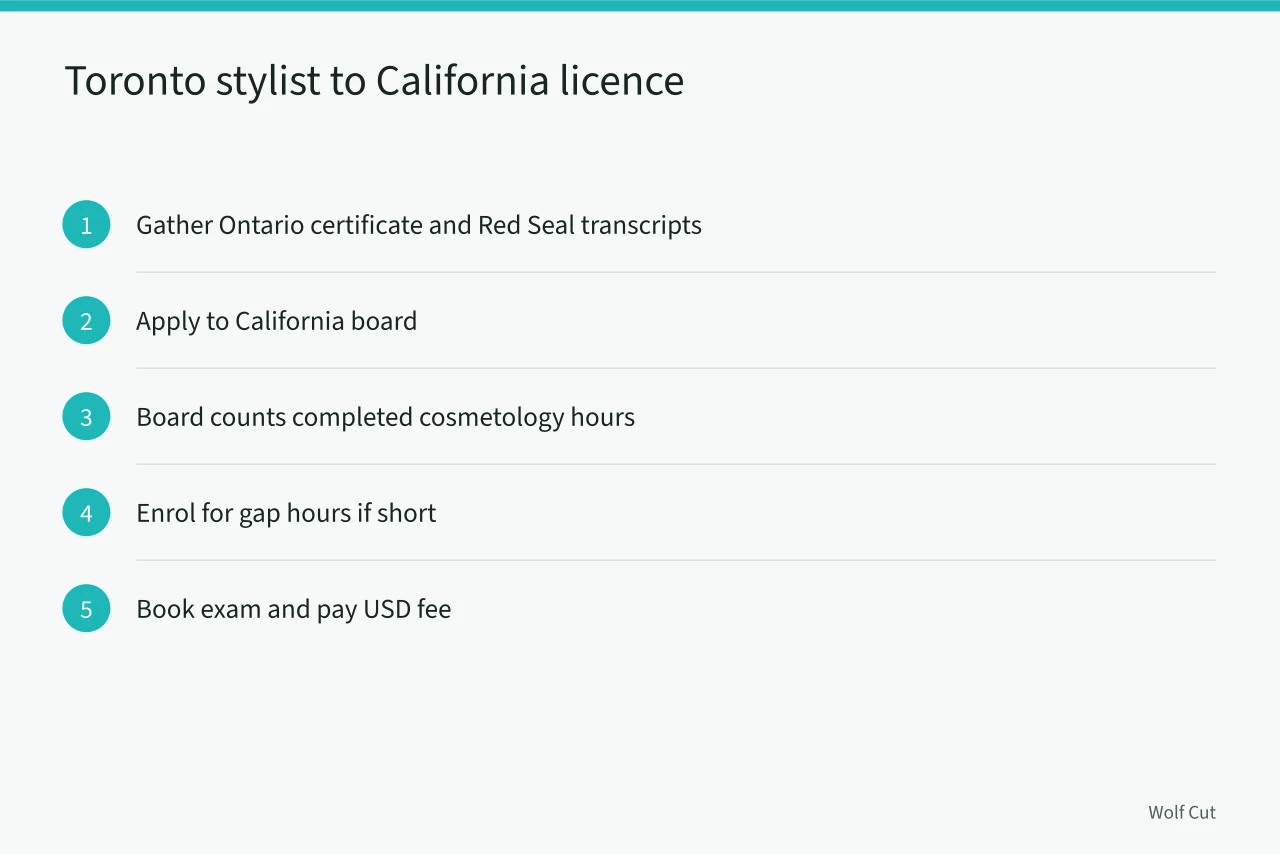
A stylist with an Ontario certificate and a Red Seal gathers transcripts and applies to California's board. The board counts completed cosmetology hours against its 1,600 hour minimum.
If the Ontario program covered fewer hours in the subjects the board counts, the stylist enrols for the difference, then books the exam and pays the USD fee.
The Red Seal helped with the paperwork story but did not shorten the process. The stylist's real cost was the gap hours plus the exam fee, not the Canadian credential.
Common questions
Does a Red Seal let me work in the US?
No. It is a Canadian interprovincial endorsement. A US state board issues its own license, and you apply to that board directly.
Do California and Florida accept Canadian hours?
They review transcripts against their own minimums. California's is 1,600 hours and Florida's is 1,200. Some Canadian hours may count, and a shortfall usually means additional approved schooling.
Which Canadian provinces have the highest hour requirements?
They differ, and they change. Quebec's Coiffure diploma is commonly listed near 1,935 hours and Ontario's apprenticeship near 3,000. Confirm the figure with your provincial regulator, because there is no single Canadian number.
Is the exam fee the same in both countries?
No. Canadian provincial fees are charged in CAD, commonly $100 to $300, and US board fees in USD, commonly $50 to $200 per attempt. Compare them after converting at a rate you check on the day.