Guides
Razor cutting a wolf cut: when it pays off and when it thins too much
Razor cutting a wolf cut works when the blade slides through wet, supported sections. Over-thinning shows up weeks later as see-through ends and lost density.
What to take away
- Razor cutting a wolf cut works on wet, tensioned sections where the blade slides down the strand at a shallow angle. It fails on dry, unsupported hair.
- The check is visible: lift a finished section and look for a soft tapered edge, not a see-through gap.
- Over-thinning from a razor shows up weeks later, so cap the number of razor passes per section.
- Cosmetology licences in most US states permit razor work, and state boards require disinfection steps that social media tutorials skip.
- Hand the job to a professional when the hair has been lightened, relaxed or chemically straightened within the past few months.
What has to be true before the first step
A razor removes weight by shaving hair at an angle rather than cutting it square. That makes it fast for a wolf cut, which needs soft internal layers and a tapered perimeter. It also makes it unforgiving.
The hair must be wet and coated. Water swells the cuticle and a light conditioner lets the blade glide. Dry razor work grabs and tears. The client should arrive with hair washed within the last day and no heavy styling product left in.
You need a fresh blade. A dull straight razor pulls rather than slices, and pulling is where frizz starts. Many US state cosmetology boards treat razors as implements that must be cleaned and disinfected between clients, the same as shears and combs. The overview of cosmetology licensing explains how those training hours and rules are structured.
The sequence
- Section the hair into a center part and two side panels, then clip the top away. Work the bottom layers first.
- Take horizontal subsections no wider than the razor blade. Comb each one smooth and hold it between two fingers.
- Place the razor at roughly a 30 degree angle to the strand and draw it down in one steady stroke. Do not saw back and forth.
- Repeat once per subsection for softness. Stop at two passes unless the section is unusually thick.
- Move up through the layers, then take the top section last so you can see the shape as it falls.
- Cross-check the perimeter and the face-framing pieces with shears to close any split ends the razor opened.
The step that decides the result
The angle of the blade decides everything. A shallow angle, close to parallel with the strand, shaves a long taper and keeps bulk. A steep angle bites into the section and removes a wedge of hair at the root end.
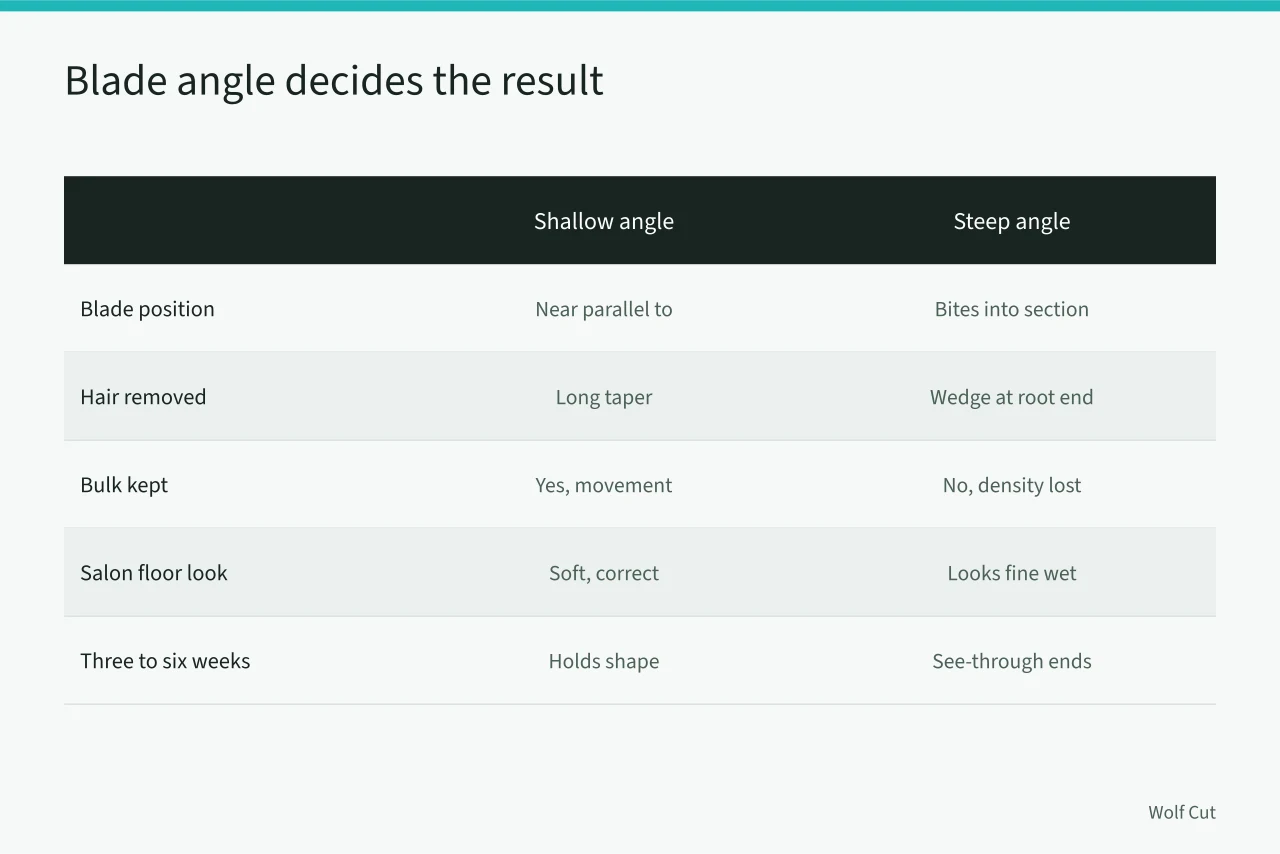
That wedge is where over-thinning starts. It does not look wrong on the salon floor because the hair is wet and clumped. It looks wrong three to six weeks later, when the shortened strands spring up and the ends read as see-through.
Razor work removes weight permanently. There is no product that puts density back into a section you shaved too hard.
If the client wants movement rather than volume loss, keep the angle shallow and take fewer passes. The razor cut reference covers how the blade interacts with texture and volume.
How to check each step came out right
Lift a finished subsection and hold it against the light. You should see a soft, feathered edge with no distinct gap. A gap means you cut too deep and the section needs blending with the surrounding hair.
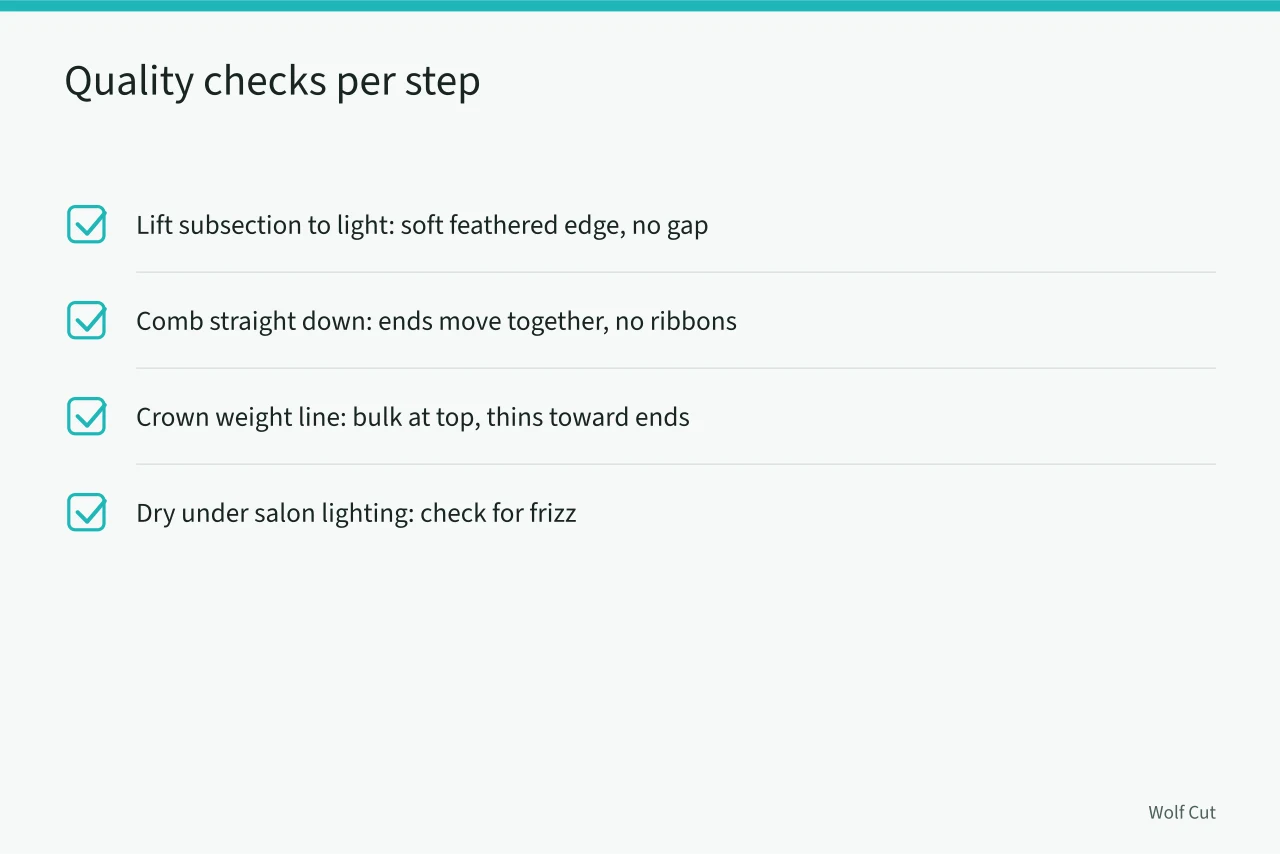
Comb the section straight down and let it fall. The ends should move together, not separate into thin ribbons. Ribbons are the visible sign of over-thinning.
Check the weight line at the crown. A wolf cut keeps bulk at the top and thins toward the ends. If the crown feels light under your fingers, you have gone too far up the head with the razor.
Finally, dry the hair and look at it under salon lighting. Wet checks catch structure. Dry checks catch frizz, and frizz is the second symptom of a blade that pulled.
What to do when a step goes wrong
Over-thinned sections are the common failure. The named recovery is blending: take the surrounding hair and slide-cut it with shears to meet the thinned section, then soften the transition with point cutting. You cannot restore the removed hair, but you can hide the gap inside a softer shape.
If the razor pulled and left frizz, stop razor work on that section. Switch to shears for the rest of the cut and finish with a light serum on the ends only.
If the perimeter went ragged, do not chase it with the razor. Close it with a blunt shear line and accept a slightly shorter length. Chasing a ragged edge with a blade removes more hair each time.
- Blade changed or disinfected before the client sat down
- Hair wet and coated, not dripping
- No more than two razor passes per subsection
- Dry check done under salon lighting before the client leaves
When to stop and hand it to a professional
Stop and refer out when the hair has been bleached, relaxed or thermally straightened within the past few months. Chemically processed hair has a weakened cortex and a razor can shred it. The explanation of hair thinning sets out how cuticle damage and density loss interact.
Refer out when the client has active scalp irritation, a recent chemical burn, or visible breakage at the mid-lengths. A razor on compromised hair turns a styling appointment into a repair job.
Refer out when you cannot see the section clearly, which usually means the hair is too fine or too short to hold between your fingers. Fine hair gives you one pass at most, and a second pass is the difference between a soft wolf cut and a thin one.
Common questions
Does a razor thin hair more than shears?
Yes, when used at a steep angle. A razor shaves hair at an angle rather than cutting it square, so it removes weight faster and leaves a tapered end. At a shallow angle the difference is smaller.
Are razors legal under a US cosmetology licence?
In most states, yes. State boards regulate razors as implements and require cleaning and disinfection between clients. Requirements vary by state, so check your own board's rules.
How soon does over-thinning show up?
Usually three to six weeks after the cut, once the shortened strands lift and the ends separate. On the day of the cut the hair still looks full because it is wet and clumped.
Can a razor be used on curly hair?
It can, but only on wet, well-coated sections and with fewer passes. Curl pattern hides gaps when wet and reveals them when dry, so the dry check matters more.