Guides
Wolf cut for thick wavy hair: thinning strategy for humid US cities
Wolf cut thick wavy hair thinning in humid US cities means removing bulk without killing movement. Here is what Atlanta humidity rules out and what still works.
What to take away
- Atlanta averages roughly 70 to 75 percent relative humidity across summer, and that is the number that governs how much bulk you can safely remove.
- Above about 60 percent indoor humidity, a heavily thinned wavy wolf cut collapses into frizz within a day. Thinning is a tool for dry air, not wet air.
- What works instead: internal slide cutting, perimeter weight left intact, and a dry finish that keeps the S pattern.
- A workable Atlanta budget runs $65 to $140 for the cut and $18 to $45 per month on products, labelled illustrative.
- When two corrective appointments fail to hold shape, stop thinning and rebuild the shape on wet cutting alone.
The constraint in measurable terms
Humidity is the limit, and it is measurable. The National Weather Service reports Atlanta summer dew points commonly between 65 and 72 F. Relative humidity indoors sits near 60 percent or higher without a dehumidifier.
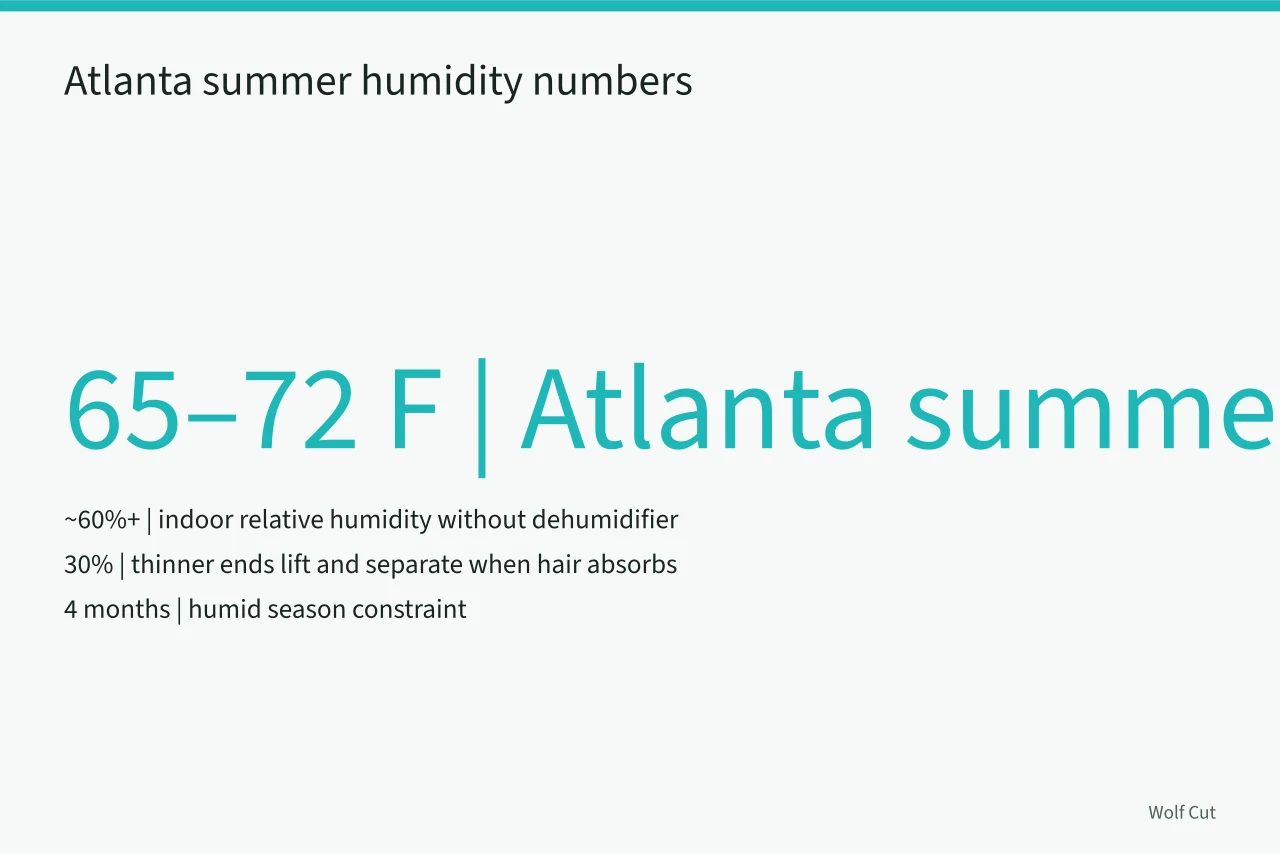
Hair is hygroscopic, meaning it takes water from the air and swells. The physics of humidity explains why a strand that is 30 percent thinner at the ends will lift and separate once it absorbs that moisture. Thinning removes the mass that holds a wave together.
So the constraint is this: in a city where the air carries that much water for four months, you can remove bulk only where the hair still has neighboring strands to lean on.
What the constraint rules out
A full thinning-shear pass through the mid-lengths is out. So is a razor finish on the interior of a wavy wolf cut.
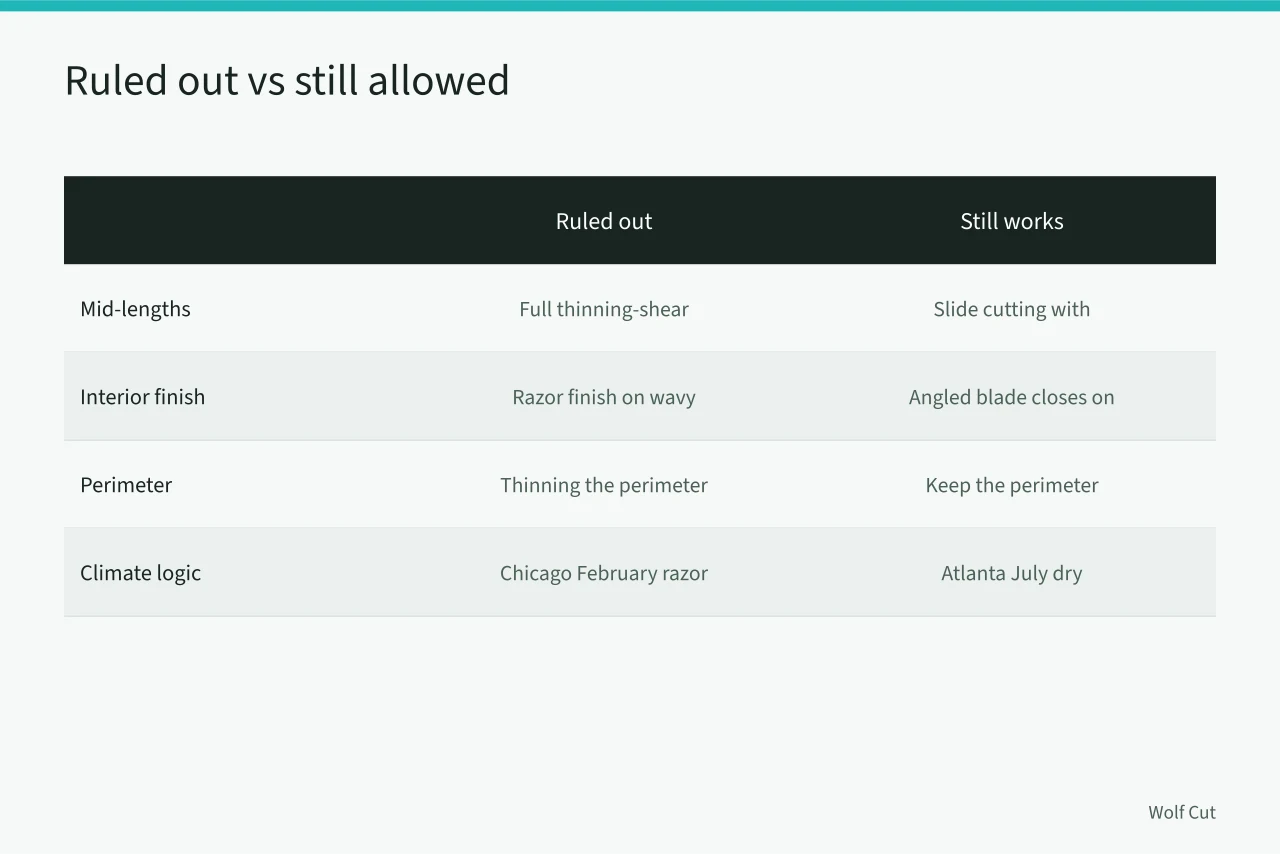
Both remove the same thing: the density that keeps a wave from turning into a cloud. A stylist who razors a thick wavy wolf cut in Chicago in February can get away with it. In Atlanta in July, that cut is a frizz helmet by the second wash.
The razor cut page is worth reading before you argue with your stylist about it. Razor work opens the cuticle and shortens strands unevenly, which increases surface area and therefore water uptake.
That is not a style opinion. It is arithmetic on how much fiber is left to carry the shape.
What still works in Atlanta humidity
Slide cutting with shears does the job thinning shears cannot. The blade stays angled and closes on the strand, so the cut end sits inside the shape rather than on top of it.
Keep the perimeter. A wolf cut's identity is the contrast between short crown layers and long back length. If you thin the perimeter, you lose the silhouette and gain frizz.
Work dry for the final 20 percent. Wet cutting hides the wave pattern. Dry refinement shows exactly which sections will lift once the air gets heavy.
Book the cut for a morning slot in summer. Hair that was styled at 9 a.m. and photographed at 9 a.m. tells you nothing about how it behaves at 4 p.m.
For a fuller account of how a razor behaves on a wolf cut, see razor cutting a wolf cut before you agree to any blade work.
A workable Atlanta routine
- Wash with a sulfate-free cleanser twice a week, no more.
- Apply leave-in to soaking wet hair, then a light gel, and scrunch once.
- Diffuse on low heat until 80 percent dry, then stop and let the rest air dry.
- Refresh on day two with water and a pea-sized amount of cream, not with more gel.
- Book a dry shape check every 8 to 10 weeks, not a full re-cut.
- Leave-in conditioner with glycerin low on the list
- Light-hold gel, not a hard-cast one
- Microfiber towel or cotton T-shirt
- Dehumidifier for the bedroom if you air dry overnight
The compromises not worth making
Do not let a stylist thin the crown to reduce volume. That is where the wolf cut gets its lift, and thinning there flattens the top while leaving the sides puffy.
Do not accept a blunt one-length cut as a substitute. It removes the humidity problem by removing the style. You will get a heavy, flat shape that takes 40 minutes to dry.
Do not buy a home thinning razor. The hair thinning overview covers why density loss is hard to reverse, and a $12 tool is not worth the regrowth wait.
If a salon quotes under $50 for a thick wavy wolf cut in Atlanta, ask what is being left out. Cut and finish for this density usually runs 75 to 90 minutes.
When to stop and do it properly
Two failed shape checks is the threshold. If the cut collapses by mid-afternoon twice in a row, more thinning will not fix it.
At that point the answer is a rebuild: grow out the thinned sections for 10 to 14 weeks, then cut the whole shape wet to a single interior line and refine dry. That costs one full appointment, roughly $95 to $160 in Atlanta, labelled illustrative.
BLS wage data for barbers, hairstylists and cosmetologists shows why senior stylists charge more, and why the rebuild is worth paying for once rather than patching monthly.
If you are choosing a salon tier, what a wolf cut costs in Los Angeles shows how the same density problem prices out in a drier market.
Common questions
Does thinning shears always ruin a thick wavy wolf cut? No. Used only on the last two inches of the ends and never in the crown, they remove weight without opening the interior. The problem is mid-length passes, which is what most quick cuts do.
How often should a thick wavy wolf cut be re-cut in Atlanta? Every 10 to 12 weeks for a full shape, with a dry check at 8 weeks. Humidity does not speed growth, but it does speed the loss of definition.
Is a dehumidifier worth it for hair? For air drying overnight, yes. Dropping bedroom humidity from 65 to 45 percent changes how a wavy wolf cut sets, and the unit costs $150 to $250, labelled illustrative.
Can I wear a wolf cut with thick wavy hair in July? Yes, with a lighter interior and a firmer gel cast. Expect more shrinkage and a rounder shape than you get in winter, and cut for that shape rather than against it.