Guides
Booth renter hairstylist insurance in Ontario: what it costs and actually covers
Hairstylist booth renter insurance Ontario costs roughly $350 to $1,400 a year, and FSRA rules decide what a policy must actually cover for chair renters.
What to take away
- A booth renter in Ontario typically pays between $350 and $1,400 a year for commercial general liability, with most solo stylists landing near $500 to $800.
- FSRA regulates insurance in Ontario, not salons. Your chair licence is a municipal matter; your liability cover is a private contract you buy yourself.
- The standard policy covers third-party bodily injury and property damage. It does not cover your tools, your lost income, or a client's scalp reaction unless you add treatment liability.
- The biggest premium driver is your annual service revenue, followed by whether you do chemical services and whether you carry your own contents cover.
What the range covers
A booth renter is not an employee. You rent the chair, you invoice your own clients, and the salon's own policy will not answer for your work. That single fact is what you are buying against.
Commercial general liability for a self-employed stylist in Ontario is a small policy by commercial standards. It exists to pay a claimant, and to pay a lawyer to defend you, when someone says your cut, colour or chemical service hurt them or damaged their property.
Ranges below are illustrative for a solo stylist working two to five days a week in a rented chair. Actual quotes move with your answers, not with the market average.
Show the numbers
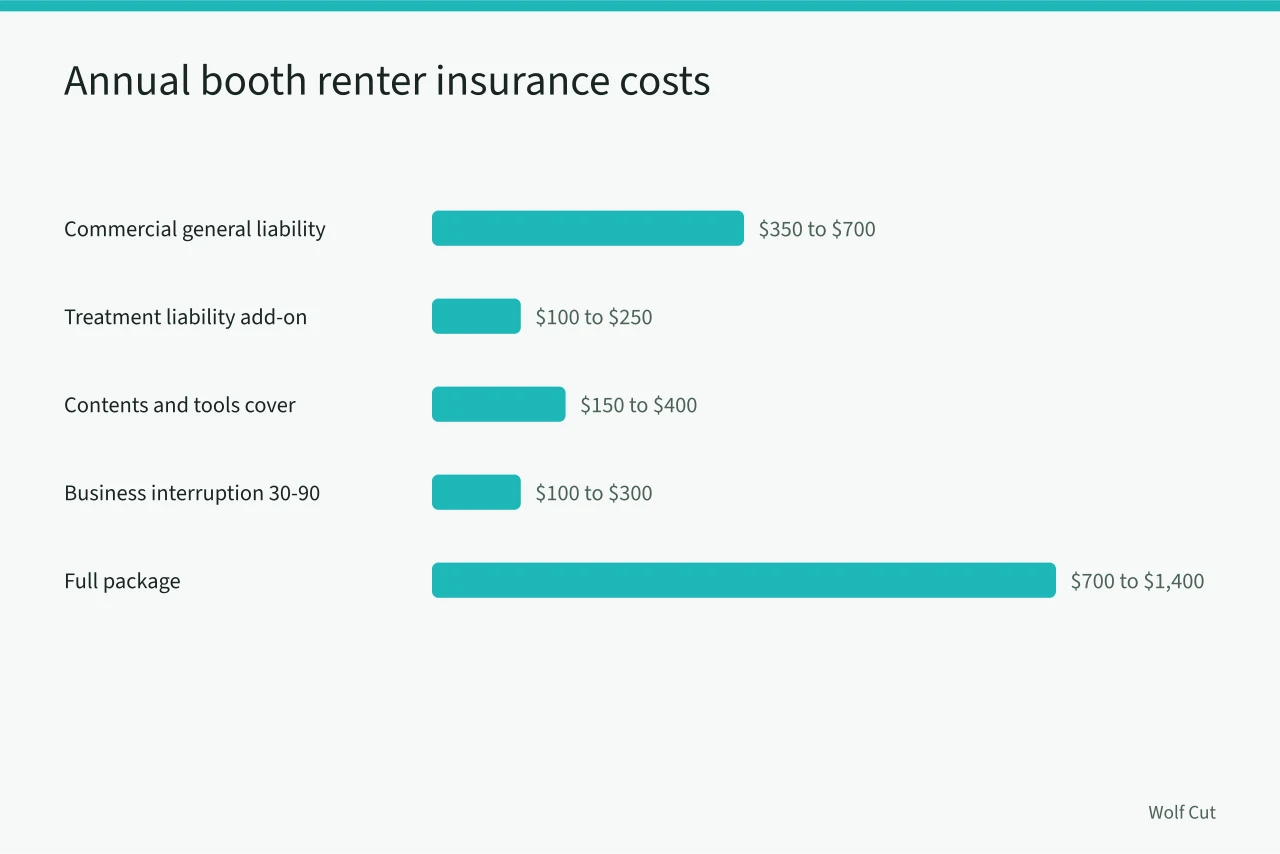
| Commercial general liability, $2M limit | $350–$700 |
|---|---|
| Treatment or professional liability add-on | $100–$250 |
| Contents and tools cover | $150–$400 |
| Business interruption, 30 to 90 days | $100–$300 |
| Full package, all of the above | $700–$1,400 |
General insurance works on the same principle whether you sell haircuts or hardware, which is why the mechanics of indemnity and limits are worth ten minutes before you sign anything.
Line by line
Commercial general liability is the base. It responds to a client who slips on wet floor near your station, or whose coat is ruined by colour. A $2 million limit is the common ask from landlords and from salons that want proof on file.
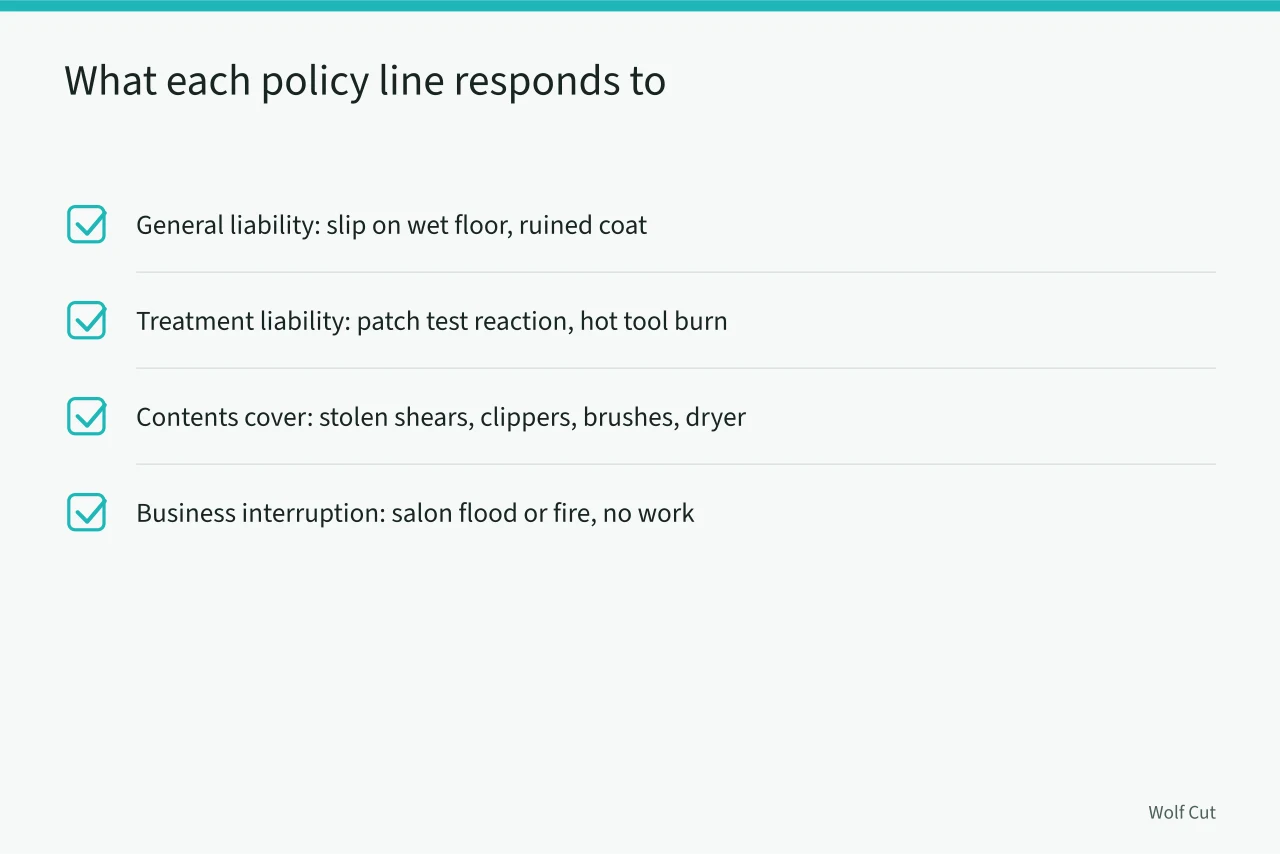
Treatment liability, sometimes sold as professional liability, is the part that responds to the service itself. A patch test reaction, a burn from a hot tool, an allergic response to developer. Many entry-level policies exclude this by default, and it is the exclusion that catches stylists.
Contents cover replaces your shears, clippers, brushes and dryer if they are stolen from the salon overnight. If you carry $3,000 of tools between three locations, this is not optional.
Business interruption pays a weekly amount if the salon floods or burns and you cannot work. Thirty to ninety days is the usual window.
What moves the number
Three things change a quote more than anything else.
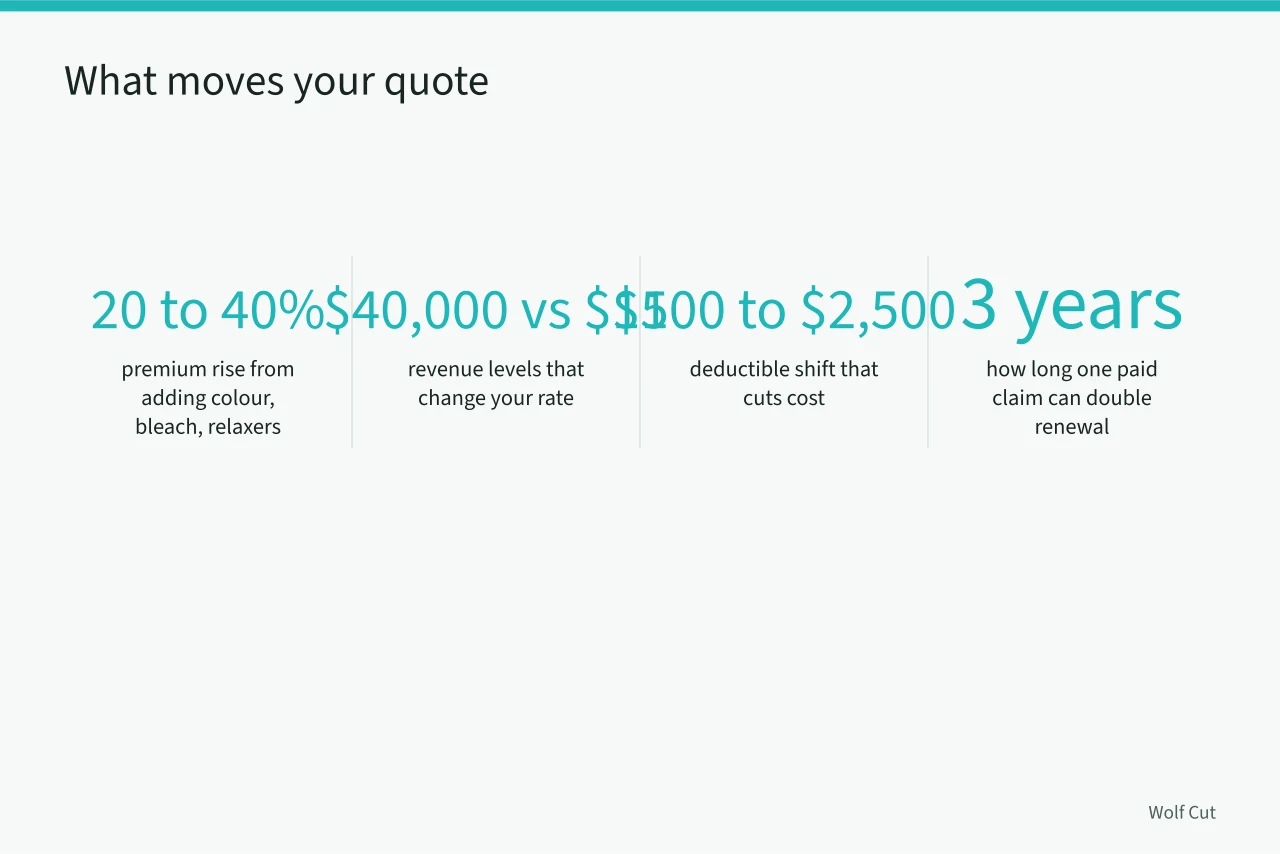
- Annual revenue. A stylist billing $40,000 gets a lower rate than one billing $110,000, because the exposure scales with client volume.
- Service mix. Adding colour, bleach and relaxers raises the premium, often by 20 to 40 percent, because chemical injury claims are the expensive ones.
- Limit and deductible. Moving from $1 million to $2 million adds cost; raising your deductible from $500 to $2,500 cuts it.
A fourth factor is claims history. One paid claim can double a renewal for three years.
What quotes leave out
Read the exclusions page before the price page. Common gaps include work performed outside the salon, mobile or house-call services, and any treatment on a client under 18 without written consent.
The salon's own insurance is a separate document. Ask the owner for a certificate of insurance and check whether you are named. If you are not, their policy is not your policy. The same logic applies to any regulated trade where the operator carries the risk, as UK salon licensing and HSE rules illustrate for readers comparing jurisdictions.
A certificate of insurance proves cover on the day it was issued. Ask for a new one at every renewal, not once at signing.
If you are still deciding how to structure your chair arrangement, how UK council licensing and HSE rules shape salon hygiene is a useful contrast for anyone weighing a move between markets.
Where people overspend
Buying the salon owner's recommended broker without comparing is the most common waste. Two or three quotes on identical limits usually spread by $200 or more.
Paying for a $5 million limit when your lease and your salon both ask for $2 million is money spent on nothing. Match the limit to the contract.
Skipping contents cover to save $200, then replacing $3,000 of tools out of pocket, is the other classic. For stylists building a pricing model around chair rent, the same discipline applies as in Leeds and Liverpool, how student demand shapes wolf cut salon pricing, where every fixed cost has to be earned back per client.
Common questions
Does FSRA require me to hold insurance as a booth renter?
FSRA regulates insurers and agents in Ontario, not individual stylists. The requirement usually comes from your salon lease or your municipal business licence, not from FSRA directly.
Is my salon's policy enough?
No. It covers the business and the owner. Your services, your tools and your client relationships are your exposure, and you need your own policy naming you as insured.
How fast can I get a certificate?
Most Ontario brokers issue a certificate the same day once payment clears. Landlords and salons normally want it before your first shift, so start the quote a week ahead.
Does it cover me at a second salon?
Only if the policy lists both locations. Working at an unlisted address is a standard exclusion, and it is the one that voids a claim after the fact.