Reviews
Part of Sectioning through dry refinement: a scissor haircutting guide
Blunt, point, slide and channel cutting compared by control and risk
Blunt, point, slide, and channel cutting compared by edge, separation, control, suitable hair conditions, tool movement, failure risks, and design purpose.
What to take away
- Blunt cutting builds a direct edge; point cutting breaks or softens that edge.
- Slide and channel cutting remove or separate hair along length, so control matters.
- Technique should answer a design problem, not decorate a finished cut.
- Sharp tools, fiber condition, tension, and hand path change the result.
- Test a low-risk area before using a new depth or motion broadly.
These techniques describe how scissors meet the hair. They do not determine elevation, distribution, or overall structure by themselves. The same point-cut edge can sit on a heavy one-length perimeter or a light interior layer. Structure is decided first, as haircut design fundamentals sets out.
Side-by-side view
| Technique | Blade relationship | Main visual effect | Common risk |
|---|---|---|---|
| Blunt or club cut | Across the section | Strong, direct line | Pushing hair or creating a hard shelf |
| Point cut | Tips enter the ends | Broken or softened edge | Deep holes and weak ends |
| Slide cut | Blades travel along length | Gradual length and density release | Dragging, tearing, or uncontrolled removal |
| Channel cut | Narrow pathway cut into a section | Internal separation or channels | Visible gaps and collapse |
Blunt cutting
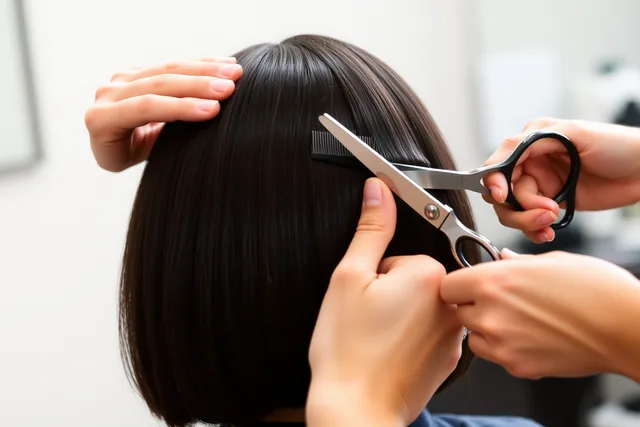
Blunt cutting uses a direct line across the held or naturally falling section. It can form a strong perimeter, establish a guide, or create a precise geometric edge. The result depends on tension, finger angle, head position, and whether the hair is cut in natural fall or elevated.
Use well-maintained blades and controlled sections. A dull shear may push fibers away from the intended line. Check around ears and hairlines with reduced tension. The wider control chain is covered in the scissor haircutting guide.
Point cutting
Point cutting places the tips into the ends at a chosen angle and depth. Shallow, closely spaced points soften an outline. Deeper or wider points can create more visible separation and reduce weight.
Do not treat point cutting as an automatic finishing step. On a fine or fragile perimeter, deep points may make the edge look sparse. On dense, straight hair, inconsistent depth can create teeth rather than softness.
England's Advanced and Creative Hair Professional standard names point cutting, slide cutting, channel cutting, slicing, graduation, layering, thinning, and precision edges as distinct methods within personalized cutting. Their separation in the standard reflects a practical truth: they create different effects and need deliberate selection.
Slide cutting
Slide cutting moves partially open blades along the hair while controlling the section. It can create a gradual length transition, face-framing movement, or internal release. The blades should glide rather than clamp, scrape, or pull.
Avoid sliding through compromised, highly tangled, or very elastic hair without a suitable test. On curl the working state changes the test, which is why wet, dry, and stretched cutting are compared separately. Keep the working hand, blade opening, direction, and pressure consistent. One uncontrolled pass can remove more than several small point cuts.
Channel cutting
Channel cutting creates selected pathways inside a section, often from an interior point toward the ends. It can separate a dense shape without changing every strand. The entry point, depth, width, direction, and spacing determine whether the result moves or looks perforated.
Map channels to the planned finish. Do not cut them blindly under the surface. Release and move the hair after each small set.
The Australian training register's unit for combined haircut structures lists blunt cutting, pointing, notching, slicing, tapering, scissor-over-comb, and razor methods while requiring multiple structures and pre-service analysis. That context matters: a cutting action earns its place by supporting the structural plan and the observed hair.
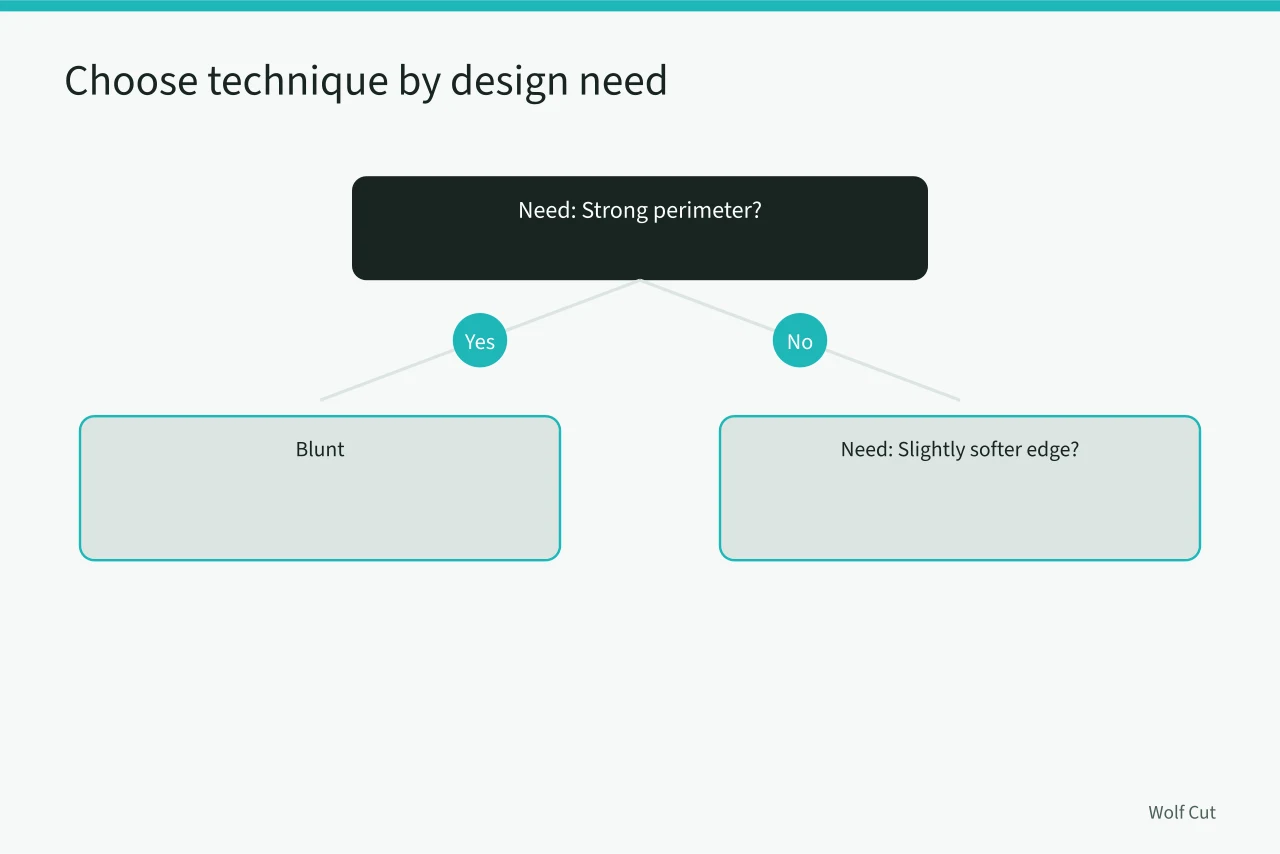
Choose by design need
| Need | First option to assess | Question before proceeding |
|---|---|---|
| Strong perimeter | Blunt | Will natural movement disturb the line? |
| Slightly softer edge | Shallow point | Can the perimeter spare the density? |
| Gradual face movement | Controlled slide | Can the fiber tolerate the motion? |
| Internal separation | Limited channels | Where will gaps appear when hair moves? |
Technique can be combined, but sequence matters. Establish structure before removing internal density. Once hair is removed through the length, it cannot be restored during the appointment. Deciding which named layered structure is wanted therefore comes before any texture work.
Common questions
Is point cutting always softer than blunt cutting?
Not necessarily. Deep, widely spaced points can create a visibly jagged edge.
Are slide cutting and slicing the same?
Terminology varies. Define the blade motion, opening, direction, depth, and intended result rather than relying on a name.
Can channel cutting replace layers?
No. It changes internal separation; it does not automatically create the planned length relationships of a layered structure.
When should a technique be tested first?
When fiber condition, movement, density, tool sharpness, or the intended depth makes the result uncertain.