Reviews
Part of Shrinkage and density anchor this curly and coily haircutting guide
Wet versus dry curly cutting: which method controls shrinkage better
Wet, dry, curl-by-curl, and stretched cutting compared by visibility, guide control, shrinkage, tension, pattern changes, reset needs, client routine, and risks.
What to take away
- No cutting state is best for every curl pattern, design, or client.
- Wet work improves section and guide control but conceals the final occupied shape.
- Dry work displays current shrinkage but may reflect product, compression, or an old set.
- Curl-by-curl work offers local control but can lose the full silhouette.
- Stretched work clarifies length relationships but cannot predict every natural landing point.
These methods are viewing and control choices. A service can combine them if each stage has a defined purpose and the client understands which finish controls the result. The full method sits in the curly and coily haircutting guide.
Comparison table
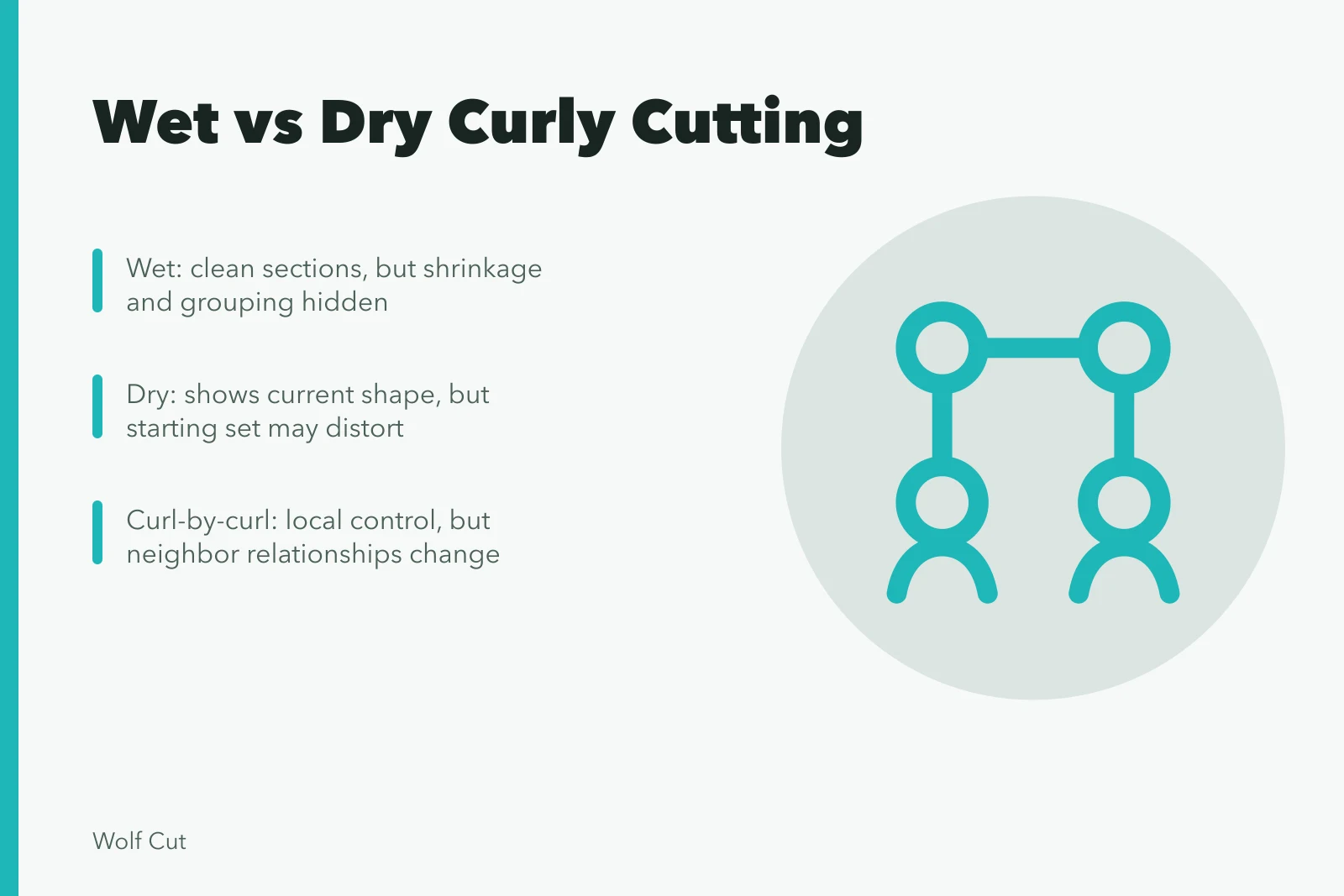
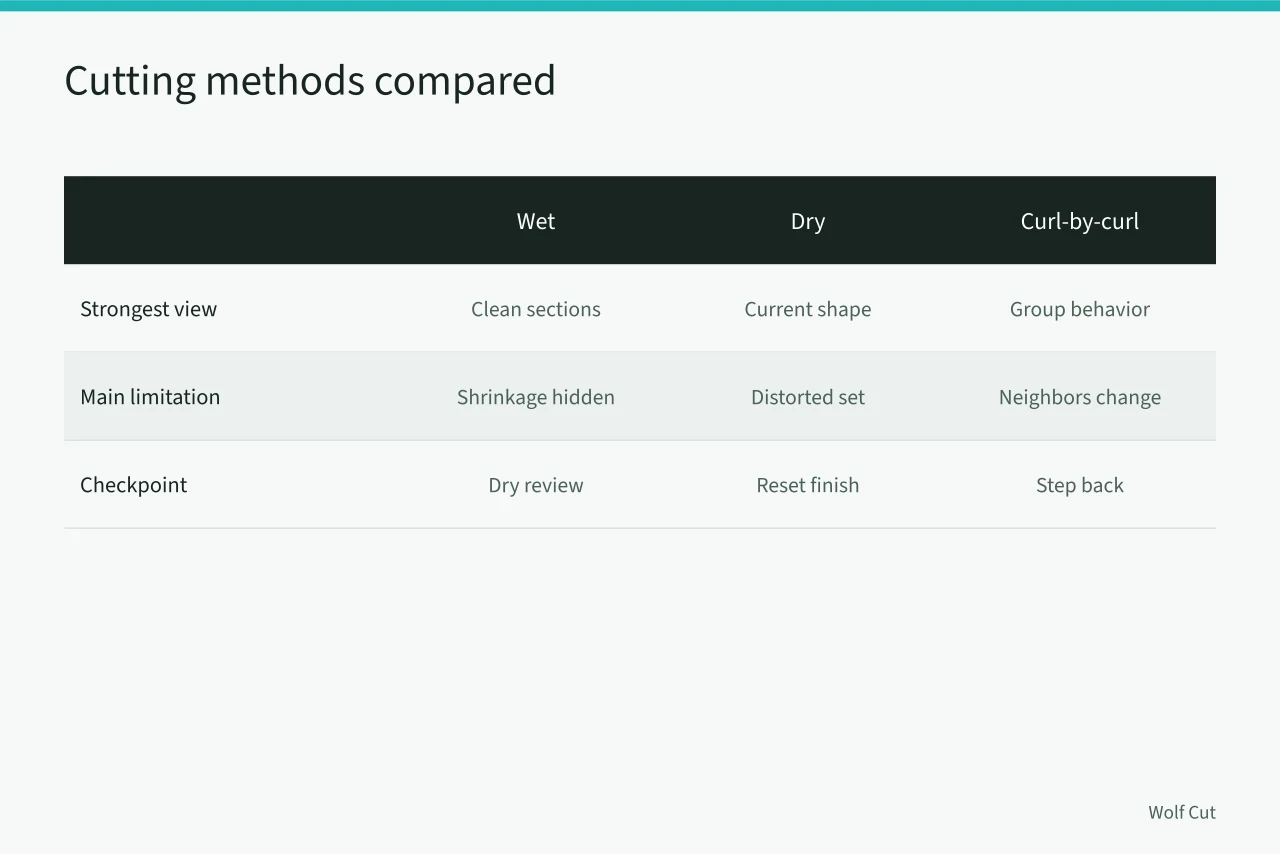
| Method | Strongest view | Main limitation | Useful checkpoint |
|---|---|---|---|
| Wet | Clean sections and guides | Shrinkage and grouping are hidden | Dry and settled review |
| Dry | Current shape and occupied space | Starting set may be distorted | Reset or second finish |
| Curl-by-curl | Individual group behavior | Neighbor relationships can change | Step back to full silhouette |
| Stretched | Extended length and internal access | Natural contraction is reduced | Release and observe by zone |
The Skills England hairdressing professional occupation map recognizes straight, wavy, curly, and very curly classifications while also requiring attention to hair characteristics, tests, contraindications, and the science of safe drying and finishing. That breadth supports adapting the method to observed hair rather than assigning one technique to a broad category.
Wet cutting
Wet hair can be divided into clean, repeatable sections. Consistent moisture and tension help a stylist establish guides, graduation, and layers. Detangling and distributing dense hair may also be easier with appropriate conditioning and control.

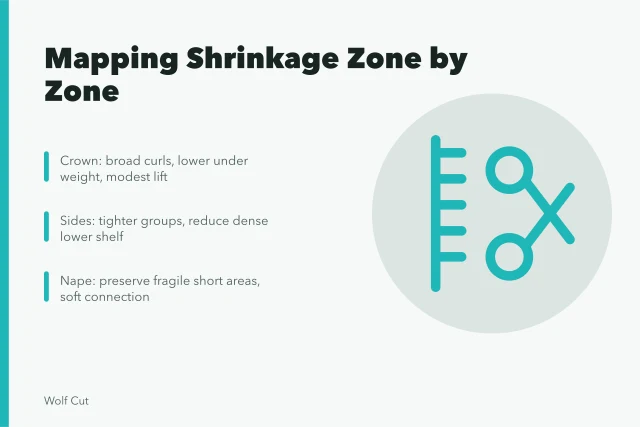
The limitation is visual. Water and tension extend curl and change grouping. A wet line does not show where the dry shape will sit. The risk rises when shrinkage varies sharply across zones or when the client wants a short fringe. A shrinkage map by zone is what makes that risk visible before cutting.
Use a wet approach when structural precision is central and the stylist has a dependable dry-check process. Set conservative lengths, keep moisture even, and review the fully settled result before declaring the shape finished.
Dry cutting
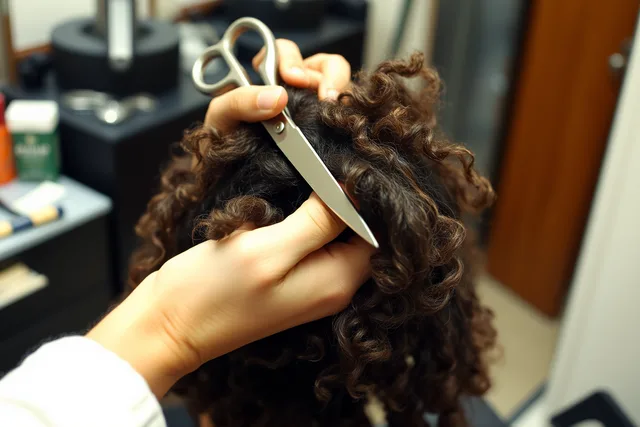
Dry work shows current width, height, grouping, and shrinkage. It can be helpful when the client wants a natural finish and arrives in a representative state. The stylist can see how small removals change the occupied silhouette.
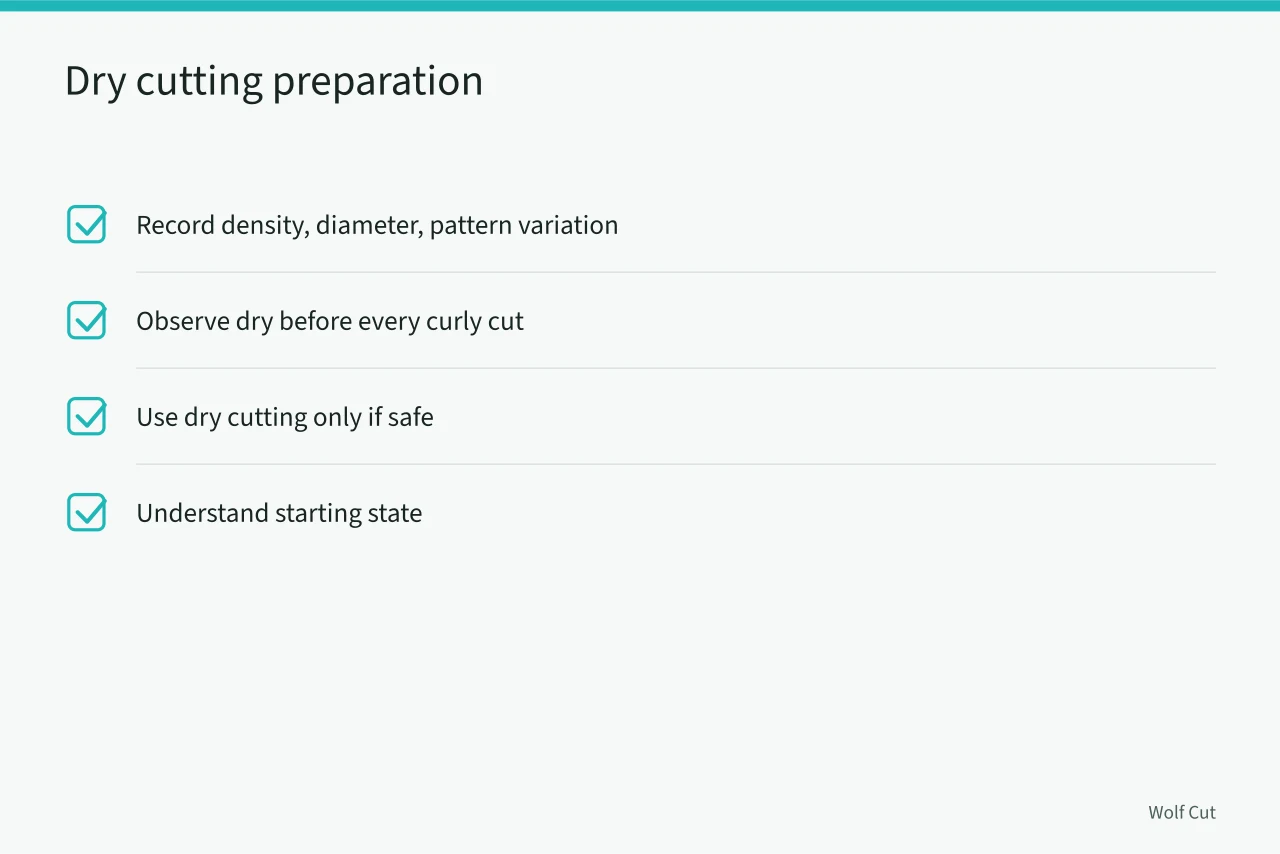
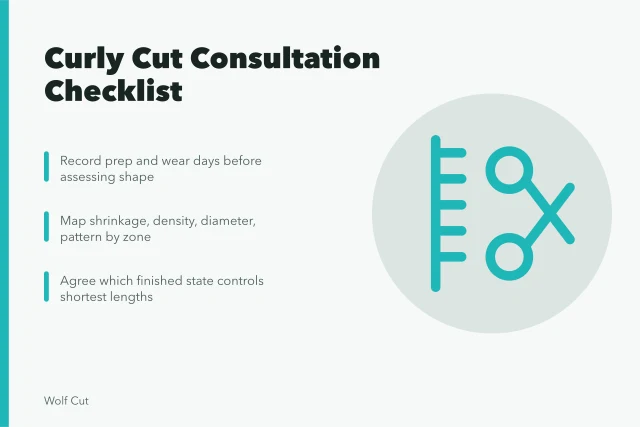
The limitation is that "dry" does not mean neutral. Product, humidity, sleep compression, banding, a twist-out, a blowout, or several days of wear may change the pattern. Tangled hair is unsafe to manipulate aggressively, and inconsistent tension can create uneven extended lengths. Record density, diameter, and pattern variation before deciding how much tension a zone can take.
Use dry observation before every curly cut, even if the technical work happens wet. The dry-informed cutting plan shows how to sequence that. Use dry cutting itself only when the hair can be handled safely and the starting state is understood.
Curl-by-curl cutting
This method treats visible curl or coil groups as local units. It can refine a perimeter, remove persistent outliers, and shape areas where conventional sections obscure the way groups sit.
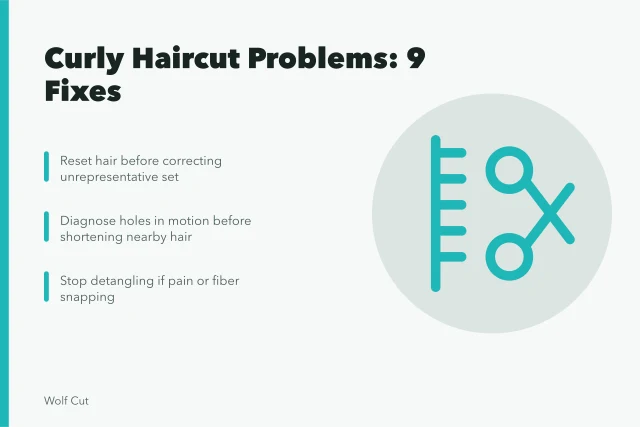
The limitation is neighborhood change. A group may divide, merge, or settle differently after washing. Trimming every visible end to match the current neighbor can create holes or a dotted outline. The cutter can also become absorbed in single curls and lose the head-wide balance.
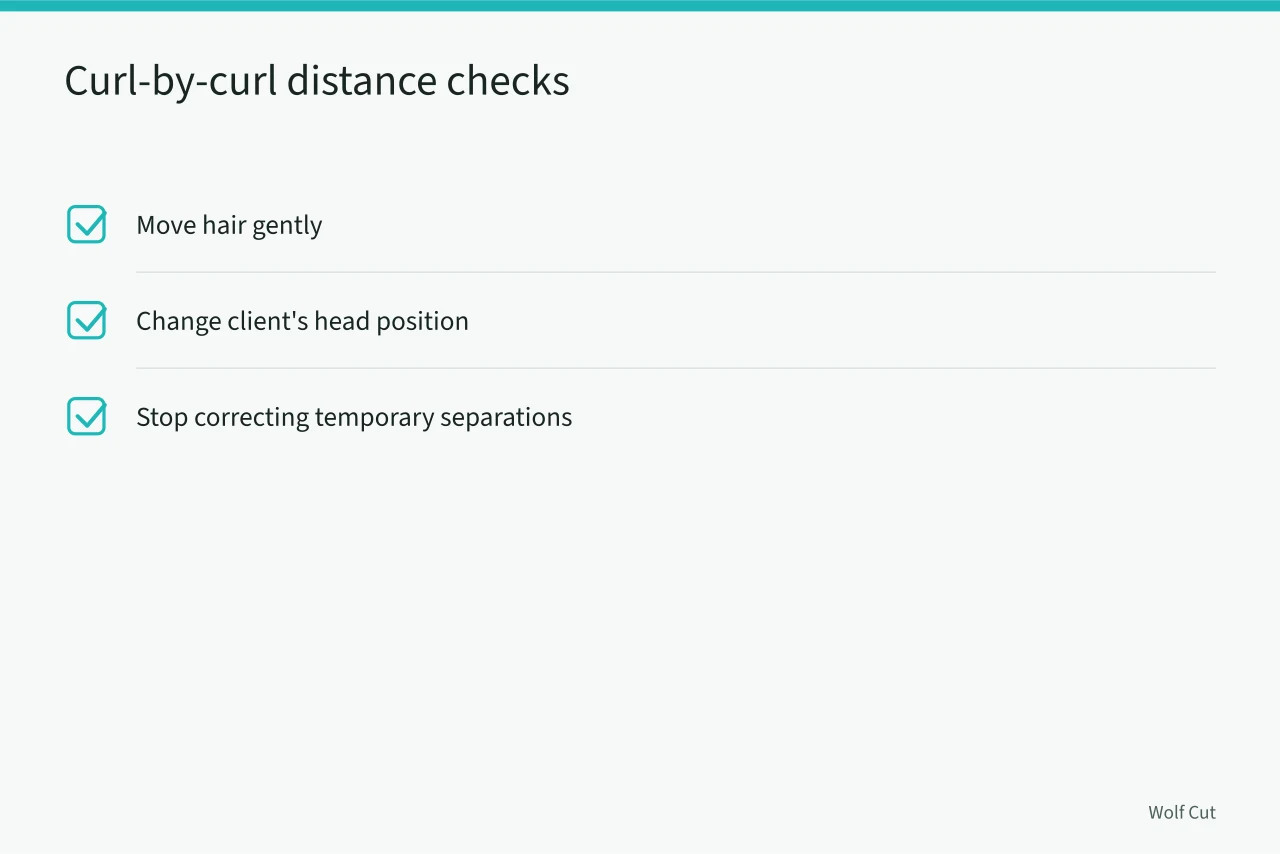
Use repeated distance checks. Move the hair gently, change the client's head position, and stop correcting temporary separations.
Stretched cutting
Stretching can reveal extended length, improve access within compact coils, and support controlled sectioning. It may be created with gentle manual extension, banding, braiding, threading, or a suitable blow-dry, depending on the client's practice and hair condition.
The limitation is that stretch suppresses natural contraction. Equal extended lengths do not guarantee an even worn shape. Tension and heat can also alter the condition being measured.
Research using tensile tests on curly hair fibers examined single fibers dry and immersed at different temperatures and strain rates. It cannot tell a stylist which cutting method to choose, but test state is part of the measurement.
In salon work, record whether a length was judged wet, dry, or stretched rather than treating those views as interchangeable.
Mixed-state cutting
A mixed approach might begin with dry shape mapping, move to damp controlled layers, and return to a natural dry finish. Another service may establish a stretched perimeter, wash and set the curls, then refine a few visible areas.
The benefit is more than one view. The risk is confusion if the stylist forgets which guide belongs to which state. Write the sequence before cutting and define a stop point for each stage.
Choose with five questions
- Which finish does the client wear most?
- Where does shrinkage vary?
- Is the current dry state representative?
- Which structural relationship must be most precise?
- What reset can verify the result before the client leaves?
The answer may differ by zone. A fringe can be dry-refined while the dense back is controlled wet. Method loyalty should not override the haircut's needs.
Common questions
Is dry cutting always more accurate for curls?
It is more revealing of the current dry shape, but that shape may be distorted by product, styling, or wear.
Does wet cutting cause uneven results?
Not by itself. Problems arise when shrinkage, tension, moisture, and the final dry review are poorly controlled.
Is curl-by-curl cutting the same as dry cutting?
No. Curl-by-curl describes the unit being cut. It may be performed dry or in another controlled state.
Can one haircut use several methods?
Yes. Record the purpose and state of each stage so the guides are not confused.