Rules
How UK council licensing and HSE rules shape salon hygiene for haircutting
UK salon licensing hygiene is enforced by local councils and the HSE: licences, environmental health inspections, COSHH, RIDDOR and waste rules.
What to take away
- UK salon licensing hygiene is split between local councils, which handle registration and environmental health inspections, and the Health and Safety Executive, which enforces workplace law.
- Special treatments such as laser, skin piercing and electrolysis need a council licence; ordinary cutting, colouring and washing usually do not, but you still must register the premises.
- Environmental health officers inspect cleanliness, waste, ventilation, records and hand-washing facilities, and can close a salon or prosecute.
- COSHH requires you to assess every dye, bleach, disinfectant and aerosol, keep safety data sheets, and train staff.
- You must report certain injuries, diseases and dangerous occurrences under RIDDOR, and manage slips and trips from hair and water.
- Waste from chemical services is commercial waste and must follow duty of care rules, with a written description and a licensed carrier.
Which salon activities need a local council licence
Most haircutting does not need a specific licence. You can open a chair, wash basins and a till without applying for one, provided the premises meet general planning and building rules.
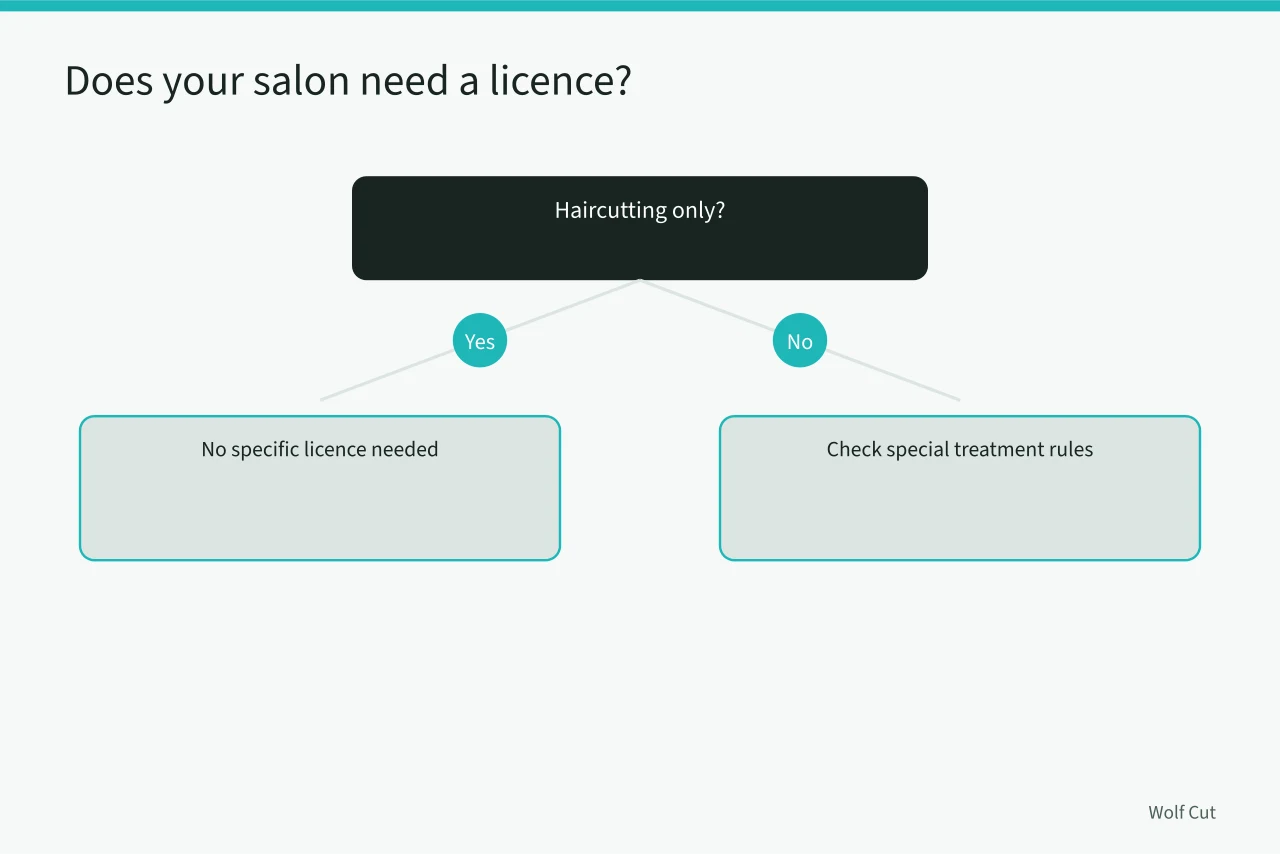
Licensing kicks in when you offer treatments that carry a higher infection or injury risk. In England and Wales, local councils license skin piercing, including ear piercing, tattooing, electrolysis and acupuncture. Some councils also license laser and intense pulsed light treatments.
If you add a sunbed, you may need to register with the council under sunbed regulations. If you play music or show television to clients, you may need a music licence from a collecting society, which is separate from council licensing.
Selling or supplying alcohol needs a premises licence and a designated premises supervisor. Some salons open a bar for events, so the licence becomes part of the compliance file.
You can check which licences apply to your business using the government licence finder, which links to the relevant council forms. Find a licence - GOV.UK covers most business types, including salons.
Registration is not the same as licensing. Many councils ask new salons to complete a simple premises registration form for environmental health, even if no licence is required. This puts you on the inspection list.
If you are unsure, call the council before you open. It is cheaper than a closure notice after an inspection.
Finding your council's licensing and environmental health department
The council that covers your salon address handles licensing and environmental health. In London, that is usually a borough council. In Manchester, Birmingham, Leeds, Glasgow, Cardiff and other cities, it is the unitary or city council.
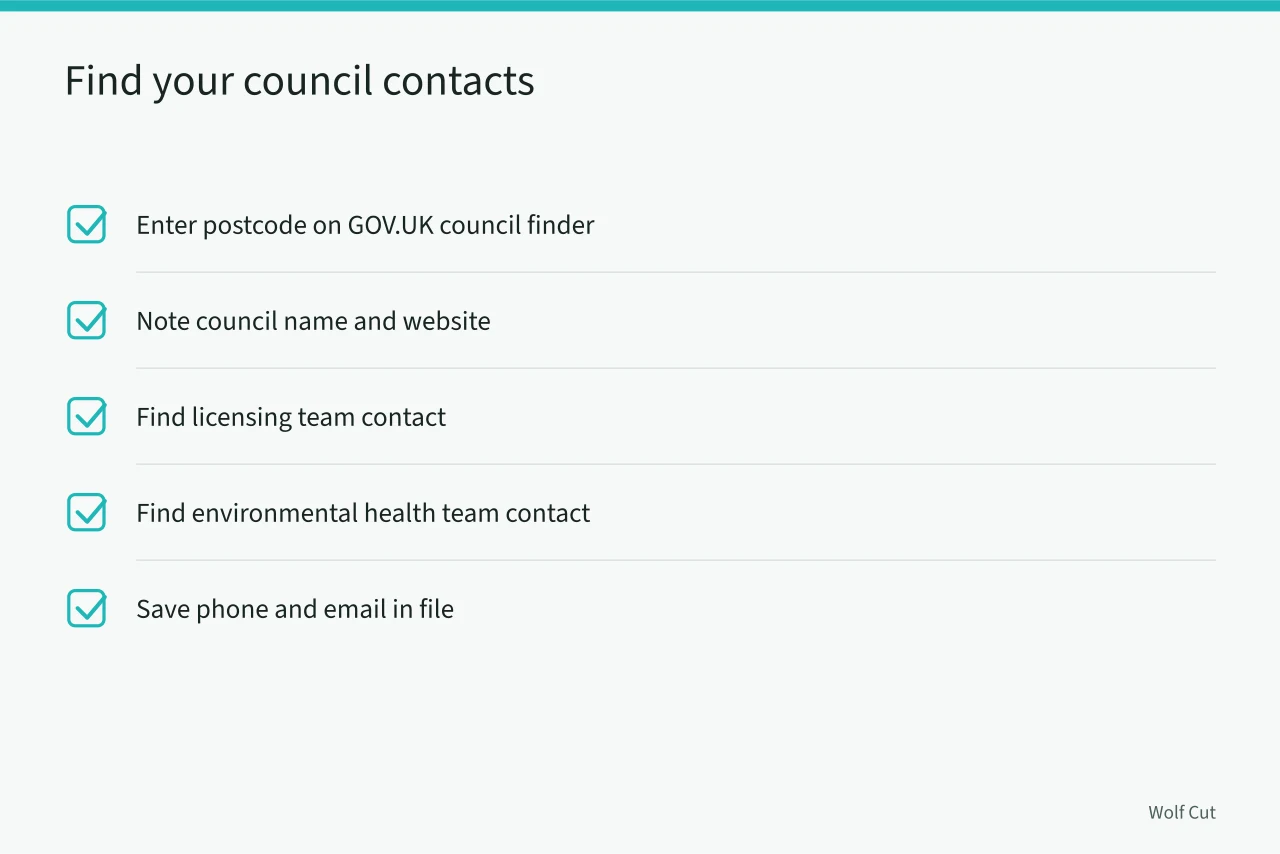
You can find the right one by entering your postcode on the government's council finder. Find your local council - GOV.UK gives the council name, website and contact details.
Once you have the council, look for two teams. Licensing handles permits for special treatments, alcohol and street trading. Environmental health handles hygiene inspections, food safety if you serve drinks or snacks, and nuisance complaints such as noise or odour.
Some councils combine both under a regulatory services department. Others split them. Ask for the environmental health team that covers hair and beauty premises.
Keep the direct phone number and email address in your compliance file. When an officer calls, you want to respond quickly, not search a website.
If you rent a chair or work in a shared building, confirm who holds the registration. The salon owner is usually responsible for the premises, but self-employed stylists still have duties for their own tools and chemicals.
Mobile stylists should register with the council where they are based. If you work across several council areas, you may need to check local rules for each, especially for special treatments.
What environmental health officers inspect in a haircutting salon
An environmental health officer can visit without an appointment. They will look at the whole salon, not just the cutting floor. The visit is usually risk-based, so a busy colour salon may see more inspections than a small barber shop.
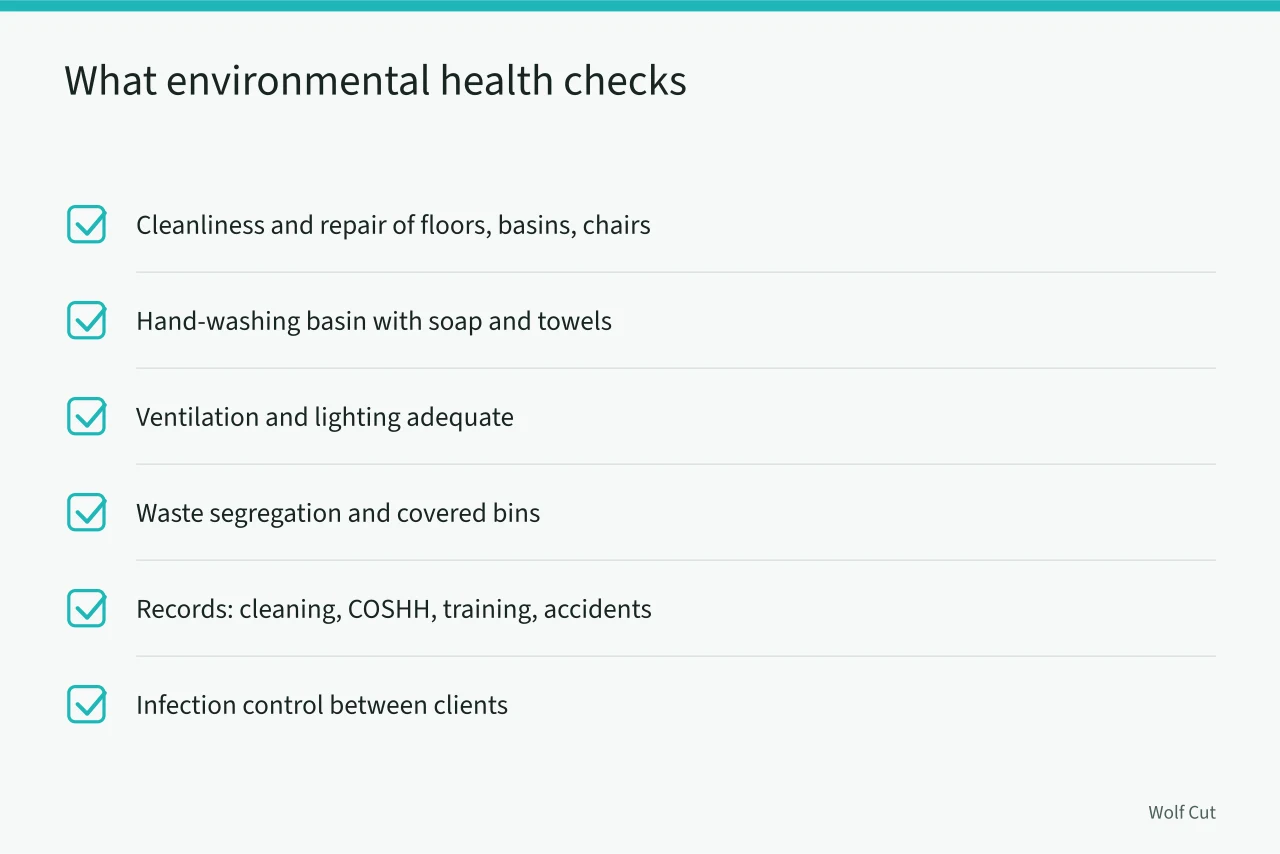
The officer checks cleanliness and condition. Floors, basins, chairs, trolleys and toilets should be clean and in good repair. Hair should not be allowed to build up in corners or under units.
They check hand-washing. You need a wash basin with hot and cold water, soap and paper towels or a hand dryer. A basin used for washing hair is not a hand-wash basin.
They check ventilation and lighting. Colour fumes and aerosols need extraction or open windows, and working areas need enough light to see what you are doing.
They check waste. Used foils, colour tubes, gloves and hair should go into covered bins. Clinical waste, such as blood-stained cotton wool, needs a separate route.
They check records. You should be able to show cleaning schedules, COSHH assessments, safety data sheets, staff training and accident records. If you cannot find them during the visit, the officer may treat the salon as non-compliant.
They check infection control. That includes how you clean tools between clients, how you store clean and dirty items, and how you handle cuts or nosebleeds. Our guide to scissor cutting techniques compared sets out a workable routine.
They may also check your registration details, insurance and any licences. If you serve food or drink, they will look at food hygiene too.
After the visit, you may get a report with actions and deadlines. Fix them and keep evidence. Repeat problems can lead to enforcement notices or prosecution.
HSE duties under the Health and Safety at Work etc. Act 1974
The Health and Safety at Work etc. Act 1974 is the main law for workplace safety in the UK. It applies to salons, barbers, mobile stylists and chair renters. Health and Safety at Work etc. Act 1974 sets out the general duties.
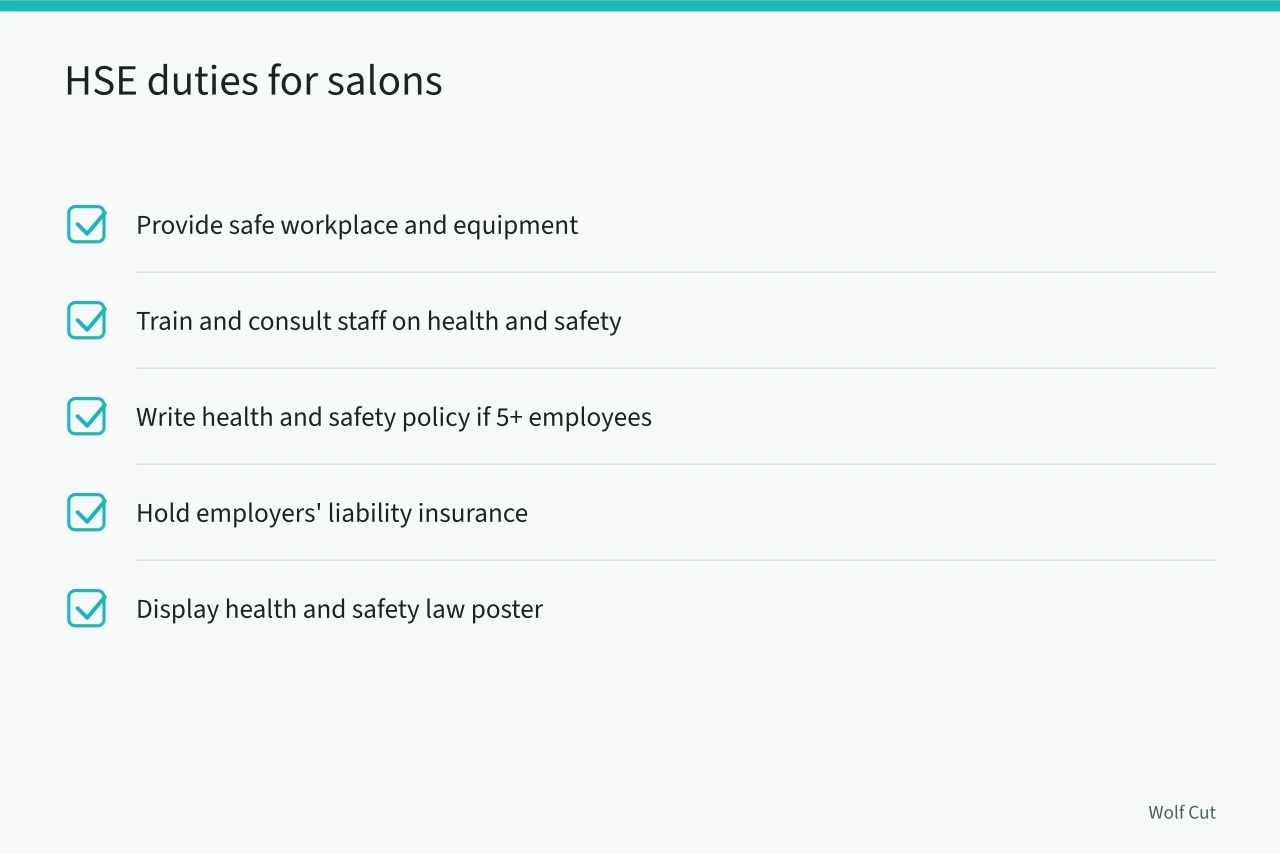
As an employer, you must provide a safe workplace, safe equipment and safe systems of work. You must also train staff and consult them on health and safety matters.
Self-employed stylists who work alone still have duties to themselves and to anyone affected by their work. If you rent a chair, you and the salon owner may share duties for the shared areas.
A written health and safety policy is required if you employ five or more people. Even with fewer staff, a written policy helps you show how you manage risks.
You must have employers' liability insurance if you employ anyone. The certificate should be displayed or available electronically.
HSE inspectors can visit salons. They may issue improvement notices, prohibition notices or fines. The HSE focuses on higher-risk workplaces, but local councils often enforce health and safety in hair and beauty premises under the same act.
You should display the health and safety law poster or give each worker a leaflet. Keep it current.
COSHH rules for dyes, bleaches, disinfectants and aerosols
COSHH stands for the Control of Substances Hazardous to Health Regulations 2002. These rules cover chemicals that can harm health, including hair dyes, bleaching products, perming solutions, disinfectants, aerosols and some essential oils.
You must assess the risk from each hazardous substance before staff use it. The assessment should cover how the product is used, who is exposed, how long for, and what controls are needed. Control of Substances Hazardous to Health (COSHH) - HSE explains the legal duties.
You do not need to write a separate assessment for every shade if the products are similar. A generic assessment for a product family can work if it is accurate and you keep safety data sheets.
Safety data sheets are not risk assessments, but they provide the hazard information you need. Keep them accessible, either on paper or on a tablet, and make sure staff know where to find them.
Controls include gloves, aprons, eye protection, extraction, closed containers and correct storage. Never decant bleach or peroxide into unlabelled bottles. Mix only what you need, in a ventilated area.
Disinfectants are covered by COSHH too. Follow the contact time on the label, and do not mix products unless the manufacturer says it is safe. Our curly and coily haircutting guide explains what each step achieves.
Aerosols and hairsprays should be used with ventilation and away from naked flames. Some products are flammable, so store them correctly.
Staff need information and training on the risks and the controls. Ensure you note down who received training and the dates on which it took place. If a product changes, update the assessment and retrain.
Risk assessments, slips and trips, and RIDDOR reporting
Risk assessments are a legal duty for all salons. They should cover the cutting floor, backwash, colour bar, storage, electrical equipment and client areas. You do not need to overcomplicate them, but you must record the significant findings if you employ five or more people.
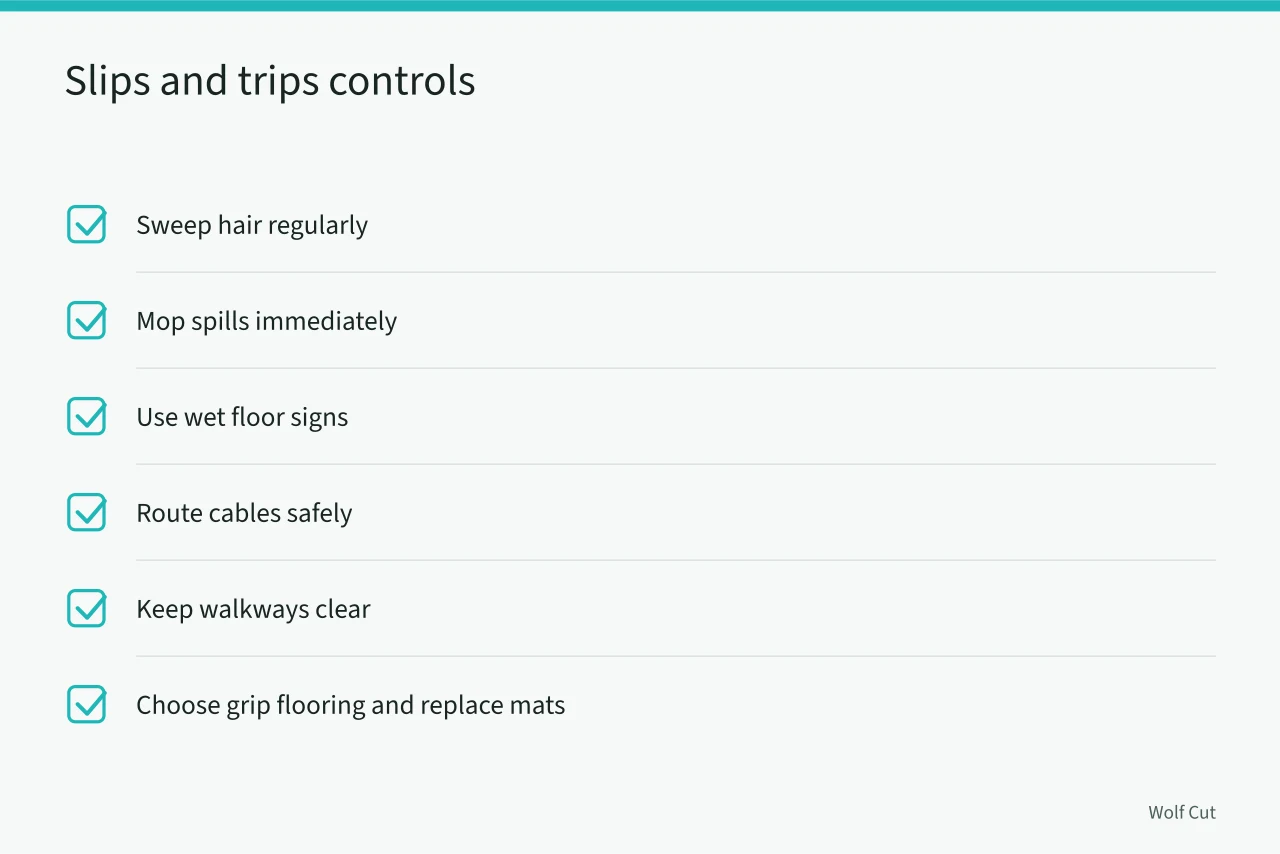
Slips and trips are the most common salon accidents. Wet floors, loose hair, trailing cables and cluttered trolleys all cause falls. Slips and trips - HSE provides guidance on prevention.
Simple controls work: sweep hair regularly, mop spills immediately, use wet floor signs, route cables safely and keep walkways clear. Choose flooring with grip, and replace worn mats.
RIDDOR stands for the Reporting of Injuries, Diseases and Dangerous Occurrences Regulations. You must report certain incidents to the HSE or the local council, depending on who enforces your premises.
Reportable incidents include a worker being off work for more than seven days after an injury, certain fractures, amputations, burns and scalds, and injuries to members of the public taken to hospital. You must also report diagnosed occupational diseases, such as dermatitis or asthma linked to work.
Dangerous occurrences, such as an electrical short circuit causing a fire, may also be reportable. Keep a record of all accidents, even minor ones, in an accident book.
Our fringe and face-framing guide covers what to do when a client has lice, broken skin or a bleeding cut.
Tool cleaning, disinfection and waste duty of care
Tool hygiene is central to salon inspections. Clippers, scissors, combs, brushes and razors must be cleaned between clients. If a tool touches blood or broken skin, it needs a higher level of decontamination.
Start with cleaning to remove hair and product. Then disinfect with a product that is suitable for the tool and the contact time on the label. Some items can be sterilised, but that is not usually needed for ordinary haircutting.
Use a one-way tool path: dirty tools go to a cleaning area, clean tools come back to the station. Never put clean tools down on a dirty trolley. Our haircut design fundamentals builds a routine around that path.
Waste duty of care applies to all commercial waste. You must store waste safely, describe it accurately, and transfer it only to a licensed carrier. Keep transfer notes for at least two years.
Hair, foils, colour tubes, gloves and packaging are general commercial waste. Blood-stained items and used razors may need to go as clinical or sharps waste, depending on your council's rules.
Do not put salon waste in domestic bins. Councils can fine businesses that do. If you are mobile, take waste back to your base and dispose of it properly.
A station turnover routine helps. Our map head shape and hair movement links blood exposure and cleanup to the changeover between clients.
Building a hygiene compliance file inspectors can follow
A compliance file saves time during an inspection. It should be organised, current and easy to find. Keep a paper copy and a digital backup.
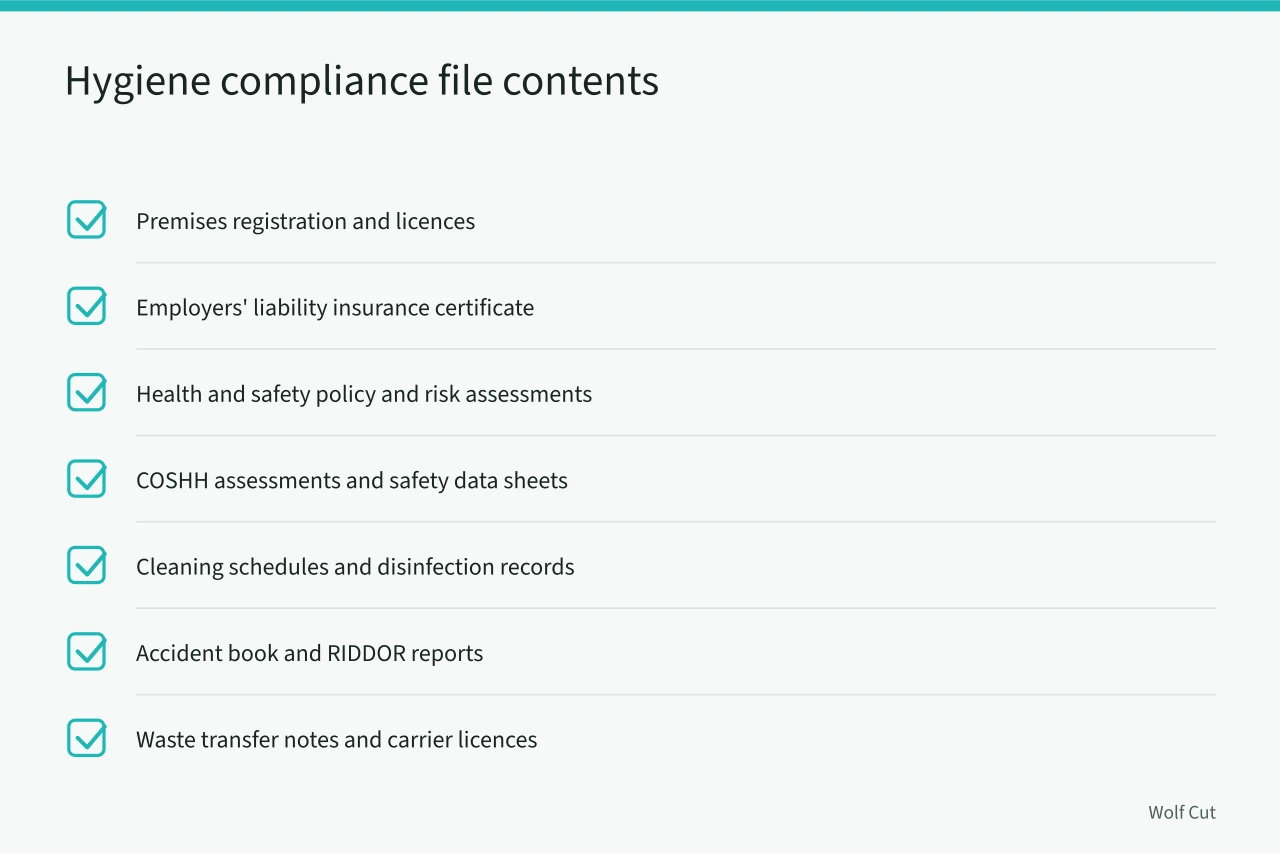
Use this checklist to assemble the file:
- Premises registration confirmation from the council
- Any licences for special treatments, alcohol or music
- Employers' liability insurance certificate
- Health and safety policy and risk assessments
- COSHH assessments and safety data sheets
- Cleaning schedules and disinfection records
- Accident book and RIDDOR reports
- Waste transfer notes and carrier licences
- Staff training records, including infection control
- Evidence of qualifications for specialist treatments
Review the file every three months. Update it when you add a product, a service or a member of staff.
When an officer arrives, ask for identification and stay with them. Answer questions honestly and take notes. If you do not know something, say you will find out and send it later.
If you receive an improvement notice, read it carefully. You can appeal within 21 days, but you must still comply unless the notice is suspended. Keep evidence of the work you do.
Training helps. The Chartered Institute of Environmental Health and industry bodies such as the National Hair & Beauty Federation offer courses and updates. Ofqual-regulated qualifications from awarding bodies such as City & Guilds and VTCT cover hygiene for hairdressing.
Companies House registration, HMRC tax compliance and ICO data protection are separate from hygiene, but inspectors may ask for basic business details. Keep them in the same folder.
A well-kept file shows you take hygiene seriously. That can reduce the risk of enforcement and make inspections quicker.
Common questions
Do I need a licence to cut hair in the UK? No, cutting hair does not need a specific licence. You may need to register the premises with your local council environmental health department, and special treatments need separate licences.
How often will environmental health inspect my salon? There is no fixed schedule. Inspections are risk-based, so a salon with poor records or complaints may be visited more often than one with a good history.
What is the difference between COSHH and a risk assessment? COSHH is the set of regulations for hazardous substances. A COSHH assessment is a type of risk assessment focused on chemicals such as dyes, bleaches and disinfectants.
When must I report an accident under RIDDOR? Report deaths, specified injuries, injuries causing more than seven days off work, certain occupational diseases and dangerous occurrences. Keep a record of all accidents, even minor ones.
Can I put salon waste in my household bin? No. Commercial waste must go through a licensed carrier and you must keep transfer notes. Putting it in domestic bins can lead to a fine.
Who enforces health and safety in a salon? Usually the local council environmental health team enforces health and safety in hair and beauty premises, with the HSE providing guidance and enforcing in some cases.