Reviews
Part of Crown shape, side weight and daily styling: the wolf cut guide
Wolf cut versus shag versus mullet: comparing crown, sides and back
Wolf cut, shag, mullet, and butterfly layers compared by silhouette, crown, sides, back, perimeter, fringe, styling needs, upkeep, and consultation language.
What to take away
- These names overlap, and salon usage is not standardized.
- A wolf cut often combines shag-like upper layering with stronger front-to-back contrast.
- A shag is usually defined by varied layers, crown fullness, and lighter edges.
- A mullet's clearest structural feature is shorter front and sides with a longer back.
- Butterfly layers usually keep a fuller long perimeter and use sweeping face-framing movement.
Trend names help clients find images. They do not replace a structural consultation. Two people can request a wolf cut and mean different amounts of crown height, side exposure, fringe, and back length. The wolf cut guide separates those five decisions.
At-a-glance comparison
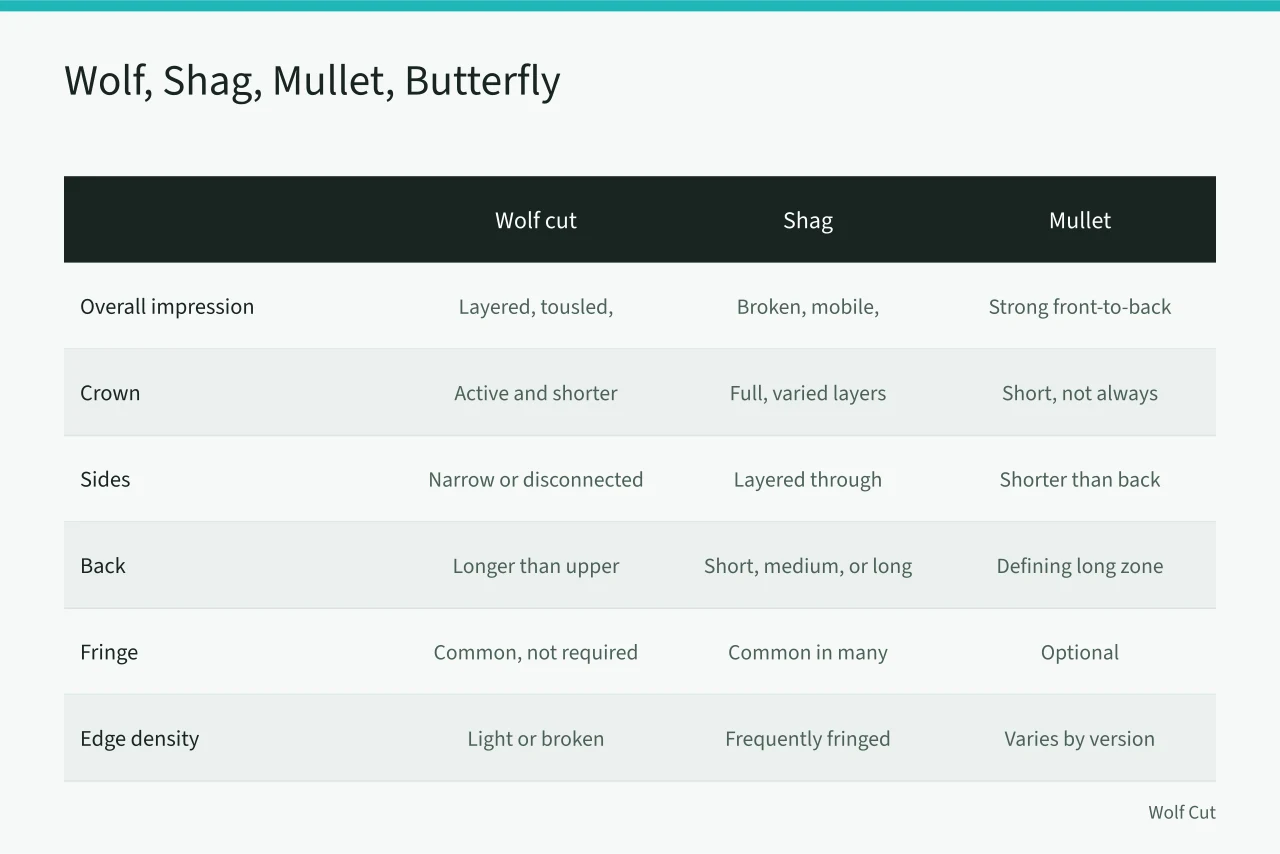
| Feature | Wolf cut | Shag | Mullet | Butterfly layers |
|---|---|---|---|---|
| Overall impression | Layered, tousled, often top-heavy | Broken, mobile, feathered | Strong front-to-back contrast | Long, full, face-framing |
| Crown | Usually active and shorter | Often full with varied layers | May be short but not always rounded | Longer, sweeping layers |
| Sides | Can narrow or disconnect | Usually layered through | Commonly shorter than back | Usually kept full |
| Back | Often longer than upper shape | Can be short, medium, or long | Defining long zone | Long perimeter with softer graduation |
| Fringe | Common, not required | Common in many versions | Optional | Curtain or long face frame common |
| Edge density | Often light or broken | Frequently fringed | Varies by version | Usually more substantial |
| Styling | Airy separation or natural texture | Separation and movement | May need little blending work | Often depends on blow-dried sweep |
These are working tendencies, not rules. The client's image and requested outline should settle any conflict with the label.
Shag: layered fullness with lighter edges
The reference description of the shag haircut identifies layers of varied lengths, fullness around the crown, and thinner or fringed edges. It also describes the wolf cut as a later shag variation with shorter front elements reminiscent of a mullet and frequent bangs.
In salon planning, a shag can be rounded and soft or highly separated. Its common thread is internal movement across the shape, not one mandatory length.
On curl, that movement behaves differently, as the curly and coily haircutting guide covers. Side layers tend to join the design, not just a sharp contrast to a long back.
Ask how much crown expansion the client wants and whether the edge should look airy or remain dense. A shag reference on thick, styled hair may not translate directly to low-density, straight hair without changing the perimeter.
Wolf cut: a variable hybrid
The wolf-cut label commonly points to energetic upper layers, a face-framing or fringe element, and some degree of length retained at the back. It may be a subtle shag with a longer nape or a bold shape with narrow sides and obvious disconnection.
The useful consultation questions are:
- How short should the crown appear?
- Should the ear area remain covered?
- Is a long back a defining feature or only a little extra length?
- Should the perimeter look wispy or solid?
- Does the client want natural texture or a styled, separated finish?
If those answers are recorded, the name has done its job. A customized wolf cut plan turns those answers into a cutting map.
Mullet: front and sides separated from the back
The specific structural definition of a mullet haircut is shorter hair at the front, top, and sides with longer hair at the back. Modern versions may add tapers, fades, texture, curls, or a softer transition, but the front-to-back contrast remains the clearest identifying feature.
A mullet does not require shaggy crown fullness, and a shag does not require a distinctly long back. A wolf cut may borrow from both. This is why a profile and back-view image matter as much as a front-facing photograph.
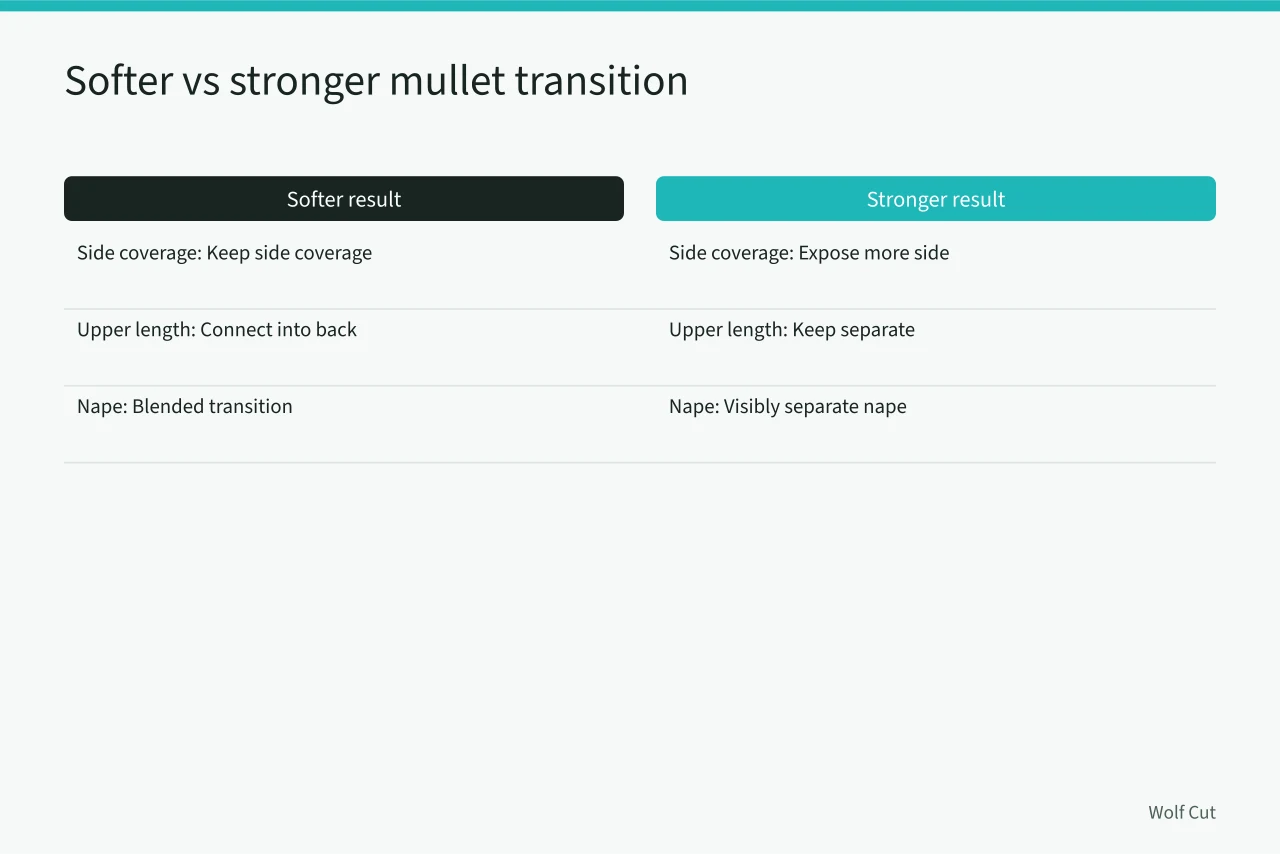
For a softer result, keep side coverage and connect some upper length into the back; for a stronger result, expose more side and keep a visibly separate nape.
Agree on the transition before cutting because vague requests like "not too mullet-like" do not define a boundary. The scissor haircutting guide covers how elevation and overdirection build that transition.
Butterfly layers: long perimeter and sweeping movement
Butterfly layers generally keep more overall length and perimeter density. Shorter face-framing pieces sweep away from the face, while longer layers preserve the impression of long hair. The finished look often relies on a round-brush or roller set that creates lift and outward movement.
Butterfly layers usually keep fuller sides and a more continuous long outline than a strongly separated wolf cut. Their edge is less likely to be deliberately thinned throughout than a classic shag.
If a client likes the front of a butterfly cut but the crown of a wolf cut, plan a hybrid with a protected perimeter. Where texture is removed matters too, as blunt, point, slide, and channel cutting shows.
Match the choice to daily life
Compare the shapes under the client's normal conditions:
| Practical question | Why it matters |
|---|---|
| Air-dry or heat-style? | Some sweeping finishes collapse without directed drying |
| Hair worn forward or tied back? | Short face layers can escape a tie |
| Ear coverage wanted? | Narrow wolf or mullet sides may expose the ear |
| Strong perimeter wanted? | Short internal layers reduce how much hair reaches the edge |
| Fringe upkeep acceptable? | A short fringe changes sooner than the back |
Finish by naming the chosen structure without forcing it into one category. "Soft wolf cut with full sides and a dense bottom" is more useful than "wolf cut" alone.
Common questions
Are a wolf cut and a shag identical?
No fixed authority controls the labels. They overlap, but a wolf cut often shows more front-to-back contrast or a stronger mullet influence.
Can a mullet have a soft transition?
Yes. The front and sides can connect gently into the longer back while retaining a clear length contrast.
Do butterfly layers work without a blowout?
They can, but the familiar swept finish often depends on directed drying. Discuss the air-dried shape separately.
Which label should go on the client record?
Record the label plus the measurable design: crown length, side connection, fringe, nape, perimeter, and finish.