Maintenance
How UK damp weather affects wolf cut styling and frizz control
UK weather wolf cut styling means cutting for shrinkage, controlling frizz in damp air and finishing for hold. A practical guide for stylists and clients.
What to take away
- UK weather wolf cut styling starts with cutting for shrinkage and recoil, because damp air shortens and swells the hair you thought you had cut.
- Humidity and rainfall vary by region, so a layer height that holds in Leeds may drop by mid afternoon in Cardiff or Glasgow.
- Frizz control in a damp climate depends on product order: humectant first, then a light sealant, then hold.
- Drying technique matters more than product in wet weather; rough drying leaves the cuticle open and the shape collapses.
- Clients need a short between-appointment routine, because most of the week is spent outside the salon.
How UK humidity and rainfall affect hair through the day
A wolf cut is a layered shape with a soft crown and length retained at the back and sides. Its identity depends on lift at the root and a visible step between layers. Damp air attacks both.
Understanding humidity - Met Office explains that relative humidity is the amount of water vapour in the air as a percentage of what the air could hold at that temperature, and that warm air holds more moisture than cool air.
Hair responds to that figure, not to the forecast headline. A muggy 14C morning in Manchester does more to a fringe than a dry 20C afternoon in Surrey.
When humidity rises, the hair shaft takes on water and swells. The cuticle lifts slightly. Individual fibres stop sitting flat against each other, which is what we see as frizz. At the same time the hydrogen bonds that hold a bend or a straight section loosen, so yesterday's shape relaxes.
Rain adds a second problem. Rain - Met Office sets out how UK rainfall arrives in fronts, showers and persistent drizzle, and drizzle is the worst of the three for styling.
It does not soak the hair, it coats it. A fine film of water sits on the surface, lifts the cuticle and lets the layer edges curl in odd directions.
Timing matters. A client who leaves the salon at 9am with good hold may look different by 2pm. Hair gains and loses moisture as the air around it changes, and a day that starts dry and ends humid will undo most of the morning's work.
Ask what the rest of the client's day looks like before deciding how much hold to build in.
Regional variation is real. Coastal and western areas, including much of Wales, the North West and western Scotland, sit in more Atlantic moisture than the South East or the East Midlands.
UK climate maps and data - Met Office carries regional maps and data showing how rainfall and temperature differ across the UK, which is worth a look when a client is moving or travelling for work.
Weather warnings are part of the picture too. UK weather warnings - Met Office covers rain, wind and other hazards, and a yellow rain warning is a fair signal that an appointment should end with a tighter, more sealed finish than usual.
Why damp air makes wolf cut layers drop, frizz and lose hold
A wolf cut relies on two things staying put: root lift and the contrast between short and long layers. Both are mechanical, and both are undone by water.
Water breaks the temporary bonds inside the hair. That is why wet hair can be reshaped and dry hair cannot. In humid air the hair keeps absorbing and releasing small amounts of moisture, so bonds keep breaking and reforming. The shape drifts. Layers that were cut to sit at cheekbone level begin to hang lower and flatter.
Frizz is the other half of the same process. Swollen fibres do not lie smoothly against their neighbours. Short layers, which are common in a wolf cut, expose more cut ends and more surface area, so they frizz faster than a blunt shape would.
A blunt bob has weight to pull it down. A wolf cut has lightness, which is the point of it, and lightness is what damp air punishes.
The third problem is hold. Setting products work by forming a film or a light bond around the fibre. When the fibre swells after styling, it stretches that film. The film cracks or softens and the hold goes. This is why a client can have a style that feels crisp in the salon and soft an hour later.
There is a further issue specific to layering. When the shorter layers shrink upwards and the longer lengths stay heavy, the silhouette changes. The cut can look rounder at the crown and thinner at the perimeter. Stylists sometimes read this as a bad cut when it is simply a wet-climate reaction.
Knowing this changes the consultation. Instead of asking what shape the client wants, ask what shape they want at 4pm on a wet Tuesday. That is the shape the cut has to deliver. Our wolf cut guide covers crown shape and side weight in detail, and it is the right starting point before any damp-weather adjustment.
Cutting for shrinkage and recoil in a wet climate
Shrinkage is the amount a section pulls up after drying. In a dry climate it may be small. In the UK it can be a centimetre or more on a mid-length layer, and it varies with curl pattern, porosity and the humidity on the day.
Recoil is how much the hair springs back when tension is released. High recoil means a section cut wet will sit higher when dry. Low recoil means it stays close to where you cut it.
Both have to be measured before you cut, not guessed. Test on the client's own hair, on the day, in the salon's own air.
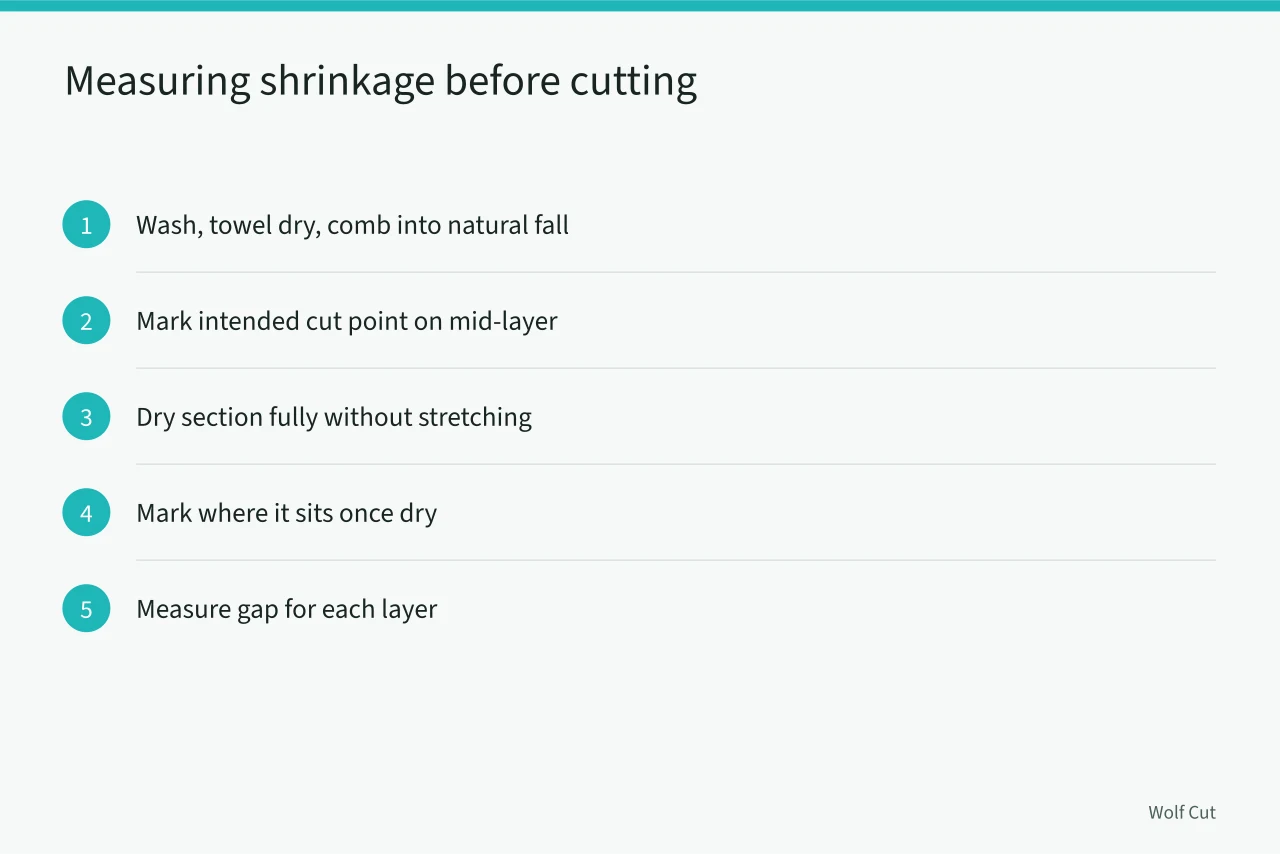
- Wash and towel dry as normal, then comb the hair into its natural fall.
- Take a mid-layer section and mark where you intend to cut it.
- Dry that section fully with a diffuser or air, without stretching it.
- Mark where it actually sits once dry.
- Measure the gap between the two marks and note it for every layer you plan to cut.
That gap is your shrinkage allowance. Cut the layer longer by that amount and it will land where you intended once dry. On a wolf cut the allowance usually needs to be larger at the crown and smaller at the perimeter, because crown layers are shorter and shrink proportionally more.
Recoil affects where you place the elevation. Cutting a crown section at 90 degrees and letting it fall gives a different dry result from cutting it flat to the head. In a wet climate, err towards the lower elevation for the top layers so the dry shape has somewhere to go.
Texturising is a useful tool but a risky one. Removing weight helps the layers move, and movement reads as shape. Remove too much and the shorter layers have nothing to hold them down, so they lift and frizz. On fine hair in a humid region, texturise lightly and check the dry result before continuing.
Borders and internal shape should be planned before the scissors come out. Our walkthrough on customized wolf cut planning sets out how to map zones so the shrinkage allowance is applied where it matters rather than evenly across the head.
One more point on length. Clients in wet regions often ask for a shorter wolf cut because they think it will frizz less. The opposite is usually true. Length gives weight, and weight gives control. A slightly longer perimeter with tighter crown layers holds better in UK conditions than a uniformly short shape.
Layering choices that keep shape when humidity rises
Layer height is the single biggest lever a stylist has over how a wolf cut behaves in damp air. Higher layers give more lift and more movement, and they also expose more surface to moisture.
A practical compromise for UK clients is a slightly lower crown layer with a longer, softer perimeter. The cut still reads as a wolf cut, with the characteristic step and the soft face frame, but the weight sits lower and pulls the shape back into place when humidity rises.
Face framing is worth attention. A short, sharp face frame frizzes first and most visibly, because it is the part the client sees and touches. Softening the face frame by a centimetre or leaving it slightly longer reduces the daily fight without losing the shape.
Disconnection is another option. A disconnected top layer over a longer base gives lift where the client wants it and weight where they need it. It also means the two zones can be styled differently, which is useful when one part of the head frizzes more than another.
Thinning shears should be used sparingly on the top layers. Thinning removes the bulk that holds a shape together, and in humid conditions the thinned sections separate and lift. If weight needs removing, take it from the interior and the ends rather than the crown surface.
Here is a short checklist to run through before finishing the cut:
- Shrinkage measured on the client's own hair, on the day.
- Crown layers cut with a wet-to-dry allowance applied.
- Face frame left long enough to survive a damp afternoon.
- Perimeter weight retained for control.
- Interior weight removed rather than surface weight.
- Dry check completed before the client leaves the chair.
- Client shown how the shape behaves when it is not freshly styled.
That last point is the one clients remember. A cut that only works in salon conditions is not a good cut for a UK climate.
Product notes: humectants, serums, mousses and finishing sprays
Product choice for frizz control in a damp climate is about order and weight, not brand. Four categories do most of the work.
Humectants attract and hold water. Glycerin, sorbitol and honey are common examples. In dry air they pull moisture from the atmosphere into the hair, which is helpful. In very humid air they can pull in too much, swelling the fibre and encouraging frizz. On a wet UK day, a heavy humectant leave-in is often the wrong first step.
Serums and oils seal. A light silicone or plant oil serum forms a film that slows moisture exchange. This is the workhorse product for UK clients. Apply to damp hair, mid-lengths and ends first, then a trace over the surface of the crown layers.
Mousses give root lift and light hold. They suit a wolf cut because the shape needs volume at the crown rather than weight at the ends. Choose a mousse with a flexible hold rather than a hard one, and work it in at the root with fingers or a wide comb.
Finishing sprays lock the shape. A light aerosol or pump spray with a flexible hold is better than a stiff lacquer for this cut, because stiff products crack when the hair moves and leave visible flakes. Spray in short bursts at arm's length and let it dry before the client touches their hair.
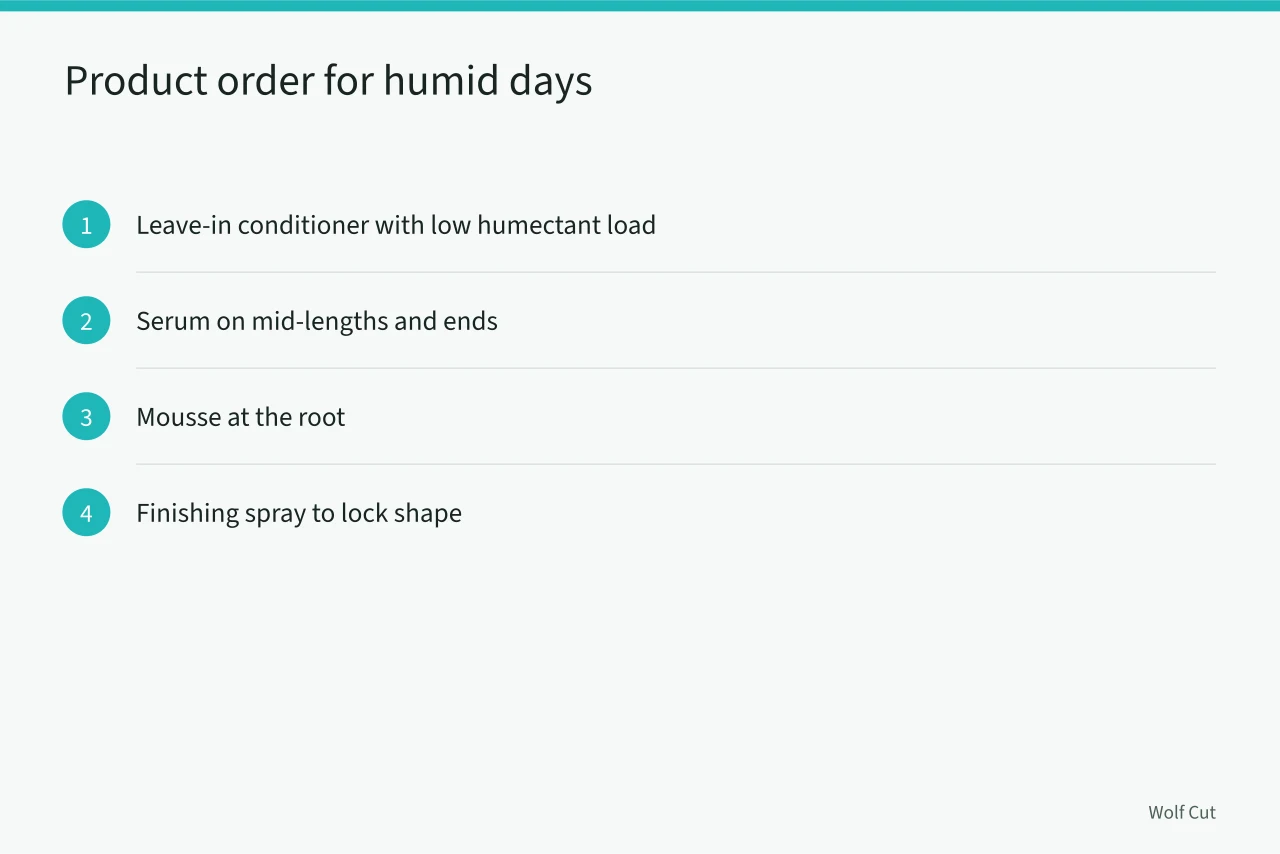
A simple order for a humid day: leave-in conditioner with a low humectant load, then serum on mid-lengths and ends, then mousse at the root, then a light finishing spray at the end. If the client's hair is coarse or curly, swap the mousse for a cream to avoid crunch.
Anti frizz products sold in the UK are covered by the same cosmetic safety rules as any other product, so the label matters more than the marketing. Look for the ingredient list rather than the front of the bottle.
Clients who react to fragrance or preservatives should patch test, and stylists should keep a note of sensitivities on the client record.
Our wolf cut for low-density hair case study goes further into moisture control through home styling, which is where most of the product decisions actually get made.
Drying and finishing techniques for hold in damp weather
Drying sets the shape. If the hair is dried badly, no product will rescue it, and in damp weather the failure shows within the hour.
Rough drying with a towel is the first mistake. Rubbing lifts the cuticle and creates the frizz the client is trying to avoid. Press or squeeze the water out with a microfibre towel instead, and stop while the hair is still damp.
Air drying works for some clients, but in humid conditions it leaves the cuticle open for too long and the shape can dry flat. A diffuser is usually better for a wolf cut because it supports the root while drying the layers.
Our comparison of scissor cutting techniques compared sets out where air, diffuser, wrap and round-brush drying each work best.
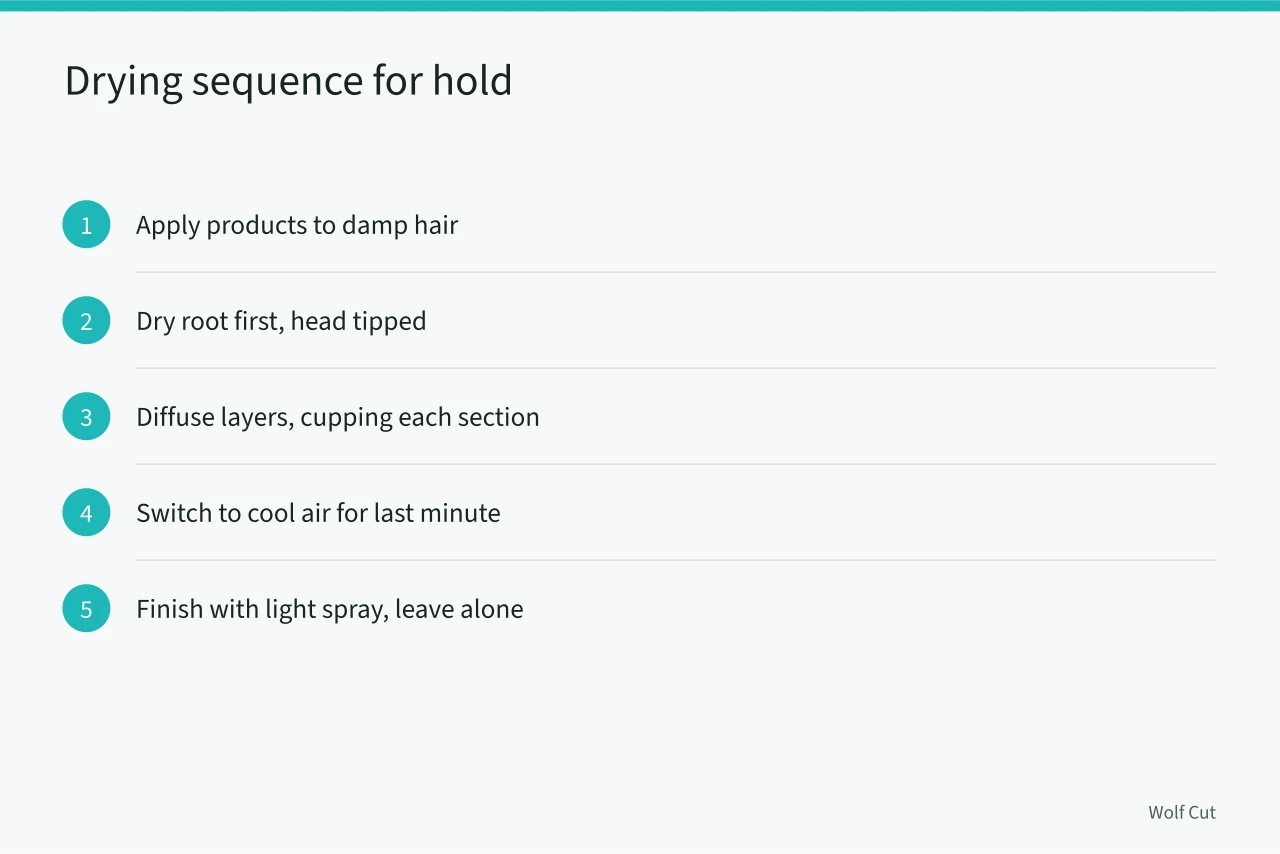
For hold in damp weather, the sequence matters more than the tool:
- Apply products to damp hair, not soaking wet hair, so they are not diluted.
- Dry the root first with the head tipped, using warm air and low speed.
- Move to the layers, cupping them in the diffuser and holding each section for a few seconds.
- Switch to cool air for the last minute to close the cuticle and set the shape.
- Finish with a light spray, then leave the hair alone until it is fully dry.
The last step is the hardest to enforce. Touching hair while it dries breaks the bonds that are forming and creates frizz exactly where the client has been fiddling.
A worked example. A client with fine, wavy, mid-length hair in Bristol has a 9am appointment on a drizzly day. Cut with a shrinkage allowance of roughly a centimetre at the crown.
Product: light leave-in, serum on the ends, mousse at the root. Dry the root first with warm air, cup the layers, then one minute of cool air to finish. Finish with two short bursts of flexible spray. The client is told not to touch the crown for ten minutes and to carry a small serum for the walk home.
Heat settings deserve a mention. High heat on damp hair can bubble the cuticle and cause lasting damage, and it also dries the surface before the interior, which leaves the shape unstable. Medium heat and moderate airflow give a better set. Our clipper cutting guide covers heat, airflow, tension and product in the order they should be applied.
A daily maintenance routine for UK clients between appointments
The salon finish lasts a day at best. What keeps a wolf cut looking sharp for six weeks is what the client does on the other thirty-nine days.
Morning is the important window. Hair that has been slept on needs to be re-set, not just brushed. A light mist of water, a small amount of serum on the ends and a minute with a diffuser at the root will restore most of the shape. Brushing dry, frizzy hair simply spreads the frizz.
Shower habits matter more than most clients realise. Steam from a hot shower raises the humidity in the bathroom and swells the hair before the day has started. A shower cap, or styling after the shower rather than before, avoids that.
On wet days, a hood or an umbrella is a styling tool. Rain that lands on freshly styled hair lifts the cuticle and softens the hold. A silk or satin scarf under a hood reduces friction, and a loose top layer of hair can be pinned up for the walk to work and released on arrival.
Weekly, the client should reset the shape rather than just wash it. A deep condition on the mid-lengths and ends, a proper dry with attention to the root, and a check of where the layers are sitting will tell them whether the cut is still working.
If the crown is collapsing every day, the answer is usually a trim, not more product.
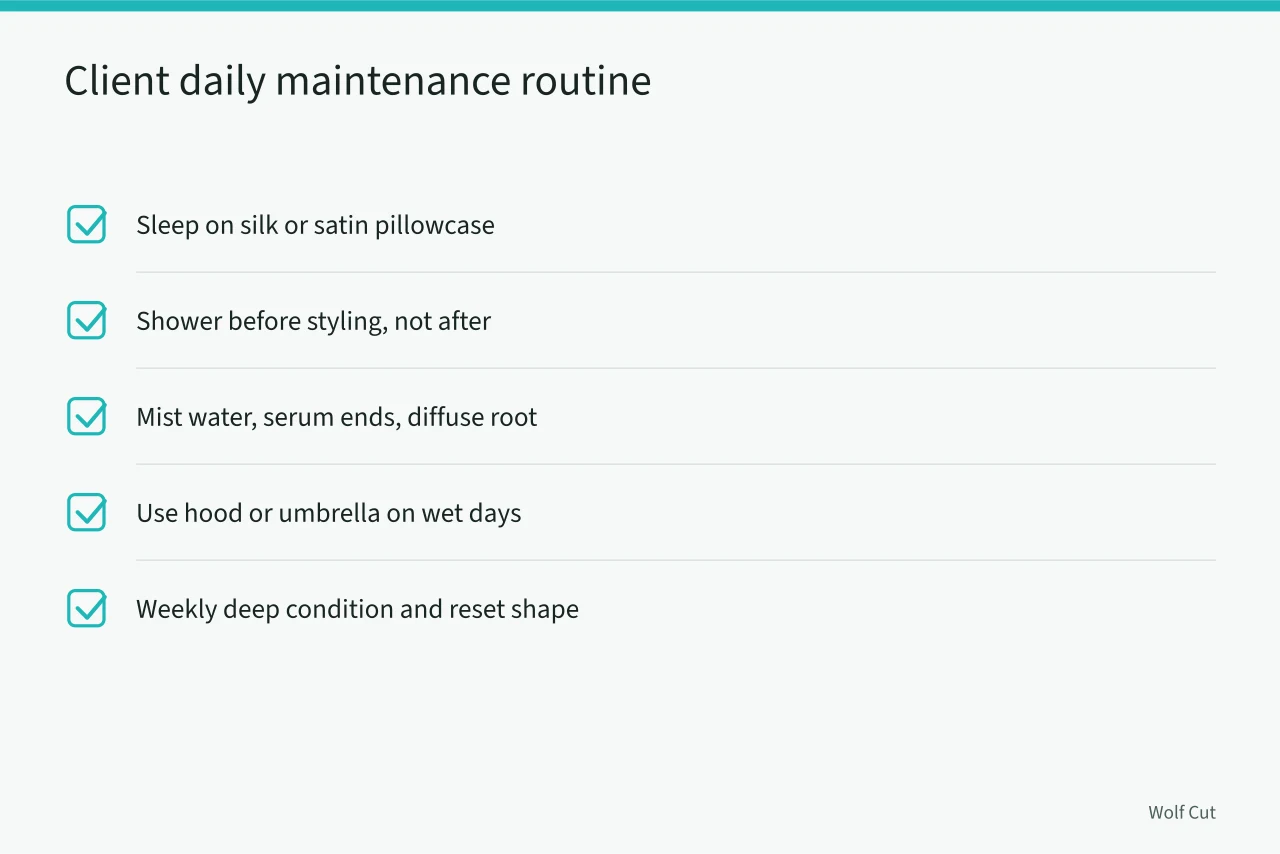
Here is a routine to hand to clients:
- Sleep on a silk or satin pillowcase to reduce friction.
- Shower before styling, or wear a cap, to limit steam exposure.
- Mist and re-set the root each morning rather than brushing dry.
- Keep a small serum in the bag for wet commutes.
- Cover the hair in rain and release it once indoors.
- Deep condition mid-lengths and ends once a week.
- Book a trim before the crown layers collapse, not after.
Stylists should also note what the client reports. If several clients in the same area are complaining about the same thing in the same week, the weather is probably the cause, and a small cutting adjustment at the next appointment will fix it better than a new product.
Common questions
How often should a wolf cut be trimmed in the UK?
Every six to eight weeks for most clients, and closer to six in wet western regions where shrinkage shows sooner. The crown layers lose their shape first.
Does a wolf cut frizz more than other layered cuts?
It can, because short layers expose more cut ends and less weight holds them down. Cutting for shrinkage and sealing the surface with serum reduces the problem a great deal.
Should clients use anti frizz products every day?
A light serum on mid-lengths and ends most days is fine. Heavy humectant products are better saved for dry spells, because in humid air they can draw in more moisture than the hair needs.
Is a diffuser better than air drying in damp weather?
Usually yes for this cut, because it supports the root while the layers dry. Air drying can work in dry weather but often leaves the shape flat when humidity is high.
What should a stylist check before the client leaves?
The dry shape, not the wet one. If the layers sit where they were intended once dry, the cut will survive the trip home and the days after it.
Do UK weather warnings change how a cut should be finished?
They can. On a rain warning day, use a tighter seal and a slightly stronger finishing spray, and warn the client that the shape may need a re-set when they get indoors.