Rules
Part of Shrinkage and density anchor this curly and coily haircutting guide
9 pointers on curly haircut problems that hold up
Curly haircut problems explained: uneven shrinkage, holes, tangles, shape collapse, fragile ends, tension, product effects, and conservative correction checkpoints.
What to take away
- Reset the hair before correcting a problem caused by an unrepresentative set.
- Uneven visible length may come from shrinkage, structure, grouping, or damage.
- A hole should be diagnosed in motion before neighboring hair is shortened.
- Tangles call for gentler handling and condition assessment, not forced combing.
- Pain, scalp injury, sudden loss, or unexplained breakage belongs with a clinician.
Curly and coily shapes change with moisture, product, tension, sleep, and styling. Start every correction by reconstructing the state in which the problem appears. A photograph after wash day and another near the next wash may reveal more than a single salon finish. The method these corrections come from is the curly and coily haircutting guide.
Problem: one zone springs much higher
Possible causes
- tighter curvature or smaller groups in that zone;
- shorter existing layers;
- less weight or lower density;
- heat or chemical alteration elsewhere;
- uneven product application;
- stretched sections that have not fully reset.
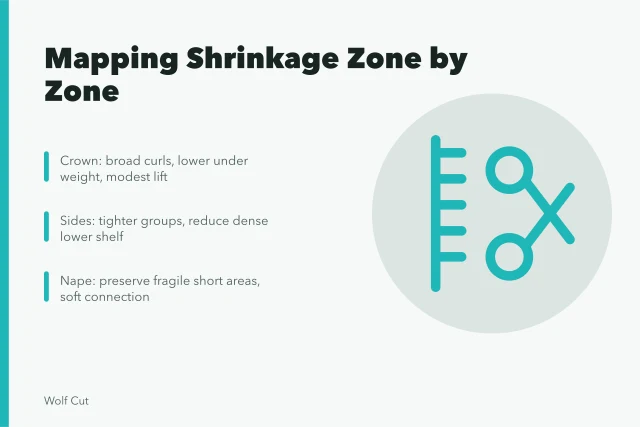
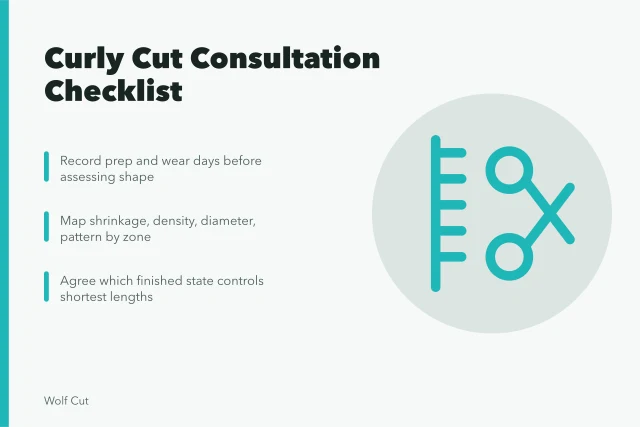
Compare gently extended lengths and let the groups reform. If the underlying structure is even but contraction differs, shortening the lower-looking area may create a new problem after another finish. Balance the occupied silhouette only within the client's agreed wearing state. A shrinkage and pattern checklist records which state that is.
Problem: a visible hole appears
A hole can come from an over-short layer, repeated curl-by-curl trimming, low local density, a strong parting, breakage, or a group temporarily splitting apart.
Move nearby hair without forcing it. Change the parting and moisture level. If the hole remains structural, options include softening a heavy shelf above it, redirecting adjacent length, or allowing the short area to grow. Cutting the whole outline to meet one gap is the highest-cost option and needs clear consent.
Problem: detangling stalls the service
Do not pull harder. Divide the hair into smaller areas, add suitable moisture and slip, support the section, and work from ends toward the base. Stop if the client feels pain or if fibers are snapping.
A recent clinical review of Afro-textured hair care describes a tendency for curved fibers to intertwine, tangle, and form knots, while also warning against broad georacial generalizations. It connects everyday handling, thermal work, chemical services, and tension with hair and scalp outcomes. In salon practice, this supports direct assessment and low-force preparation rather than assumptions about a client's identity.
If matting cannot be released within the agreed time and comfort limits, pause and discuss options. Do not hide major detangling, length loss, or added cost from the client.
Problem: the shape collapses after wash day
Check first
- Was the salon result stretched or strongly diffused?
- Did root product create temporary lift?
- Does water weight pull the top down before full drying?
- Are upper layers too long for the intended shape?
- Are they so short or sparse that they cannot form a strong mass?
- Does the client's ordinary drying method direct everything downward?
Recreate the normal routine. Adjust product placement or drying direction before cutting. If structure is the confirmed cause, test a conservative internal change and release it. Do not promise lasting height from a haircut alone.
Problem: the ends look transparent or fuzzy
Transparent ends may reflect low density, weathering, breakage, over-layering, or excessive texturizing. Fuzz may also come from disrupted groups, dry brushing, rough drying, or humidity.
Inspect the perimeter against a contrasting background, and determine whether a stronger line requires an immediate length change or a staged grow-out. Avoid further texture work on weak zones; use a gentle reset to see whether the surface appearance changes before removing hair.
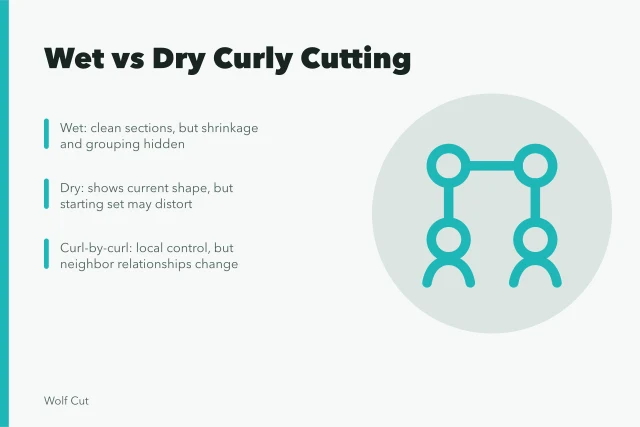
How the earlier cut was judged matters too, and wet, dry, and stretched cutting differ.
Problem: the crown separates
A whorl, lower density, a short guide, product, or sleep compression can divide the crown. Observe the direction from above. Shortening may make a split more visible if the hair loses covering length.
Try a different parting and drying direction. If cutting is appropriate, change a small section within the recorded minimum. Review without backcombing or forced root lift.
Problem: tension or a protective style affects the result
Recent tight styling may temporarily change direction, leave tenderness, or reveal breakage. The American Academy of Dermatology warns that hairstyles that pull can lead to traction alopecia and lists pain, stinging, scalp crusts, tenting, broken hair at the forehead, recession, and loss patches as warning signs. It advises loosening or stopping tight styles and seeking dermatologic assessment for hair loss.
A haircut appointment is not the place to diagnose traction alopecia. If the scalp is painful or injured, stop. If the hair has just been released from a tight style, allow it to settle before judging its ordinary fall.
Problem: mixed altered and natural texture creates two outlines
Heat-straightened, relaxed, or otherwise altered ends may hang below new natural growth. Ask whether the client wants to keep length, remove altered hair, or use a staged transition.
Do not cut the natural section based only on the hanging ends. Show the length difference in both states and document the chosen transition line. A gradual plan can preserve length, while a single reset cut creates a more immediate consistent pattern at the cost of length. The planning version of that decision is the dry-informed curly haircut plan.
A conservative correction sequence
- Identify the state in which the problem occurs.
- Reset product, compression, or parting when needed.
- Map density, shrinkage, and condition.
- Separate structural faults from fiber and finish effects.
- Protect minimum lengths.
- Test one small response.
- Review the full settled shape.
- Record the cause, change, and remaining limit.
Common questions
Should the lower side always be shortened to match the higher side?
No. First check shrinkage, density, grouping, and the client's normal finish.
Can a hole be filled by cutting around it?
Sometimes a heavy edge can be softened, but cutting cannot add density. A grow-out plan may be safer.
Is painful detangling normal for dense curls?
No. Stop, add control and slip, reduce section size, and respect the client's comfort.
When should the service stop?
Stop for pain, scalp injury, unexplained loss, or when the proposed correction would exceed agreed length limits.