Features
Part of Shrinkage and density anchor this curly and coily haircutting guide
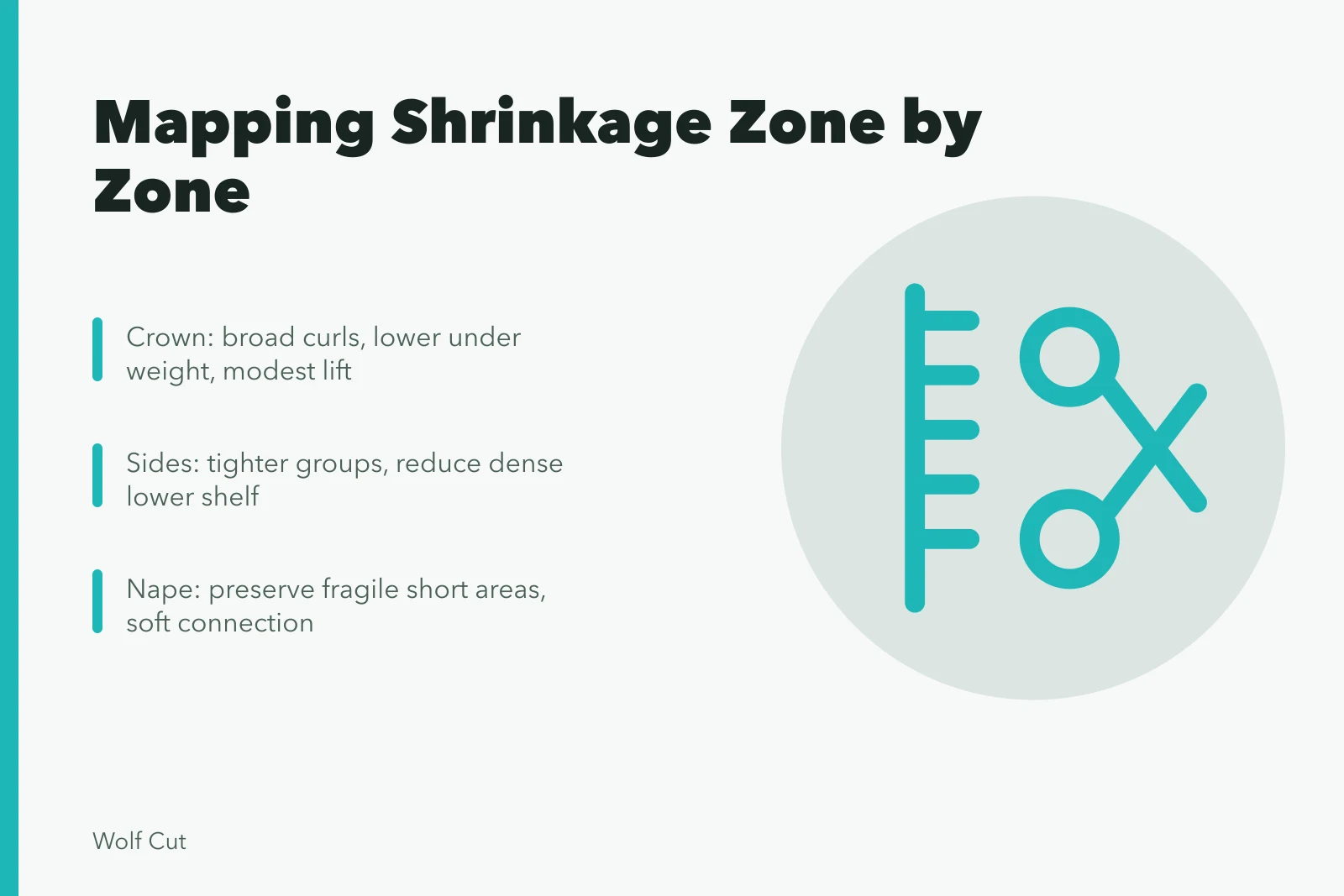
Mapping shrinkage zone by zone in a mixed-pattern curly haircut case
Mixed-pattern curly haircut case showing representative preparation, zone-by-zone shrinkage mapping, a mixed-state cut, dry review, practical styling, and records.
What to take away
- This fictional case illustrates decisions, not a promised result.
- The client had broad crown curls, tighter sides, and a compact nape.
- Equal stretched lengths would not have produced the desired dry outline.
- A mixed-state plan used damp structural control and a settled dry review.
- The stylist balanced the full silhouette without forcing every group to match.
Client brief
Jordan, a fictional client, wanted a rounded shoulder-length shape with less lower-side bulk and a face frame that could still be tied back. Jordan usually wore a wash-and-go, occasionally used a twist-out, and did not want a cut that depended on a blow-dry.
The crown formed broad curls and sat lower under its own weight. The sides contained tighter, smaller groups that expanded outward. The nape contracted most and contained several short sections from prior breakage. The front hairline was fine and changed direction near the temples. The general method for reading that variation is the curly and coily haircutting guide.
Why the label was not enough
Jordan described the hair as one consumer curl type, but the useful information was local. Research on quantifying hair-fiber morphology shows curvature and cross-sectional form are continuous traits. Subjective categories can obscure variation, especially in more tightly curled samples.
A salon does not need laboratory measurement, but it can apply the same principle by recording observed differences instead of assuming one label describes every zone.
The stylist photographed the settled front, sides, and back with consent, then lightly extended representative groups. No numerical shrinkage promise was made. The notes simply marked the nape as highest contraction, the sides as high expansion, and the crown as broader and weight-sensitive. A shrinkage and pattern checklist gives that observation a fixed set of zones.
Design agreement
Jordan and the stylist chose five controls:
| Area | Agreement |
|---|---|
| Crown | Keep enough length for broad groups to form, then add modest lift |
| Sides | Reduce the dense lower shelf without cutting to the nape's height |
| Nape | Preserve fragile short areas and create a soft visual connection |
| Face frame | Begin below the cheekbone and remain tie-back friendly |
| Perimeter | Rounded, with natural variation rather than a rigid horizontal line |
The wash-and-go controlled the shortest lengths. The twist-out was treated as a secondary finish that could look longer and smoother.
Preparation
The hair arrived with an old, compressed set, so the stylist did not shape it immediately. It was cleansed, conditioned, detangled in sections, and dried with Jordan's at-home products and diffuser approach.
The reset revealed more side expansion and less crown height than the arrival state. Building that reset into the sequence is the point of a dry-informed curly haircut plan.
The current Skills England hairdressing professional standard frames salon work around comprehensive consultation, applicable tests, client requirements, safe practice, and a wide range of clients. In this case, that broad duty meant adapting the workflow to Jordan's real pattern and routine, not asking the hair to fit a preset diagram.
Cutting plan
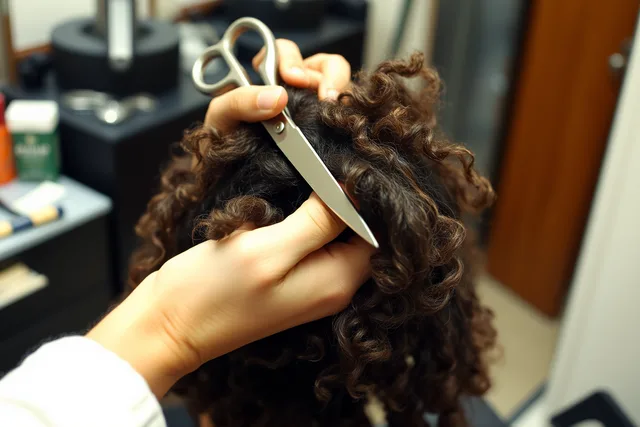
The stylist began with the hair lightly damp to control the lower structure. The nape guide was left longer than its wet appearance suggested. Side sections used less tension and retained more extended length than the crown because they contracted more.
The crown received a modest layer directed to preserve its broad grouping. The stylist did not make the crown as short as the most expanded side, because doing so would have created a separate upper cap.
Around the face, each side was released repeatedly. The finer temple areas stayed longer than a mechanically mirrored section would have dictated. The target was visible balance and tie-back function, not identical quantities of removed hair.
Settled dry review
After diffusing, the nape rose to the planned boundary. The right lower side still formed a dense corner. Instead of thinning the whole panel, the stylist isolated the corner, shortened a small internal group, and released it.
One crown curl hung below its neighbors. Moving the hair showed that it joined several different groups and did not break the silhouette consistently, so it was left alone. This prevented a temporary outlier from becoming a permanent hole after the next wash. The failure it avoids is one of the curly haircut problems.
The face frame landed below the cheekbone and reached the tie. The final perimeter was rounded but not ruler-straight, which matched the agreed natural finish.
Secondary-finish check
Jordan asked how a twist-out would look, so the stylist tested a small area instead of resetting the whole head. The stretched section sat longer and reduced side width.
Jordan accepted the twist-out would create a different outline and did not ask for a second cut to match both states. The same lesson wet, dry, and stretched cutting draw about test state.
Service record
The record included:
- arrival set and reset method;
- zone-by-zone pattern and shrinkage notes;
- damp perimeter and layer work;
- lower tension through the tight sides;
- protected nape and temple areas;
- right-side corner refinement;
- wash-and-go products and diffuser method;
- twist-out difference and client acceptance.
At the next service, the stylist would compare Jordan's home wash-and-go photographs with the record before changing the crown or sides.
What the case shows
The success measure was not identical curls. It was a stable rounded silhouette, controlled side width, protected fragile areas, and a finish Jordan could repeat. Mixed patterns required different length decisions within one coherent plan.
This case does not establish a universal technique for curly hair. A different density, condition, routine, or goal could require a fully dry, fully wet, stretched, or staged approach.
Common questions
Why were the sides left longer when stretched?
They contracted and expanded more than the crown, so equal extended lengths would not have created the agreed dry shape.
Why was the old set reset before cutting?
Compression hid the normal side width and crown behavior.
Why leave one longer crown curl?
It did not consistently break the full silhouette and could join different groups after washing.
Did the wash-and-go and twist-out have identical outlines?
No. Jordan accepted that the stretched finish would sit longer and narrower than the controlling wash-and-go shape.