Maintenance
Part of Shrinkage and density anchor this curly and coily haircutting guide
Curly haircut consultation and shrinkage checklist (2027 update)
Curly haircut checklist for preparation, pattern variation, shrinkage by zone, density, condition, cutting state, dry review, aftercare, and service records.
What to take away
- Record normal preparation and wearing states before assessing the shape.
- Map shrinkage, density, diameter, and pattern variation separately.
- Agree which finished state controls the shortest lengths and outline.
- Use conservative guides where the hair's response is uncertain.
- Review and record the result after curls or coils have settled.
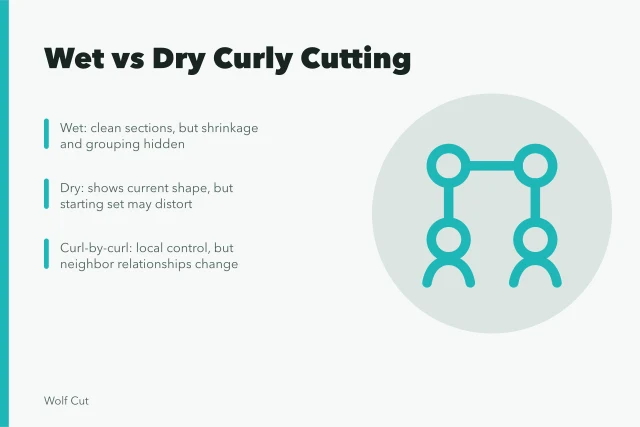
This checklist supports a professional consultation and haircut plan. The method behind it is in the curly and coily haircutting guide. Adapt it to local rules, salon procedures, product instructions, and the stylist's training. It is not a diagnostic tool for hair or scalp disease. Which working state to cut in is compared in wet, dry, and stretched methods.
Client routine and goals
- Ask how often the hair is worn natural, stretched, braided, twisted, or heat-styled.
- Ask how the current hair was prepared and how many days it has been worn.
- Identify regular cleansers, conditioners, styling products, and tools.
- Record detangling method and usual level of tension.
- Discuss tie-back, protective styling, head coverings, and sleep routine.
- Agree the desired width, height, perimeter, face frame, and nape.
- Define the minimum dry length at high-risk zones.
- Decide which finish controls the design promise.
A dermatology review of hairstyling practices in women of African descent reports that highly textured hair is more susceptible to breakage than other hair types. It carries a higher proportion of spirals and relatively fewer elastic fibers anchoring the follicles to the dermis. Its stated aim is individualized recommendations, not one rule applied to everyone.
For a salon checklist, that supports gentle preparation and individualized care, not a universal wash schedule or haircut method. A dry-informed haircut plan sequences that preparation.
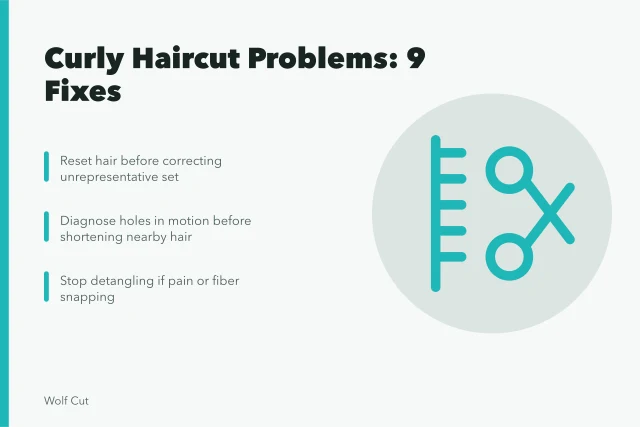
Starting-state check
- Is the hair clean enough to assess?
- Is heavy product changing the grouping or weight?
- Has sleep, banding, or tying compressed one area?
- Does the current set represent normal wear?
- Can the hair be handled without force?
- Is a wash or conditioning reset needed before cutting?
- Has the client consented to the preparation and finish plan?
Hair and scalp observations
- Inspect the scalp without diagnosing conditions.
- Note pain, sores, inflammation, scaling, smooth patches, or sudden thinning.
- Map density at crown, front, temples, sides, back, and nape.
- Record strand diameter and mixed-diameter areas.
- Note knots, split ends, breakage, altered texture, and chemical history.
- Identify strong growth directions and hairline variation.
- Refer concerns outside salon scope to an appropriate clinician.
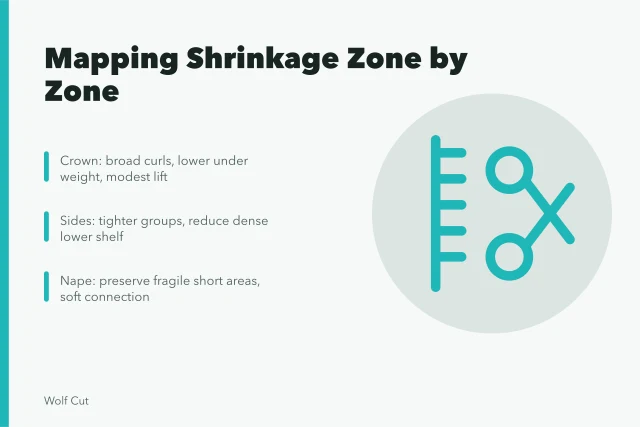
Pattern and shrinkage map
- Observe the full shape without stretching.
- Identify broad waves, curls, coils, compact bends, and mixed areas.
- Note group size and whether groups divide easily.
- Compare gently extended and settled length at several zones.
- Record areas with markedly greater or lower contraction.
- Check the fringe and nape separately.
- Avoid using ancestry as a proxy for observed behavior.
- Avoid promising one fixed shrinkage percentage.
Technical plan
- Choose wet, dry, stretched, or mixed states by purpose.
- Mark guides for the outer shape and internal structure.
- Protect the minimum fringe, side, nape, and perimeter lengths.
- Decide how much density must remain at the edge.
- Choose section size that stays controllable.
- Plan consistent moisture and tension within each zone.
- Define cross-check and dry-review stages.
- Set a stopping point before optional texturizing.
The draft Skills England hairdressing assessment plan covers observation on live clients with differing classifications and characteristics. It lists consultation factors: density, texture, elasticity, porosity, and condition. It also names growth patterns, lifestyle, previous services, and service limits.
That range supports a full assessment, not a method from curl appearance alone, so separate density, diameter, texture, and growth pattern, not one label.
Cutting controls
- Position the client upright for outline checks.
- Use gentle detangling and manageable sections.
- Keep a guide's working state consistent.
- Release test sections before expanding a short guide.
- Check the full silhouette from working distance.
- Do not trim every temporary outlier.
- Stop if the perimeter loses agreed density.
- Keep the client's minimum lengths visible in the record.
Reset and finish
- Use the agreed products and realistic quantities.
- Avoid excessive heat, airflow, handling, or tension.
- Let groups settle before refinement.
- Review front, profiles, back, crown, and overhead shape.
- Move the hair gently to reveal holes or shelves.
- Compare the result with the agreed wearing state.
- Make small, confirmed corrections only.
- Explain how another finish may change the silhouette.
Service record
- Starting state and preparation
- Pattern and shrinkage map
- Density, diameter, and condition notes
- Cutting states and guides
- Protected zones and texture decisions
- Products and drying method
- Client response and home routine
- Referral or service-limit notes where applicable
Common questions
Should shrinkage be written as one percentage?
Usually not. Record how representative zones behave because contraction can vary across one head.
Is a curl chart enough for consultation?
No. It omits density, diameter, condition, growth, routine, and local pattern variation.
Why record the starting set?
It explains whether the observed shape came from natural fall, a fresh set, compression, or stretching.
What should trigger referral?
Pain, sores, inflammation, smooth patches, sudden shedding, or unexplained thinning need clinical assessment rather than salon diagnosis.