Guides
Shrinkage and density anchor this curly and coily haircutting guide
Curly and coily haircutting guide covering curl variation, shrinkage mapping, density, shape, wet and dry checks, detangling, finishing, maintenance, and records.
What to take away
- Assess the individual head, not a curl-type label or assumed ancestry.
- Map shrinkage, density, strand diameter, condition, and grouping by zone.
- Choose wet, dry, stretched, or mixed cutting states for a stated reason.
- Judge the silhouette in the finish the client normally wears.
- Preserve length when uncertainty, breakage, or uneven shrinkage raises the risk of overcutting.
Curly and coily hair is not one uniform material. One head can hold broad waves, tight coils, compact bends, and looser sections. Areas may change from heat, chemicals, tension, or damage, so a good haircut starts by seeing variation, not forcing it into one number or letter.
Separating density, diameter, texture, and growth is the first step in that observation.
Describe what the hair does
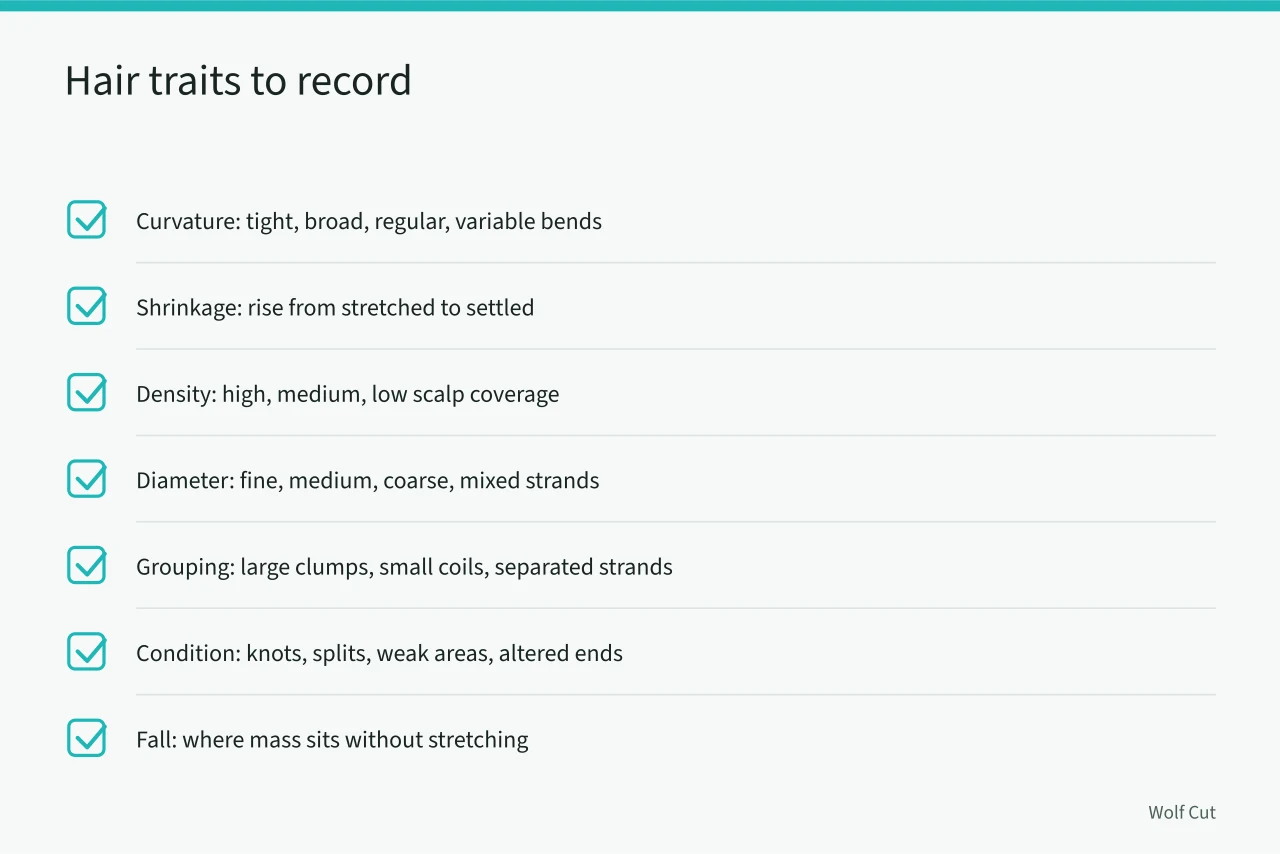
Useful observations include:
| Property | Salon question |
|---|---|
| Curvature | How tight, broad, regular, or variable are the bends? |
| Shrinkage | How far does each zone rise from stretched to settled? |
| Density | Where is scalp coverage high, medium, or low? |
| Diameter | Are strands fine, medium, coarse, or mixed? |
| Grouping | Do fibers form large clumps, small coils, or separated strands? |
| Condition | Are there knots, splits, weak areas, or altered ends? |
| Fall | Where does the mass sit without forced stretching? |
A 2026 systematic review of high-curl-pattern hair classification found several competing systems and notes that familiar alphanumeric labels can miss multiple patterns on one head, density, and porosity. It also describes newer approaches based on measurable morphology. For a haircut, the practical lesson is to record visible traits directly and avoid treating a category as a complete service plan.
Map shrinkage before setting lengths
Shrinkage is the visible difference between an extended fiber and its settled form. It can vary across the crown, sides, hairline, and nape. Mapping it point by point is what the curly haircut shrinkage checklist is for. Product, moisture, drying method, gravity, and previous alteration also change the comparison.
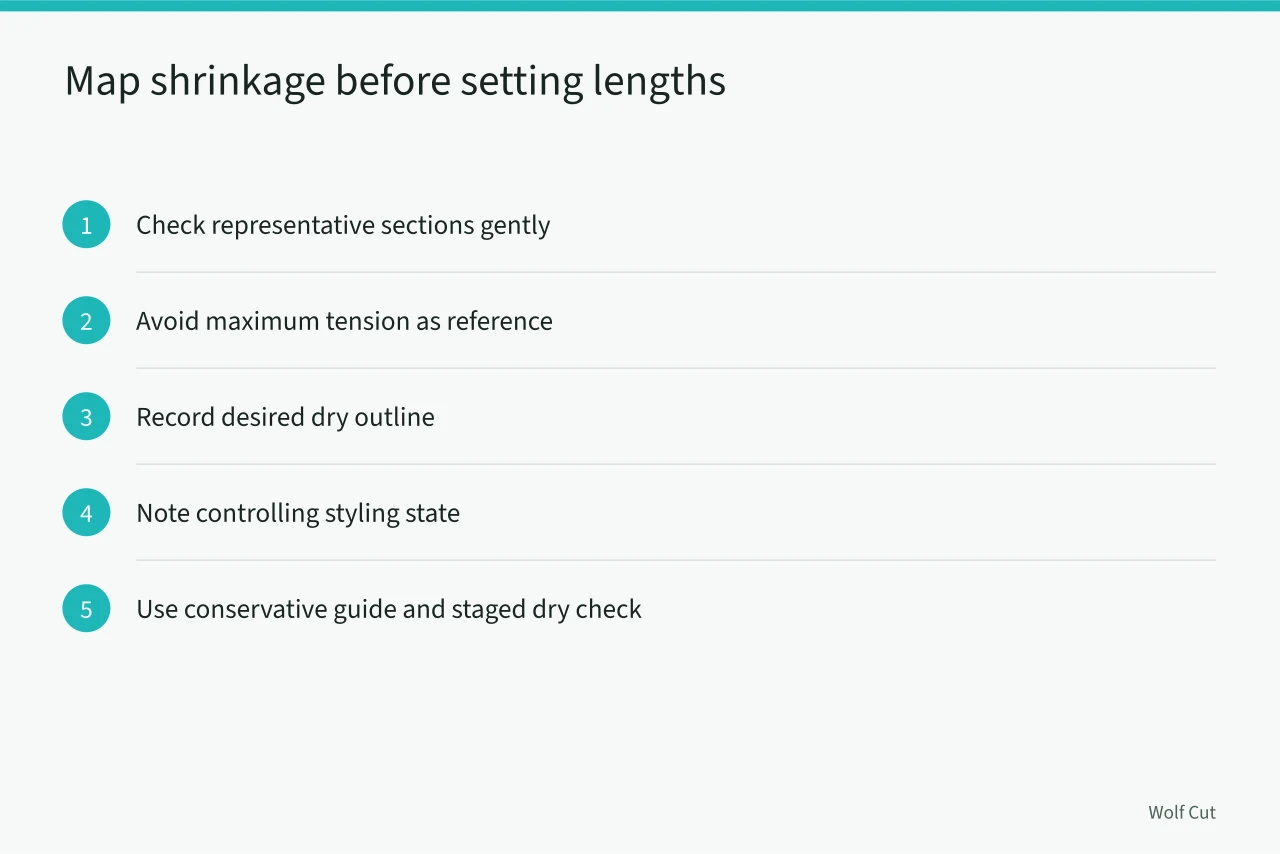
Check representative sections gently. Do not pull to the point of discomfort or use maximum tension as the only reference. Record where the client wants the dry outline to land and which styling state should control that promise.
If the front springs much higher than the back, mechanically equal wet lengths may not create an even dry outline. A conservative guide and staged dry check are safer than applying a single shrinkage allowance to the whole head.
Design the mass, not isolated curls
Decide the overall width, height, perimeter, crown, face frame, and nape. Then consider how individual groups support that form.
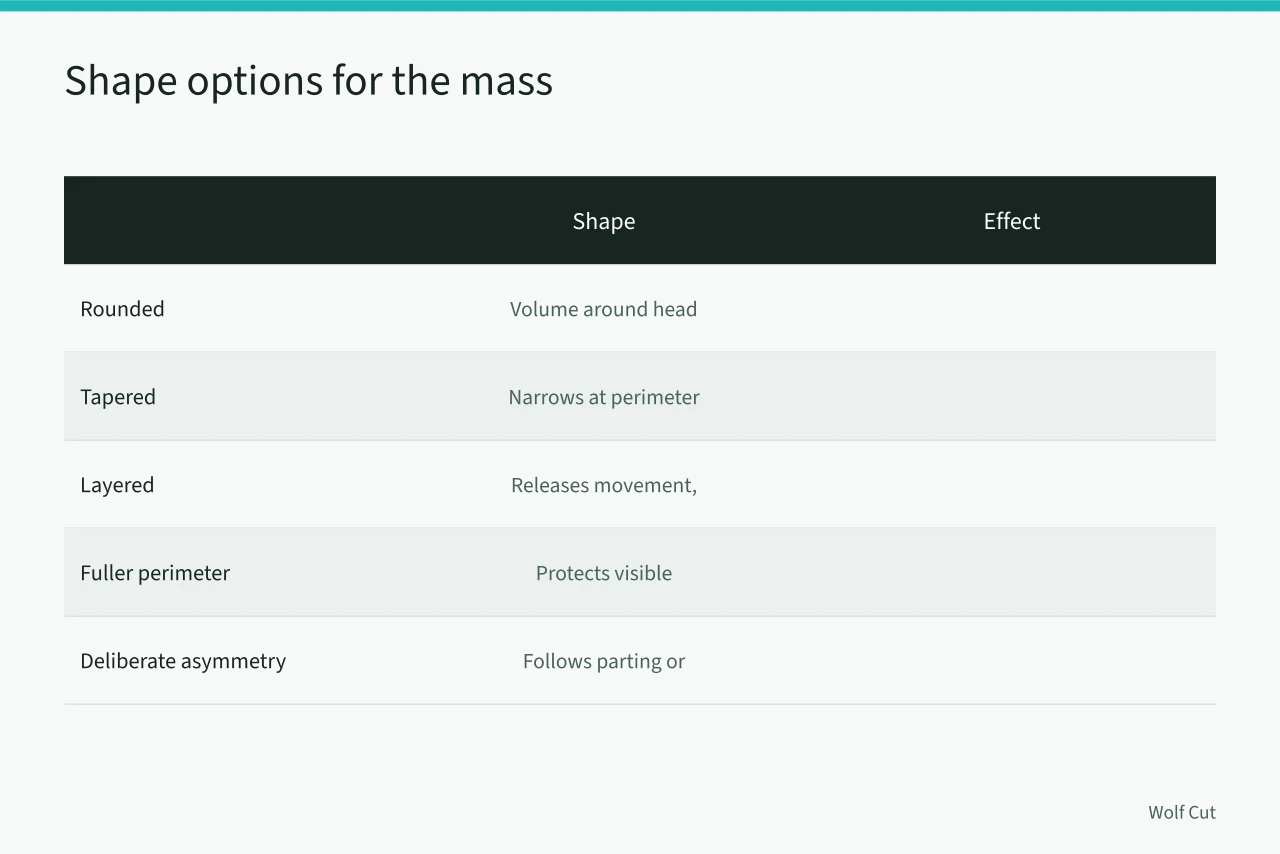
- A rounded shape distributes volume around the head.
- A tapered shape narrows toward the perimeter or nape.
- A layered shape can release movement and prevent a dense lower shelf.
- A fuller perimeter protects visible density and length.
- A deliberate asymmetry can follow the client's parting or preferred silhouette.
Cutting every curl to its apparent neighbor can create holes when groups reform after washing. Work between close observation and the full silhouette.
Choose the cutting state by purpose
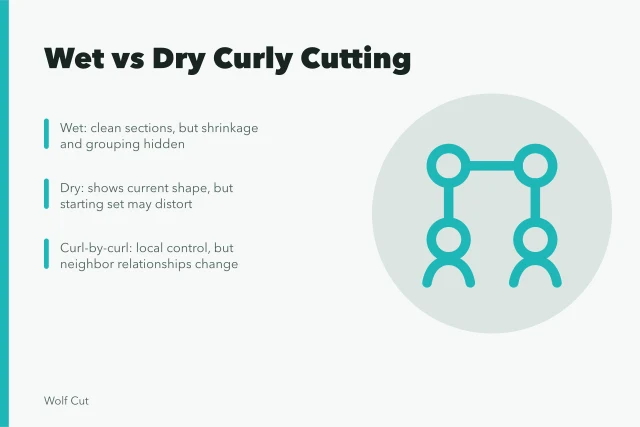
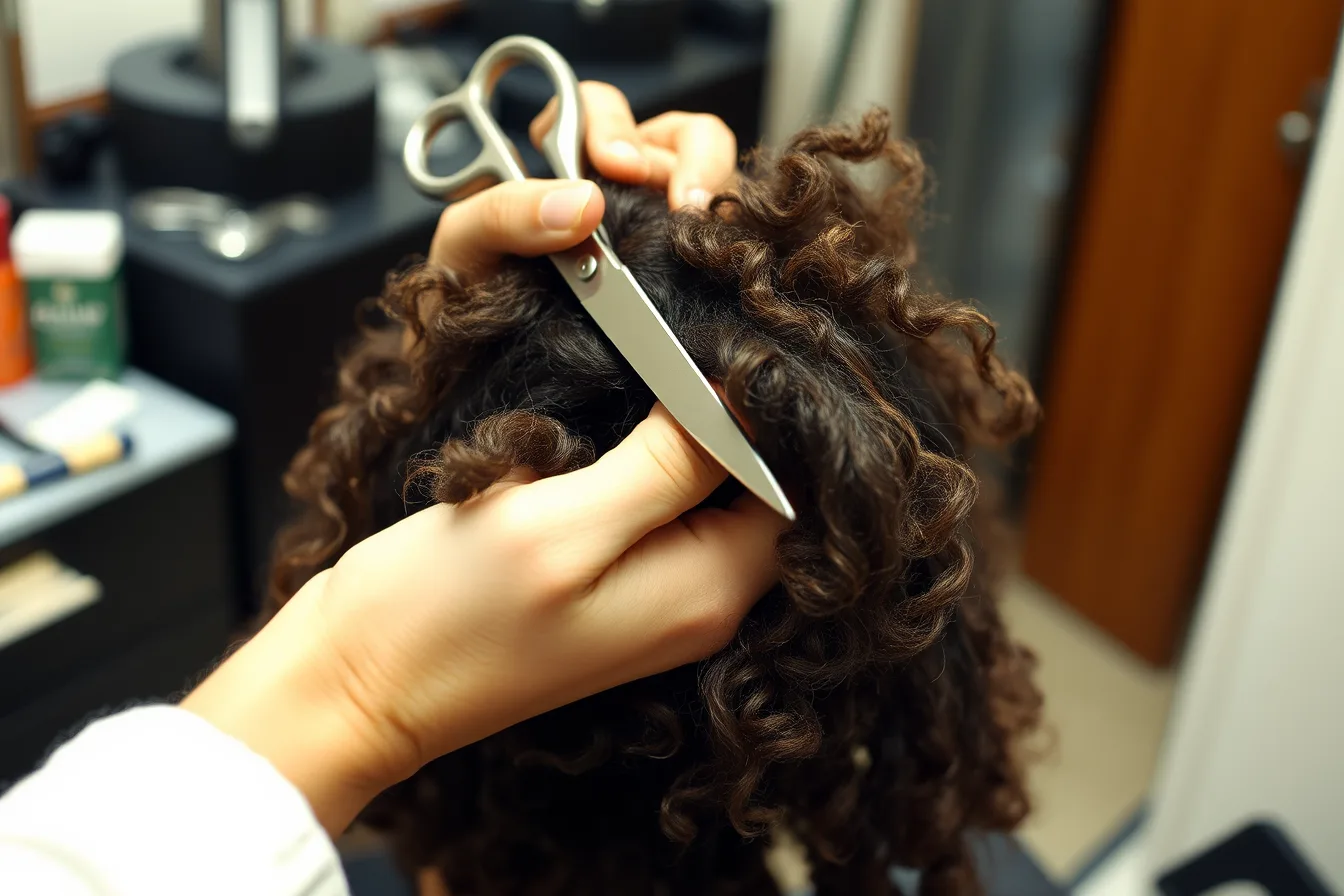
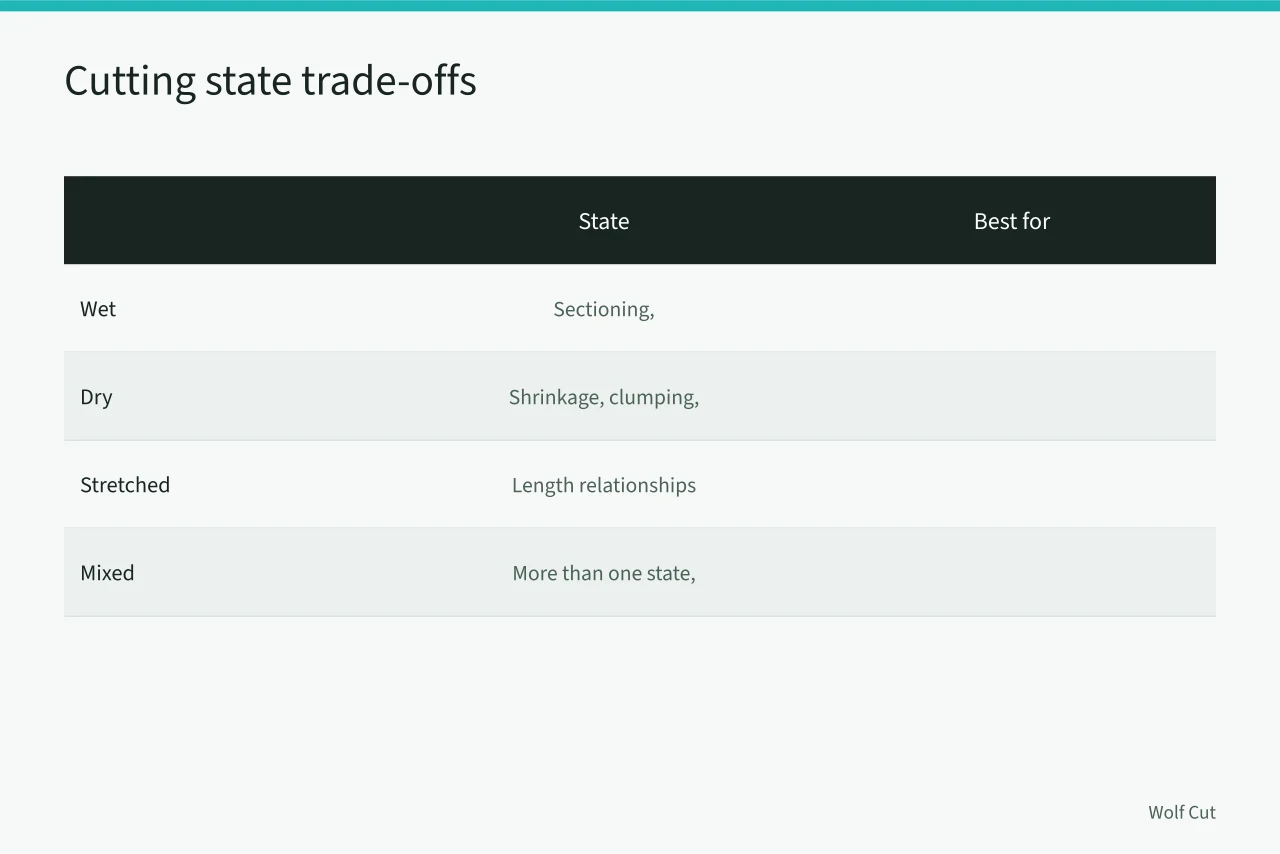
Wet work can make sectioning, detangling, and guide control easier. Dry work reveals current shrinkage, clumping, and occupied space. Stretched work can clarify length relationships in compact coils. A mixed service can use more than one state, but each stage needs a defined job. The trade-offs of wet, dry, group, and stretched cutting are worth reading side by side.
Ask whether the client arrives with the hair in its typical clean, dry finish. Heavy product, an old twist-out, tight banding, or prolonged compression may distort the shape. If the starting state is not representative, reset it rather than pretending the observation is neutral. A dry-informed curly haircut plan builds that reset into the sequence.
Control handling and tension
Detangle in manageable sections with suitable moisture, slip, and tools. Support the hair near a knot and avoid repeated pulling. During cutting, use enough tension to control the section without erasing its behavior.
Maintain a consistent state within guide-dependent work. A drying subsection may shrink while a wet neighbor remains extended. This can look like an inaccurate guide even when the sectioning was correct.
Cross-check in natural movement
After the main structure is complete, let the hair settle. Check the front, profiles, back, crown, and overhead silhouette. Move the hair gently and inspect for empty spots, shelves, dense corners, and stray extended ends.
Do not require every curl to land at the same visual height. Natural groups vary. Correct shape-breaking lengths that persist through normal movement, not every temporary separation.
Finish without hiding the cut
Use the client's agreed routine when possible. Product amount, application method, drying direction, diffuser handling, and stretching can all alter the outline. A highly controlled set should not be the only evidence that the cut works.
Teach a manageable routine and name what will change with a wash-and-go, twist-out, braid-out, blow-dry, or stretched finish. Record the finish used during the review.
Maintenance and referral boundaries
Discuss tangling, knotting, perimeter wear, and shape changes as the cut grows. Do not diagnose scalp disease or hair loss.
The U.S. National Library of Medicine's health topic on hair problems groups hair loss, infections, and flaking as common scalp complaints. It also covers shaft conditions such as trichorrhexis nodosa. That range is why a stylist cannot separate them by eye.
Refer sudden shedding, smooth patches, pain, inflammation, scaling, sores, or unexplained thinning to an appropriate clinician.
The service record should contain shrinkage observations, density map, working state, guides, protected zones, finish, client response, and agreed maintenance.
Common questions
Is one curl type enough to plan a haircut?
No. Density, diameter, shrinkage, condition, grouping, and pattern variation also affect the result.
Must curly hair be cut dry?
No. Wet, dry, stretched, and mixed methods each offer different controls. The choice should match the design and client.
Should every curl end at the same height?
No. The full silhouette should be balanced, but natural groups can land differently.
Can a stylist diagnose the cause of thinning?
No. A stylist can observe and document concerns, limit the service, and recommend clinical assessment.
In this guide
- Planning a dry-informed curly haircut with a proper zone mapDry-informed curly haircut planning from representative prep and shrinkage mapping through silhouette building, controlled cutting, reset checks, and records.
- Wet versus dry curly cutting: which method controls shrinkage betterWet, dry, curl-by-curl, and stretched cutting compared by visibility, guide control, shrinkage, tension, pattern changes, reset needs, client routine, and risks.
- Curly haircut consultation and shrinkage checklist (2027 update)Curly haircut checklist for preparation, pattern variation, shrinkage by zone, density, condition, cutting state, dry review, aftercare, and service records.
- 9 pointers on curly haircut problems that hold upCurly haircut problems explained: uneven shrinkage, holes, tangles, shape collapse, fragile ends, tension, product effects, and conservative correction checkpoints.
- Mapping shrinkage zone by zone in a mixed-pattern curly haircut caseMixed-pattern curly haircut case showing representative preparation, zone-by-zone shrinkage mapping, a mixed-state cut, dry review, practical styling, and records.