Reviews
Part of Moisture control through home styling: the haircut finishing guide
Air, diffuser, wrap and round-brush drying compared for haircut visibility
Hair drying methods compared by finish, airflow, tension, heat, time, curl preservation, volume, smoothness, haircut visibility, and home upkeep.
What to take away
- No drying method is automatically best for every hair type or haircut.
- Air drying limits active heat but can leave shape dependent on natural grouping and gravity.
- Diffusing supports curl groups when airflow and handling stay controlled.
- Wrap drying creates broad direction with less concentrated bend than round brushing.
- Round brushing offers focused lift and polish but adds tension, coordination, and repeated exposure.
The method used after a haircut changes the visible result. A client may judge a cut as flat, full, smooth, or uneven when part of that impression comes from drying. Compare methods by the same agreed variables: shape, movement, heat, tension, time, product, and repeatability. The controls behind each variable are set out in the haircut finishing guide.
Comparison table
Typical finish
- Air drying
- Natural grouping and fall
- Diffuser drying
- Supported wave or curl definition
- Wrap drying
- Broad smooth direction
- Round brushing
- Focused bend, lift, and polish
Main control
- Air drying
- Moisture, product, placement, disturbance
- Diffuser drying
- Airflow, heat, cup position, touch
- Wrap drying
- Head shape, brush path, airflow
- Round brushing
- Barrel, section, tension, heat, cooling
Common mismatch
- Air drying
- Expecting salon-directed root lift
- Diffuser drying
- Blasting groups apart
- Wrap drying
- Flattening volume needed by the cut
- Round brushing
- Hiding weak structure with temporary shape
These are broad patterns. A skilled stylist can adapt each method, and many finishes combine two of them.
Drying Methods Compared
Air
- Finish
- Natural grouping
- Main control
- Moisture, placement
- Common mismatch
- Expecting root lift
Diffuser
- Finish
- Curl definition
- Main control
- Airflow, cup position
- Common mismatch
- Blasting groups apart
Wrap
- Finish
- Smooth direction
- Main control
- Head shape, brush path
- Common mismatch
- Flattening volume
Round brush
- Finish
- Bend and polish
- Main control
- Barrel, tension, heat
- Common mismatch
- Hiding weak structure
Air drying
Air drying removes active dryer heat and can show how the cut behaves under gravity and natural curl grouping. It is useful when the client's routine avoids electrical tools or when a natural finish is the design target.
It is not a zero-control method. Product amount, water level, parting, clips, scrunching, touch, clothing contact, and time spent wet affect the result. Dense interior areas may remain damp after the surface feels dry.
Dermatologists advise limiting excessive heat and reducing blow-dryer frequency when hair is fragile. The American Academy of Dermatology's hair styling guidance also recommends allowing hair to partially air dry and using low or medium settings for heated tools. This supports a conservative approach, not a claim that every person must air dry completely.
Best fit: clients who want a natural result and can allow sufficient undisturbed drying time.
Diffuser drying
A diffuser spreads the dryer airflow over a wider area. It can preserve wave and curl groups while bringing roots and dense sections to a controlled dry state. Position and remove the diffuser deliberately instead of constantly stirring the hair.
Low disturbance is often more important than maximum lift. Dry the underside and root zones, then check the surface. High air speed can separate groups into frizz before a gel or setting product forms support.
Best fit: wavy, curly, coily, or mixed-pattern hair when the goal is to support rather than straighten movement. The cutting side of that goal is the curly and coily haircutting guide.
Wrap drying
Wrap drying follows the head shape, moving sections around the contour with a flat or paddle brush. Changing direction can reduce strong parting or add broad root movement. Airflow follows the section while tension stays even.
This method creates a smooth base without giving every section a round-brush bend. It can reveal perimeter balance and produce a flexible foundation for later detail work. Too much downward control can flatten a crown that needs lift.
Best fit: smooth, mobile finishes; short to medium shapes; or a neutral base before selective volume.
Round brushing
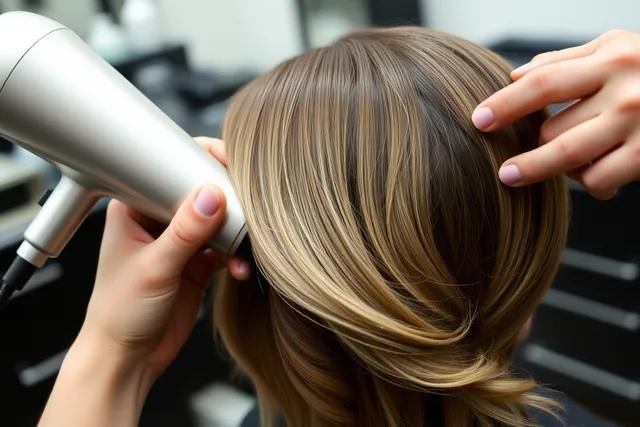
Round brushing combines heat, airflow, tension, barrel diameter, overdirection, and cooling. A smaller barrel can create more bend; a larger barrel can create broader shape, subject to hair length and section size.
The method can polish a perimeter, turn ends, build root lift, or support a layered arc. It also demands coordination. Oversized sections dry unevenly, and repeated passes may overheat the surface while the interior remains damp.
Australian competency guidance for drying hair to shape calls for measuring products according to instructions, systematic sectioning, thorough drying, directing warm air along the hair-shaft imbrications, and finishing to the planned outcome. It is a training standard, not a promise that one brush method suits every client.
Best fit: clients who want directed volume, bend, or polish and can reproduce at least the important parts of the technique.
Compare by practical constraints
Time
Air drying uses little active labor but may take the longest elapsed time. Diffusing reduces elapsed time but requires attention. Wrap drying and round brushing use more active styling time.
Heat and tension
Air drying uses no powered heat. A diffuser uses heat and airflow with little or no brush tension. Wrap drying uses broad tension. Round brushing can apply the most focused tension and repeated heat.
Haircut visibility
Air drying and diffusing show natural grouping. Wrap drying shows broad balance and perimeter. Round brushing can reveal polish but may conceal a layer that does not fall well without support. Avoiding that is the point of finishing a layered cut honestly.
Home repeatability
Match the method to mobility, coordination, sensory tolerance, tools, time, and reach. A technically impressive finish is a poor prescription when the client cannot or does not want to repeat it.
Use a hybrid plan
A client might partially air dry, diffuse roots, and round-brush only the fringe. Another might wrap dry the base and use fingers on layered ends. Name each step's purpose. Remove any step that does not contribute to the agreed result.
Record both the salon method and the simplest home version. For curl, the dry-informed curly haircut plan treats that record as part of the design. At the next appointment, compare how the cut behaved between visits.
Common questions
Is air drying always the gentlest method?
It avoids powered heat, but prolonged wetness, handling, environment, and hair condition still matter. Avoid absolute claims.
Does a diffuser prevent frizz?
Not by itself. Air speed, heat, product, moisture, handling, and existing hair condition affect frizz.
Is wrap drying the same as flat ironing?
No. Wrap drying uses directed dryer airflow and a brush around the head; a flat iron uses heated plates.
Which method best reveals layers?
The one that matches the intended wear pattern and lets the hair settle without being held in a temporary brush shape.