Guides
What do NVQ and VRQ hairdressing qualifications mean for UK stylists?
NVQ and VRQ hairdressing qualifications explained for UK stylists covering levels, awarding bodies, Ofqual regulation and how to check a course.
What to take away
- NVQ means National Vocational Qualification. VRQ means Vocationally Related Qualification. Both are regulated in England by Ofqual.
- An NVQ is assessed on real clients in a real salon. A VRQ is taught first and assessed on blocks, mannequins and supervised clients.
- Level 2 is the usual salon floor entry point. Level 3 is the advanced cutting tier most senior stylists hold.
- City & Guilds and VTCT are the two awarding bodies you will meet most in UK hairdressing.
- You can check any qualification and any awarding organisation free on the government registers before you pay a deposit.
What NVQ and VRQ actually stand for in hairdressing
NVQ stands for National Vocational Qualification. VRQ stands for Vocationally Related Qualification. Both are vocational, both can be taken in hairdressing, and both are regulated in England by Ofqual.
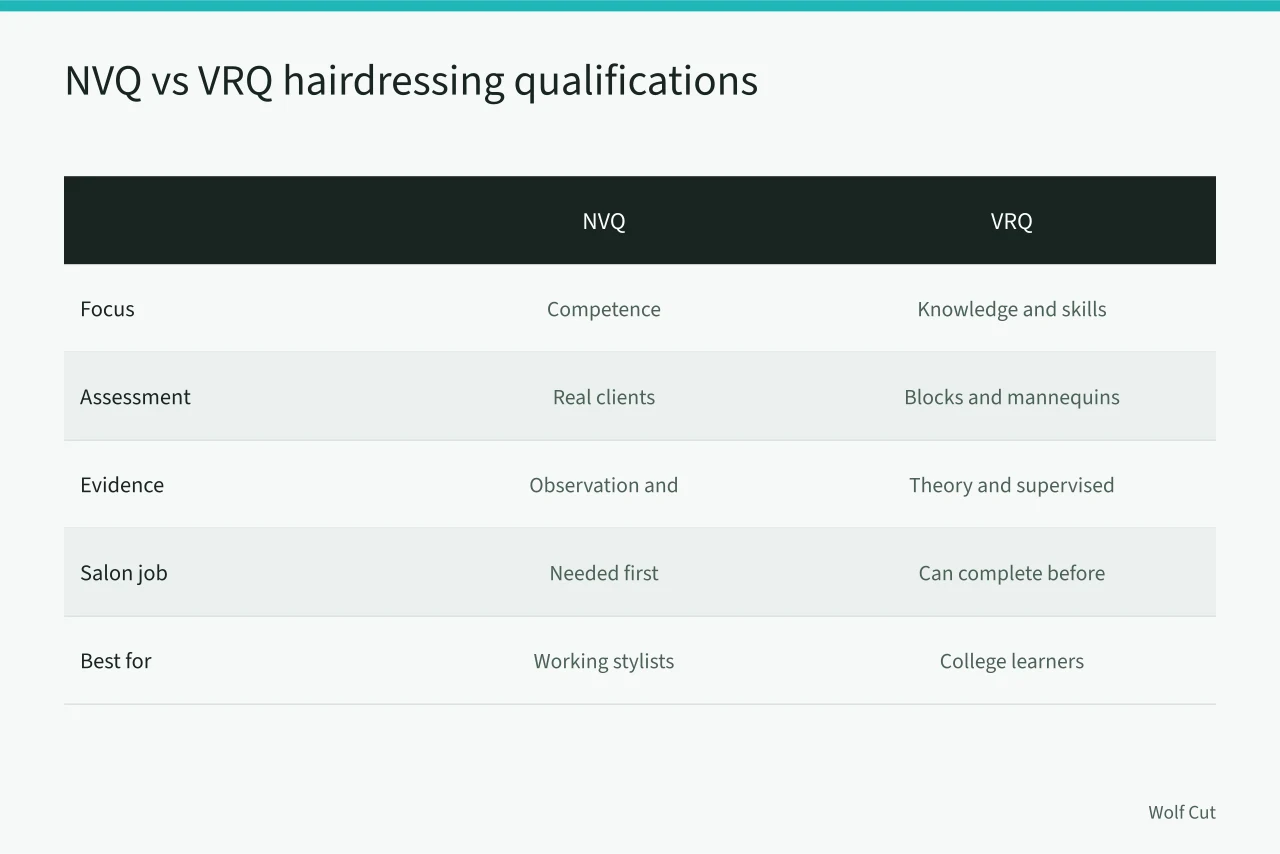
The difference is how they are assessed. An NVQ is competence-based. You prove you can do the job on real clients, in a real salon, to commercial standards. Evidence comes from observation, witness testimony and your own portfolio.
If you already work in a salon, an NVQ is usually the faster route, because your paid work becomes your evidence.
A VRQ is knowledge and skills based. You learn the theory and practise the techniques, often in a college or private training centre, on blocks, mannequins and supervised clients. A VRQ can be completed before you have a salon job. Many learners take one first, then move into an NVQ or an apprenticeship.
For a wolf cut specialist, the practical upshot is simple. The NVQ proves you can cut and finish hair on the salon floor. The VRQ proves you were taught the underpinning knowledge:
- head shape
- sectioning
- tension
- elevation
- graduation
- layering
- disconnection
A wolf cut leans on all of those. It is a heavily layered shape with weight removed from the interior and length kept at the perimeter.
Some providers blend the two. You might enrol on a Level 2 NVQ and sit VRQ units alongside it, or take a VRQ in a specialist area such as barbering or creative styling. Ask the provider which qualification you will actually be certificated for, and check that certificate against the register later.
One more distinction matters in the UK. An NVQ is not a licence to practise. Hairdressing is not a protected profession, and no single certificate is legally required to cut hair for money.
What the qualification does is give employers, insurers and clients a recognised benchmark. It also supports the case for higher pricing once you can demonstrate a specialist shape like a wolf cut.
Higher pricing and repeat clients usually follow from a shape planned around the individual head. The process behind that is covered in customized wolf cut planning.
Qualification levels explained: from Level 1 to Level 3 and beyond
The UK framework runs from Entry Level up to Level 8. Hairdressing occupies the lower and middle rungs, with clear progression. The government publishes the full level descriptors if you want the official wording behind each tier, and you can read what each qualification level means before you choose a course.
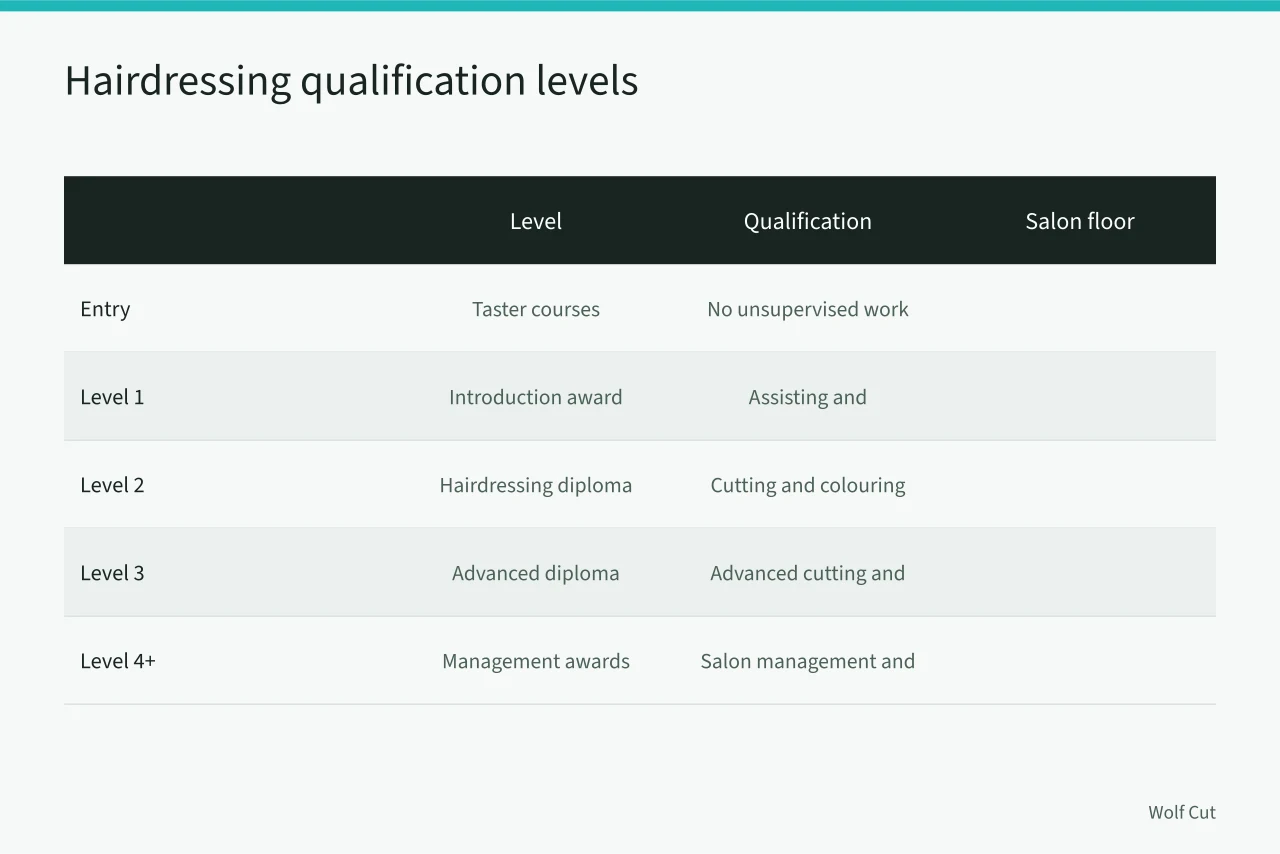
| Level | Typical hairdressing qualification | What it means on the salon floor |
|---|---|---|
| Entry Level | Pre-vocational taster courses | No unsupervised client work |
| Level 1 | Award or Certificate in an Introduction to Hair and Beauty | Assisting, shampooing, basic prep |
| Level 2 | NVQ or VRQ Diploma in Hairdressing | Cutting, colouring and styling on clients under supervision or independently |
| Level 3 | NVQ or VRQ Diploma in Advanced Hairdressing | Advanced cutting, colour correction, creative styling, senior stylist roles |
| Level 4 and above | Higher qualifications, management and teaching awards | Salon management, education, technical specialisms |
Level 1 is an introduction. It covers shampooing, conditioning, basic blow-drying and salon health and safety. It is a stepping stone, not a working qualification.
Level 2 is the standard entry point for a junior stylist in the UK. It covers cutting, colouring, perming and styling, plus client care and consultation. Most salon jobs advertised for junior stylists ask for a Level 2 in hairdressing or equivalent.
If you can cut a layered shape and hold a conversation about aftercare, you are working at this level.
Level 3 is the advanced tier. It covers advanced cutting, advanced colour, creative styling and often salon supervision. It is the qualification most senior stylists and educators hold. For a wolf cut specialist, Level 3 is where you would expect to see units on advanced layering, disconnection and personalised styling, because those are the technical foundations of the cut.
Level 4 and above move into management, teaching, trichology or technical training. These are not cutting qualifications as such, but they matter if you want to run a salon, teach in a college or train staff.
Levels are not a measure of talent. A stylist with a Level 2 and five years on the salon floor can out-cut a newly qualified Level 3. Levels describe the scope of the qualification, not the skill of the holder. Employers know this, which is why interviews and trade tests sit alongside certificates.
If you are choosing a course, match the level to the job you want. Level 2 for salon floor work. Level 3 if you want to specialise, teach or supervise. Beyond that, choose by specialism rather than by number.
Awarding bodies: City & Guilds, VTCT and how to verify them
An awarding body designs the qualification, sets the assessment standards and issues the certificate. In UK hairdressing, two names come up constantly: City & Guilds and VTCT. Others operate too, including awarding organisations that offer hairdressing and barbering qualifications.
City & Guilds is one of the oldest awarding bodies in the country. Its hairdressing qualifications are widely recognised by salons, and its Level 2 and Level 3 diplomas are common in colleges and apprenticeships. If you trained in a further education college, there is a good chance your certificate carries the City & Guilds name.
VTCT is the Vocational Training Charitable Trust. It specialises in hair, beauty, complementary therapies and related vocational areas. Many private training academies and colleges deliver VTCT qualifications, and its hair professional standards cover cutting, colouring, styling and barbering.
Both are regulated awarding organisations. That matters, because it means their qualifications sit on the official register and their assessment arrangements are monitored. You can look up any awarding organisation on the register of regulated awarding organisations before you commit to a course.
The register is the fastest way to check a provider's claim. If a training school says it offers a "City & Guilds Level 3" but City & Guilds does not list that qualification, something is wrong. The same test applies to VTCT and to any smaller awarding body you have not heard of.
Awarding bodies do not teach. They approve centres, moderate assessment and issue certificates. The teaching happens at a college, a private academy or in your salon through an apprenticeship provider. When you compare courses, compare the centre's teaching quality and the awarding body's recognition separately. A strong centre with a recognised awarding body is the combination you want.
For wolf cut work specifically, the awarding body matters less than the units on offer. Look for units covering advanced cutting, layering, texturising and personalised styling. Those are the units that map onto the shape you want to learn, and the shape itself is set out in our wolf cut guide.
Ofqual regulation and the conditions awarding organisations must meet
Ofqual is the regulator of qualifications, examinations and assessments in England. It grants recognition to awarding organisations and keeps watch over the qualifications they provide. Its remit covers general and vocational qualifications, including hairdressing, as set out on the Ofqual page on GOV.UK.
Regulation is not a rubber stamp. To be recognised, an awarding organisation must meet a set of general conditions. These cover how qualifications are designed, how assessment is carried out, how results are issued and how complaints are handled. The full conditions are published in the Ofqual Handbook.
The conditions exist to protect learners. They mean a regulated qualification has a defined purpose, a valid assessment method and a certificate that can be checked. If an awarding organisation fails to meet the conditions, Ofqual can intervene, and in serious cases withdraw recognition.
Scotland, Wales and Northern Ireland have their own arrangements. Qualifications in Scotland are regulated by SQA Accreditation, and in Wales by Qualifications Wales. If you train in Glasgow, Cardiff or Belfast, the regulator named on your certificate may differ from the English one.
The qualification can still be recognised across the UK, but the paperwork trail runs through a different body.
For a working stylist, the practical value of regulation is threefold. It tells you the qualification is real. It tells employers and insurers that the standard has been checked. And it gives you a route to complain if a training provider or awarding organisation lets you down.
Regulation does not cover every short course. A one-day cutting workshop, a manufacturer's colour update or an in-salon session is not usually a regulated qualification. That does not make it worthless, but it does mean you should not expect it to appear on the register. Know which type of training you are buying.
How employers read qualifications when hiring wolf cut specialists
Salon owners read qualifications quickly, then move to the trade test. A certificate gets you the interview. A haircut gets you the job.
Most UK salon job adverts ask for a Level 2 in hairdressing or equivalent, with Level 3 preferred for senior roles. "Or equivalent" is doing real work in that sentence. It covers overseas qualifications, unregulated but substantial training, and long salon experience without formal certificates. If you have the skills, apply.
When a salon is hiring for a specialist shape such as a wolf cut, the advert often mentions layered cutting, creative styling or advanced techniques. That is a signal that they want a stylist who can handle weight distribution, face framing and a soft, blended perimeter. A Level 3 with advanced cutting units is the closest formal match.
Employers also read the awarding body. City & Guilds and VTCT certificates are familiar and trusted. An unfamiliar awarding body is not automatically a problem, but expect questions. Be ready to explain what you covered and how you were assessed. The questions clients and employers raise are listed in our wolf cut checklist.
Insurance is the other filter. Many salon insurance policies and self-employed policies ask for evidence of training. A regulated qualification makes that straightforward. If you are mobile or rent a chair, check what your insurer accepts before you rely on a short course alone.
Finally, employers watch for gaps between certificate and competence. A Level 3 who cannot section cleanly or blend a fringe will not last. A Level 2 who cuts a clean, wearable wolf cut on a trade test will. Bring your portfolio, bring photographs, and be ready to cut.
CPD options and short courses that build on a formal qualification
CPD stands for continuing professional development. In hairdressing it is not usually mandatory, but it is how you keep your skills current and move into specialist work. For a wolf cut specialist, CPD is where the formal framework ends and your own style begins.
- Awarding body short courses. City & Guilds, VTCT and similar bodies offer units and short qualifications in specific techniques. These carry a certificate and may sit on the register.
- Manufacturer and brand education. Colour houses and product brands run cutting and colour courses, often tied to a product launch. Good for technique and product knowledge, not a regulated qualification.
- Salon group academies. Larger UK salon groups run internal academies with structured progression. Valuable if you want to rise within that group.
- Independent specialist courses. One and two day workshops focused on a single shape or technique, including layered and disconnected cuts. Quality varies, so ask for the trainer's background and see previous work.
- Peer and online learning. Tutorials, live streams and community critique. Useful for ideas, weak as evidence of competence.
For wolf cut work, the most useful CPD combines advanced layering, dry refinement and consultation. Layering gives you the structure. Dry refinement lets you check balance and remove weight with precision, which is the subject of our scissor haircutting guide.
Consultation keeps the result wearable for the client's hair type and routine. A stylist who understands weight, texture and movement will adapt the same shape to very different heads, which is a skill that builds over years rather than weeks.
Build a simple CPD record. Note the course, the date, the trainer, what you practised and what you changed in your cutting as a result. Insurers, employers and future clients respond well to a stylist who can show progression. It also helps you price specialist work confidently.
If you want a formal route, look at Level 3 advanced cutting units, then add specialist short courses on top. That combination gives you a regulated base plus a distinctive skill set, which is exactly what a salon hiring a wolf cut specialist wants to see.
Checking a qualification is regulated before you pay for training
This is the step most learners skip, and it is the one that protects your money. Before you pay a deposit, run these checks.
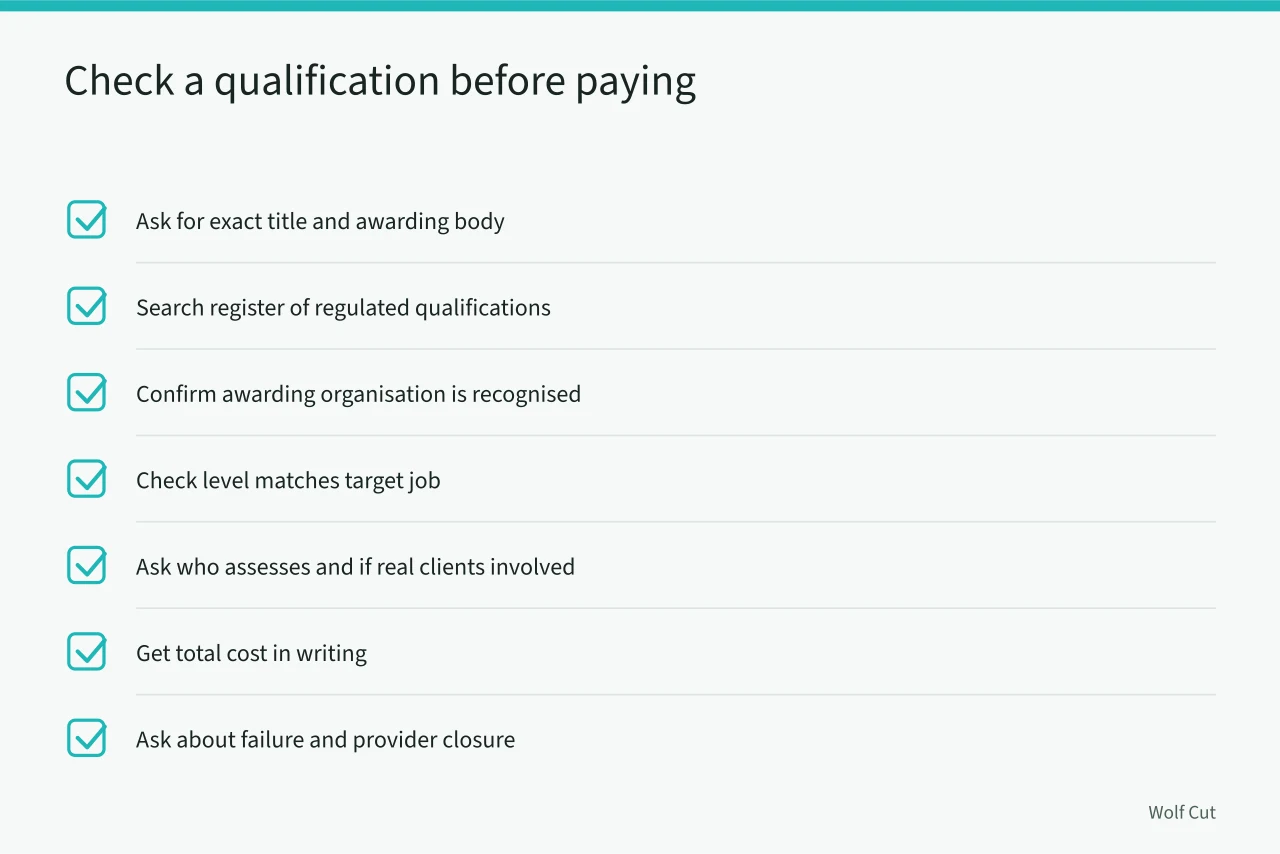
- Ask the provider for the exact qualification title and the awarding body name.
- Search the qualification on the register of regulated qualifications.
- Confirm the awarding organisation appears on the register of regulated awarding organisations.
- Check the level matches the job you are targeting, usually Level 2 or Level 3.
- Ask who assesses you and whether real clients are involved.
- Get the total cost in writing, including kit, registration and resit fees.
- Ask what happens if you fail a unit or the provider closes mid-course.
If the qualification does not appear on the register, ask why. Some legitimate training is not a regulated qualification, and the provider should say so plainly. If they claim it is regulated and you cannot find it, walk away.
Check the awarding organisation too. A recognised awarding body has a status you can verify, and its qualifications should be listed under its name. If the body is not on the register, its certificates carry no regulatory weight, whatever the course brochure says.
A few practical points for UK learners. Apprenticeship funding and advanced learner loans usually require a regulated qualification, so an unregulated course may not be fundable. Some employers will not count unregulated training towards pay progression. And if you plan to work abroad, check whether the destination country recognises your qualification before you enrol.
Wherever your training sits on the register, the sections, elevation and weight distribution you use are governed by the same design rules, which are set out in haircut design fundamentals.
Finally, keep your certificates and unit records. You will need them for job applications, insurance and sometimes for salon registration or licensing checks run by local councils. A clear paper trail is worth the filing effort.
Common questions
Is an NVQ better than a VRQ for hairdressing?
Neither is better in the abstract. An NVQ suits you if you already work in a salon and can be assessed on real clients. A VRQ suits you if you are training full time before entering salon work. Many stylists hold both.
Do I need a qualification to cut hair in the UK?
No. Hairdressing is not a protected profession, so no certificate is legally required. Employers and insurers, however, usually expect a Level 2 or equivalent, and clients increasingly ask about training.
Are City & Guilds and VTCT qualifications recognised across the UK?
Yes. Both are established awarding organisations, and their hairdressing qualifications are recognised by salons across England, Scotland, Wales and Northern Ireland. Regulators differ by nation, but the certificates travel.
How do I check if a course leads to a regulated qualification?
Ask for the exact title and awarding body, then search both on the government registers. If the qualification is listed, it is regulated. If it is not, treat it as unregulated training.
What CPD should a wolf cut specialist do?
Focus on advanced layering, dry refinement and consultation. Add short courses from recognised trainers, keep a written record, and practise the shape on different hair types until the result is repeatable.