Features
Part of Sectioning through dry refinement: a scissor haircutting guide
A graduated bob correction case: mapping drift, then rebuilding balance
Graduated bob correction case showing how posture, partings, guide drift, elevation, distribution, corners, and dry behavior were mapped and repaired in stages.
What to take away
- The stylist diagnosed the old structure before cutting.
- One side was shorter because the guide and client posture had both drifted.
- The correction preserved the stronger front corner instead of matching the shortest area.
- Graduation was rebuilt from verified nape panels.
- Dry checking corrected visual balance without repeated perimeter loss.
This fictional case demonstrates a correction process. Measurements and names are illustrative, and the method must be adapted to the person's hair and agreed design.
The starting cut
Nia arrived with a jaw-length graduated bob cut elsewhere two weeks earlier. The right front looked shorter, the left back carried a heavy shelf, and the nape line rose when she sat upright. Nia wanted balance but did not want the front shorter than the jaw. The general shape of that repair is covered in scissor haircut problems.
Stylist Devon observed the hair dry, then photographed it with consent from neutral front, profile, and back positions. Nia naturally lowered her right shoulder and tilted her head left. Her hair was denser behind the left ear and grew upward at the center nape.
Structural diagnosis
Devon divided the evidence into measured and behavioral differences:
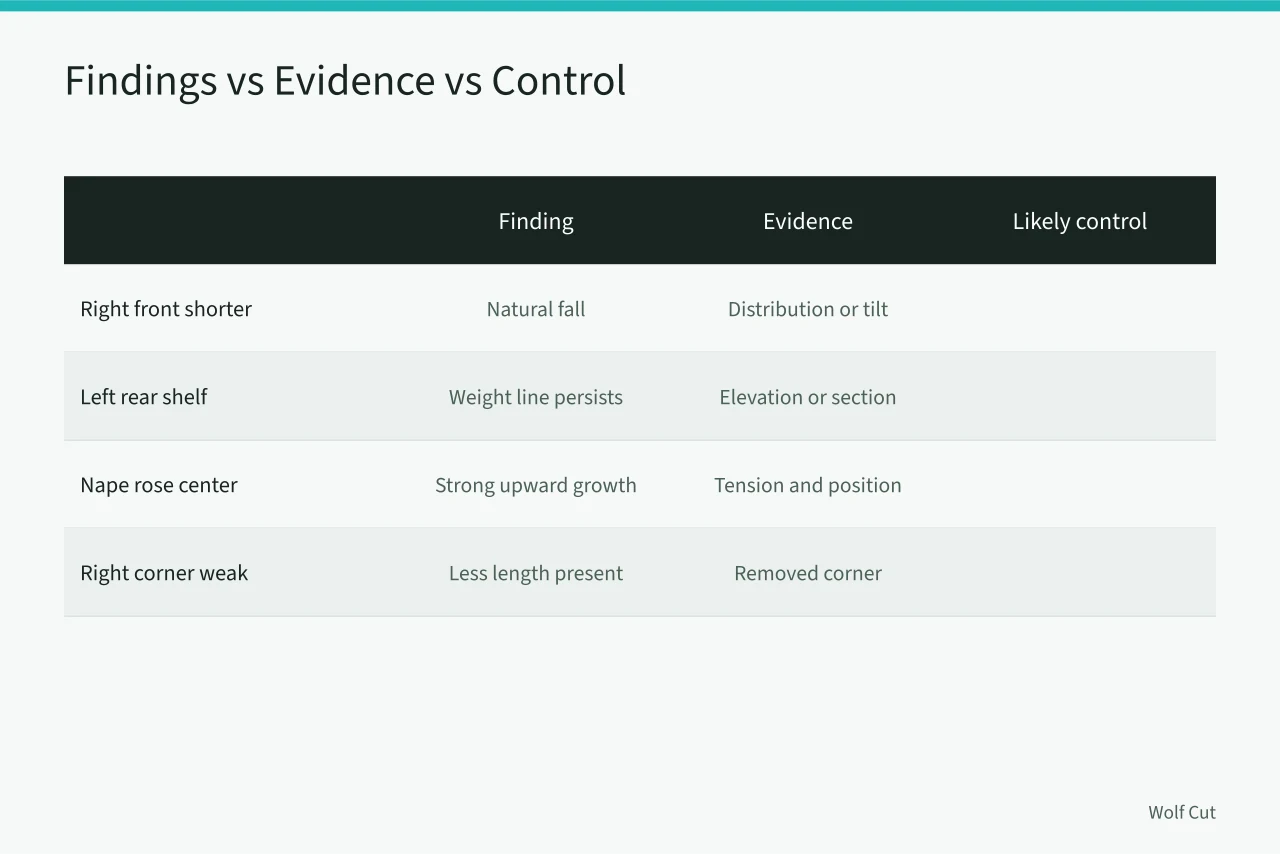
| Finding | Evidence | Likely control involved |
|---|---|---|
| Right front visibly shorter | Natural fall and mirror comparison | Prior distribution or head tilt |
| Left rear shelf | Weight line persisted after movement | Elevation change or large section |
| Nape rose at center | Strong upward growth | Tension and head position |
| Right corner weak | Less length present | Removed corner, not just styling |
The Australian register's unit for graduated haircut structures identifies graduation as a planned structure rather than a generic short back. Devon used that principle to map the intended outer line, weight area, partings, lift, distribution, and corner before choosing any repair.
Agreeing on the correction boundary
The shortest right-front area sat just at Nia's minimum. Matching the left front to it would have violated the goal. Devon offered two paths:
- shorten both fronts for immediate measured symmetry;
- preserve the left corner, rebuild visual balance through the back and sides, and let the right corner grow.
Nia chose the second. The record stated that measured side lengths would remain different while the silhouette became more balanced.
Rebuilding the nape
Devon dampened the hair evenly and created small horizontal nape panels. Nia sat centered with chin in the exact planned position. The first guide was cut with very low tension and checked after the head returned upright. The full routine is in build and follow a guideline.
At the upward-growing center, Devon preserved a small safety margin rather than pulling the hair down tightly. Each new section used controlled elevation to rebuild a gradual weight relationship. Elevation and distribution are separated in the scissor haircutting guide. The left shelf was not thinned; it was traced to one abrupt elevation change and connected in narrow panels.
Restoring the sides
Devon maintained the left front length and used backward distribution to preserve its corner. On the right, the existing shortage was protected. Internal weight was adjusted above it without cutting the perimeter shorter.
The national training unit for designing haircut structures defines plans through interior and exterior lines, starting points, parting patterns, lift angles, distribution, guidelines, and weight areas. Devon checked each of those fields when moving from back graduation to the side panels, which prevented the rebuilt guide from drifting across the head.
Dry verification
The hair was dried in Nia's usual smooth finish without forcing the ends under. Devon returned her head and shoulders to neutral, then checked profiles and back. The nape settled evenly. The left shelf no longer appeared, and the side widths balanced despite the preserved length difference.
Only two small dry adjustments were made where dense left-side strands extended beyond the intended line. A sectioning and cross-check checklist is what keeps that restraint deliberate. The front corners were not repeatedly detailed.
Closing record and growth plan
The service note stated:
- left front intentionally longer than right;
- right corner protected for growth;
- center nape cut with reduced tension;
- left rear elevation transition rebuilt;
- smooth natural-fall finish used for assessment;
- next review planned after enough right-front growth to reconsider the perimeter.
Nia saw all views and approved the visible shape. She understood that the next appointment, not extra cutting today, would address measured side equality.
Why the correction held
- Posture and growth behavior were separated from true length errors.
- The shortest area did not become the automatic target.
- Graduation was rebuilt through structure, not hidden with thinning.
- The cut was checked dry in the client's ordinary finish.
- An intentional temporary asymmetry was documented.
Common questions
Why not cut the left front to match immediately?
That would have crossed Nia's minimum length and removed the stronger corner.
Was the heavy shelf fixed with texturizing shears?
No. Devon corrected the abrupt length relationship that created it.
Why use low tension at the nape?
It reduced the risk of the upward growth springing shorter after release.
When can the front become measurably equal?
After the shorter right corner grows enough to support a new agreed perimeter.