Maintenance
Part of Sectioning through dry refinement: a scissor haircutting guide
Setup, sectioning and cross-checks: the scissor haircut checklist
Scissor haircut checklist for sharp tools, neutral posture, client protection, controlled partings, guidelines, tension, head position, cross-checks, and cleanup.
What to take away
- Prepare sharp, clean tools and a neutral working height.
- Write the guideline, elevation, distribution, and tension before starting.
- Keep sections small enough to control.
- Recheck client posture at every major zone.
- Cross-check the structure before cosmetic detailing.
Use this list for a scissor-led service. The technique it checks is set out in the scissor haircutting guide. Apply local licensing, sanitation, sharps, and workplace rules in addition to these craft controls. The reference the whole cut hangs on is covered in building and following a guideline.
Tool and station setup
- Correct shears selected for the planned action.
- Blades clean, aligned, sharpened, and moving without excess force.
- Finger inserts and rest fit the operator without forcing the hand.
- Cutting combs, clips, spray bottle, towels, and neck protection prepared.
- Disinfected tools separated from used tools.
- Floor, cords, and trolley kept clear of travel paths.
- Lighting reveals the cutting line without leaning.
The HSE brief guide to managing upper limb disorders lists prolonged repetitive work using the same hand or arm action, uncomfortable or awkward working postures, and sustained or excessive force among the causes. Its controls include tools and equipment that fit the worker's hands and suit the task, and workstations set at a comfortable working height.
Lighting must be adequate, because dim light, shadow, or glare makes a worker adopt an awkward position to see better. Those controls apply directly where one person cuts hair all day. The design they serve is described in haircut design fundamentals.
Client and operator position
- Chair height supports relaxed shoulders and neutral wrists.
- Client sits centered with feet supported when possible.
- Cape and neck strip protect clothing and skin without restriction.
- Head position stated for the first section.
- Mirror is not used as the only alignment reference.
- Stylist can move around the chair without reaching across the client.
Design map
- Exterior and interior lines marked.
- Starting point identified.
- Stationary, traveling, or combined guides named.
- Parting direction recorded by zone.
- Elevation and distribution recorded separately.
- Tension level and moisture state chosen.
- Corners to keep or remove marked.
- Connections and disconnections labeled.
Section control
- Main divisions follow the structural plan.
- Clips hold without twisting the roots.
- Subsection reveals the guide clearly.
- Base is not wider than the hand can control.
- Hair is evenly wet or intentionally dry.
- Comb path begins at roots and follows chosen distribution.
- Finger and blade line match the plan.
- Each section is released before the next one hides it.
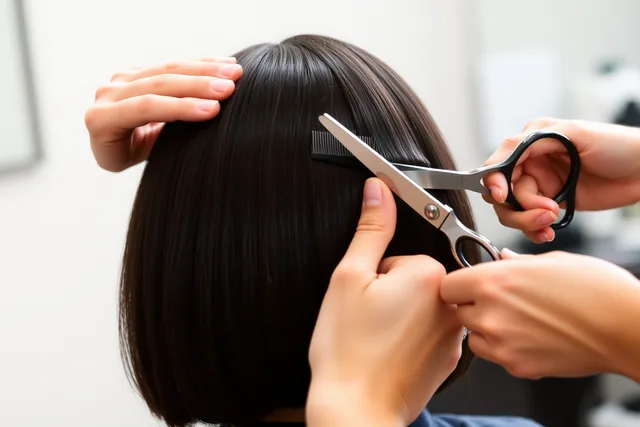
The Australian layered-haircut assessment requirements connect sectioning, parting, scissor angle, head position, and natural growth. They also cover client comfort, posture, and tool grip, and require both uniform and increased-layer structures.
A neat parting alone is not enough: the section must preserve all planned variables. The blunt, point, slide, and channel work comparison covers which cutting action to use in a section.
Guideline checks
- First guide released and confirmed at natural fall.
- Next subsection contains a visible portion of the guide.
- Traveling guide advances at the planned pace.
- Stationary guide does not migrate.
- New guide created where the structure intentionally changes.
- Lost guide rebuilt from the last verified section.
Cross-check
- Hair released from clips before structural review.
- Client returned to neutral posture.
- Cross-check partings intersect original sections.
- Equivalent zones compared when symmetry is intended.
- Intentional asymmetry and disconnection protected.
- Perimeter checked with minimal tension.
- Crown, ears, and nape checked in natural movement.
- Dry result checked after the agreed finish.
Closeout
- Loose hair removed from skin and clothing comfortably.
- Client sees front, profiles, and back.
- Home routine demonstrated.
- Result compared with the agreed design.
- Any adaptation recorded.
- Used tools moved into the cleaning process.
- Hair waste and sharps handled under applicable rules.
Common questions
Why check sharpness before every service?
A poorly maintained edge can push or pull fibers and increase the force required from the hand.
Should the chair remain at one height?
No. Adjust it by working zone to keep posture and sightline controlled.
Is a cross-check another cutting system?
No. It tests the planned structure from another direction.
What if the cross-check reveals intentional disconnection?
Leave it. Confirm it against the design map rather than blending it automatically.