Features
Part of Goals, access and consent guide this salon consultation process
Weak records and a late checkpoint: how one length dispute unfolded
Haircut dispute case showing how vague length language, a late checkpoint, and weak records caused conflict, followed by review, remedy, and process changes.
What to take away
- The fictional dispute began with two meanings of "shoulder length."
- A photograph showed front layers but did not establish the back perimeter.
- The first meaningful checkpoint came after too much length had been removed.
- The salon documented facts, listened, offered remedies, and avoided arguing intent.
- New landmark, checkpoint, and record controls addressed the cause.
This fictional case examines a service dispute and process repair. It does not decide legal liability, refund rights, or consumer-law duties in a real case. A salon should follow the law, insurer requirements, and complaint policy that apply.
The consultation
Elena booked a major restyle from mid-back hair to "shoulder length with movement." She showed a front-facing image with collarbone layers. The stylist repeated "around the shoulders" and recorded "long layers, shoulder length, soft face frame." The four ways clients brief a haircut show why words alone rarely fix an endpoint.
Two interpretations of shoulder length
Client's meaning
- Endpoint
- Perimeter touches shoulders
- Finish
- After drying
- Landmark
- Top of shoulders
- Record
- Not recorded
Stylist's understanding
- Endpoint
- Sits above shoulders
- Finish
- Rounded finish added
- Landmark
- No dry point marked
- Record
- Long layers, shoulder length
Neither person marked a dry point at the back. Elena meant the perimeter should touch the top of her shoulders after drying. The stylist understood that the hair could sit above the shoulders once a rounded finish was added.
The service failure
The stylist cut the wet perimeter, built layers, and began blow-drying before showing the back. Once dry, the longest point sat about two inches above Elena's intended endpoint. Elena became quiet, then said it was much shorter than agreed.
When the back was first shown
- Cut wet perimeter
- Built layers
- Began blow-drying
- Showed back after drying
- Longest point two inches above endpoint
The stylist replied that shoulder length commonly meant that result. That response escalated the problem because it defended salon vocabulary instead of acknowledging the missing shared landmark. It is one of the recurring haircut consultation problems.
Stabilize the conversation
The manager moved the discussion to a private area, offered a seat and water, and asked Elena to describe the expected endpoint. The stylist stopped finishing and did not cut more to make the shape look intentional.
Known facts summarized by manager
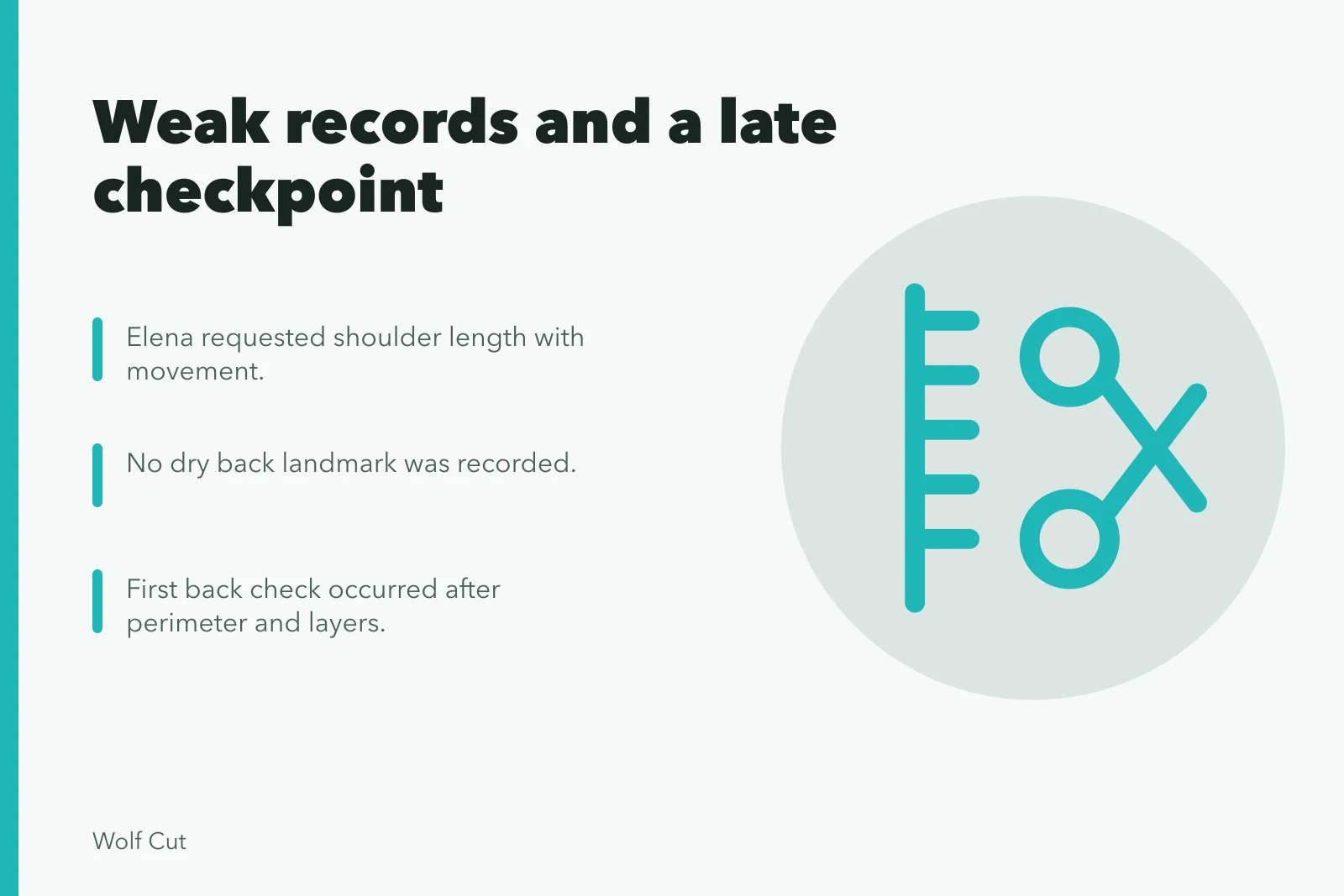
- Client requested shoulder length
- Reference did not show back
- No dry back landmark recorded
- First back check after cutting
- Length cannot be restored by recutting
The salon did not claim the client had agreed merely because she wore a cape or watched part of the service in a mirror. A consent and record checklist keeps that distinction explicit.
Record the complaint accurately
The manager asked what outcome Elena wanted now, noted the impact, preserved the original booking record, and obtained consent before taking any technical photos. The salon wrote down each offered remedy and gave Elena a copy of the agreed next step.
Complaint recording steps
- Ask desired outcome
- Note impact
- Preserve original booking record
- Get consent before technical photos
- Write down each offered remedy
- Give client copy of next step
Australian government guidance on handling customer complaints recommends listening, recording promises or agreements, gathering relevant documents, understanding legal obligations, and following up. It is general Australian guidance, so the fictional UK salon still needed its own consumer-law and insurer advice.
Offer remedies within authority
The manager explained that no same-day technical service could replace lost length. Options included stopping with no more cutting, a conservative balance check, a refund under salon policy, complimentary staged maintenance during growth, and escalation through the formal complaint route.
Elena chose to stop further cutting, receive the policy remedy, and return in six weeks for a no-charge shape review. She declined public before-and-after photography. The manager confirmed the terms in writing without requiring Elena to remove a review or waive unrelated rights.
Find the causes
The review found four failures:
| Failure | Evidence | Control added |
|---|---|---|
| Ambiguous length word | No landmark in record | Dry body landmark plus shown sample |
| Incomplete photo use | Front view only | Require back and profile discussion |
| Late checkpoint | Back shown after cutting | Check after first perimeter guide |
| Weak note | Trend words only | Structured design record |
The stylist's intent was not the central question. The process allowed two reasonable but different interpretations to survive until the result was irreversible.
Change the consultation system
For major length changes, the salon now marks the dry endpoint with the client standing or sitting in normal posture. A reference photo case shows the same landmark discipline applied before the first cut. The record states whether the hair should touch, clear, or sit below a named landmark after the intended finish.
The stylist cuts a conservative first guide and stops to show the back before connecting the full perimeter. Layer and face-frame checkpoints follow separately. Staff no longer use "shoulder length" without a physical point. The checkpoint discipline behind that rule is in the salon haircut consultation guide.
Limit and retain records responsibly
The complaint file included the original service note, client statement, salon response, agreed remedy, relevant images with permission, and follow-up. Access was limited to responsible staff. The salon did not add commentary about Elena's personality or online activity.
ICO guidance on the storage limitation principle says organizations should justify retention, set standard periods where possible, review data, and erase or anonymize it when no longer needed. It also recognizes that some former-customer information may be needed for complaints or legal claims. The salon applied its qualified UK data-protection advice rather than keeping the dispute file forever.
Follow up and close
At six weeks, Elena returned for review. A different senior stylist inspected the growth without defending the original result. Elena chose minor perimeter balancing and no new layers. The salon recorded the service and confirmed the next growth goal.
The complaint closed after the agreed remedy and follow-up were complete. Training used an anonymized scenario, not Elena's images or identity.
Common questions
Who was at fault in the fictional case?
The review focused on an inadequate confirmation system: no shared landmark, incomplete reference analysis, late checkpoint, and weak record.
Could recutting fix hair that was too short?
No. It might balance shape, but it cannot restore removed length.
Should a salon delete a complaint record immediately after resolution?
Not automatically. Use a lawful, justified retention schedule that accounts for complaints, legal obligations, and privacy.
Should the stylist argue that the client watched the haircut?
No. Visibility does not replace a specific agreed endpoint and a meaningful checkpoint before the irreversible cut.